Google Sheets has a new AI function — how does it perform on classification tasks?

A new AI function is being added to Google Sheets that could make most other functions redundant. But is it any good? And what can it be used for? Here’s what I’ve learned in the first week…

AI has been built into Google Sheets for some time now in the Clippy-like form of Gemini in Sheets. But Google Sheets’s AI function is different.

Available to a limited number of users for now, it allows you to incorporate AI prompts directly into a formula rather than having to rely on Gemini to suggest a formula using existing functions. 

At the most basic level that means the AI function can be used instead of functions like SUM, AVERAGE or COUNT by simply including a prompt like “Add the numbers in these cells” (or “calculate an average for” or “count”). But more interesting applications come in areas such as classification, translation, analysis and extraction, especially where a task requires a little more ‘intelligence’ than a more literally-minded function can offer.

I put the AI function through its paces with a series of classification challenges to see how it performed. Here’s what happened — and some ways in which the risks of generative AI need to be identified and addressed.

Continue reading

How do I get data if my country doesn’t publish any?

Spotlight photo by Paul Green on Unsplash

In many countries public data is limited, and access to data is either restricted, or information provided by the authorities is not credible. So how do you obtain data for a story? Here are some techniques used by reporters around the world.

Continue reading

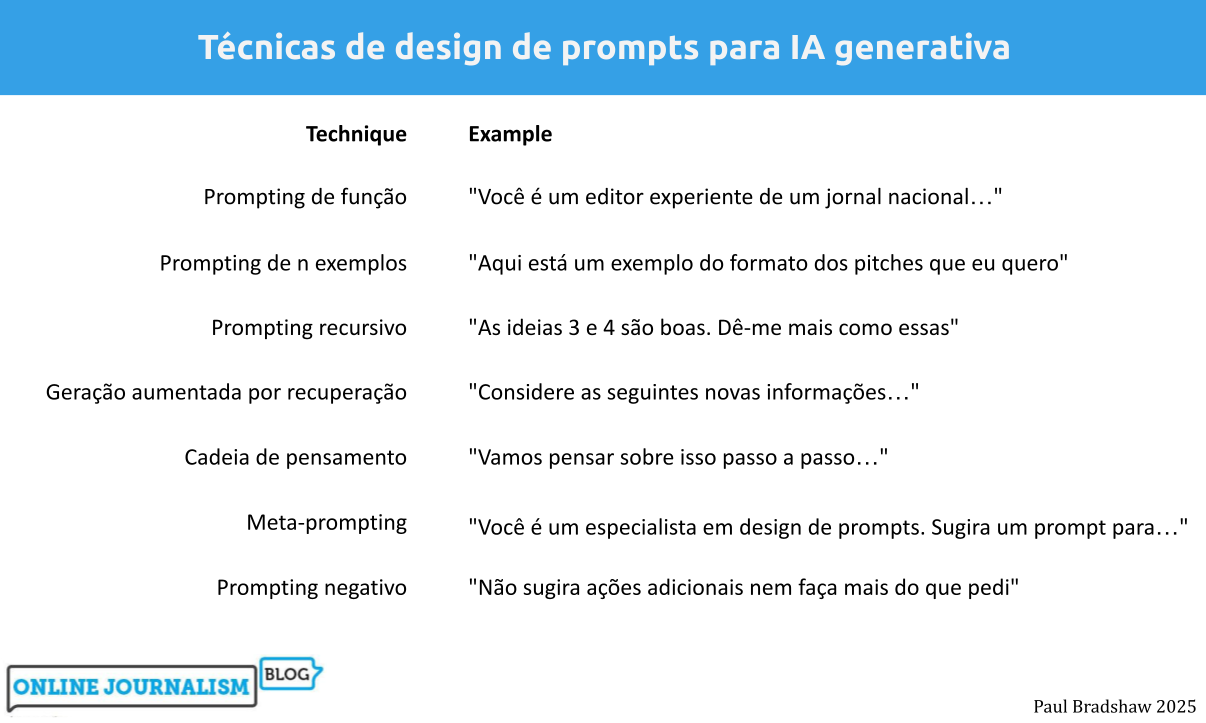
7 prompt design techniques for generative AI every journalist should know

Tools like ChatGPT might seem to speak your language, but they actually speak a language of probability and educated guesswork. You can make yourself better understood — and get more professional results — with a few simple prompting techniques. Here are the key ones to add to your toolkit. (also in Portuguese)

Prompt design techniques for genAI
Role prompting
One-shot prompting
Recursive prompting
Retrieval augmented generation
Chain of thought
Meta prompting
Negative prompting
Continue reading

De vanligste vinklene journalister bruker når de forteller historier med data

 7 vanlige vinkler for datahistorier_
Omfang, Veksling, Rangering, Variasjon, Utforske, Relasjoner, Dårlig/åpne, + saker

Datadrevet historiefortelling kan deles i syv hovedkategorier ifølge en analyse av 200 artikler. I den første av to poster vil jeg demonstrere de fire mest brukte vinklene i nyhetshistorier, hvordan de kan gi deg flere muligheter som reporter, og hvordan de kan hjelpe deg med å arbeide mer effektivt med data.

De fleste datasett kan fortelle mange historier — så mange at det for noen kan virke overveldende eller forstyrrende. Å identifisere hvilke historier som er mulige, og å velge den beste historien innenfor den tiden og de ferdighetene du har tilgjengelig, er en viktig redaksjonell ferdighet.

Mange nybegynnere innen datajournalistikk søker ofte først etter historier om sammenhenger (årsak og virkning) — men disse historiene er vanskelig og tidkrevende. Du kan ønske å fortelle en historie om ting som blir verre eller bedre — men mangle dataene for å fortelle den. Hvis du har svært liten tid og vil komme i gang med datajournalistikk, er de raskeste og enkleste historiene du kan fortelle med data, historier om omfang.

Continue reading

What are we talking about when we say the “ethics” of AI and journalism?

A path forking into three
There are three broad paths in ethics. Image by pfly CC BY-SA 2.0

Many people — including me — are quite uncomfortable with generative AI. Most of this discomfort can be traced to the various ethical challenges that AI raises. But an understanding of the different schools of ethics can help us both to better address those challenges and what to do about them.

Three different ethical approaches

The first thing to say about the ethics of AI is that there is no single ‘ethics’. When we engage with ethical issues there are typically at least three different systems that might be in play:

Continue reading

The Art of Disagreement — lessons for journalists

Why Are We Yelling?
Learn the life-changing art of productive disagreement.

Journalists are no strangers to disagreement: the job regularly involves reporting on conflicts, putting one party’s point of view to another, or engaging with audience challenges around bias and veracity.

So I was curious whether Buster Benson’s book, Why Are We Yelling? The Art of Disagreement, might have some lessons to offer for reporters.

Spoiler alert: I think it does.

Continue reading

Niamh McIntyre: tips from a career in data journalism

Niamh McIntyre

The Bureau of Investigative Journalism’s Big Tech Reporter Niamh McIntyre has been working with data for eight years — but it all stemmed from an “arbitrary choice” at university. She spoke to MA Data Journalism student Leyla Reynolds about how she got started in the field, why you don’t need to be a maths whizz to excel, and navigating the choppy waters of the newsroom. 

Starting out on any new path can be daunting, but in the minutes before my phone call with Niamh McIntyre, I’m acutely aware that upping sticks to Birmingham and training in data journalism at the grand old age of 29 is nothing less than a tremendous luxury.

A younger me might have — would have — quaked at such a scenario, so I’m keen to know more about Niamh’s work, which ranges from investigating the gig work industry to private children’s homes.

Continue reading

VIDEO: Developing ideas for factual storytelling

Strong factual storytelling relies on good idea development. In this video, part of a series of video posts made for students on the MA in Data Journalism at Birmingham City University, I explain how to generate good ideas by avoiding common mistakes, applying professional techniques and considering your audience.

The links mentioned in the video include:

Related post: Here’s how we teach creativity in journalism (and why it’s the 5th habit of successful journalists)

Identifying bias in your writing — with generative AI

Applications of genAI in the journalism process 
Pyramid with the third 'Production' tier highlighted: 

Identify jargon and bias; improve spelling, grammar, structure and brevity

In the latest in a series of posts on using generative AI, I look at how tools such as ChatGPT and Claude.ai can help help identify potential bias and check story drafts against relevant guidelines.

We are all biased — it’s human nature. It’s the reason stories are edited; it’s the reason that guidelines require journalists to stick to the facts, to be objective, and to seek a right of reply. But as the Columbia Journalism Review noted two decades ago: “Ask ten journalists what objectivity means and you’ll get ten different answers.”

Generative AI is notoriously biased itself — but it has also been trained on more material on bias than any human likely has. So, unlike a biased human, when you explicitly ask it to identify bias in your own reporting, it can perform surprisingly well.

It can also be very effective in helping us consider how relevant guidelines might be applied to our reporting — a checkpoint in our reporting that should be just as baked-in as the right of reply.

In this post I’ll go through some template prompts and tips on each. First, a recap of the rules of thumb I introduced in the previous post.

Continue reading

How to improve story ideas using the SCAMPER method

SCAMPER: Substitute, Combine, Adapt, Modify, Put to another use, Eliminate, Reverse

One of the techniques that can be used to come up with more creative story ideas is the SCAMPER method.

SCAMPER is a mnemonic for seven different actions that can be applied to ideas in order to improve those ideas or generate more interesting alternatives. It is a technique adapted from design and engineering circles — but with just a little thought it can be applied to journalism too.

Continue reading