The ‘Metajournalist’ and the return of personalised news: research on automated reporting

Matt Carlson has written an interesting piece of research (£) into ‘The Robotic Reporter’: namely, automated journalism where articles are written by algorithms.

His interest lies largely in the “technological drama” of competing narratives and cultures – but along the way he identifies some developments and implications which appear in the minority of reports beyond those recurring stories of “augmentation or elimination” (of journalists’ jobs), but which may be more interesting. Continue reading

2 weeks to “Save journalists’ sources” in consultation over law used to spy on journalists

Save Our Sources

2014 was the year journalists found out just how widely the Regulation of Investigatory Powers Act (RIPA) was being used by public authorities to spy on reporters and identify their sources.

Two years earlier political editor Tom Newton Dunn had refused to co-operate with officers on his sources for a story despite being threatened with arrest himself.

So the police obtained his mobile phone records and call data to his newsdesk. His sources, identified from the logs, were then sacked.

Since we have heard The Spectator’s Nick Cohen report that “the police now tell journalists that they have [used the RIPA Act to pull] reporters’ phone records in every single leak inquiry in the last ten years.”

Press Gazette’s William Turvill has reported on the council that used RIPA to spy on a local journalist’s meeting with a member of staff.

And he has also reported on RIPA’s possible involvement in “allegations of improper seizure of journalistic material … from a Sky News journalist.”

Two things to do

This month, you can do two things about that.

Firstly, you can sign Press Gazette’s petition to ‘Save Our Sources’ which asks the Home Secretary to:

“find out how many times public authorities have used RIPA to obtain the phone records of journalists and to ensure new guidelines are in place to prevent this happening in future.”

Secondly, there is a rare opportunity to contribute to a government consultation on RIPA.

The NUJ have helpfully provided all the details on their call to members to respond, including a template letter.

There are two weeks to get your letter in: the deadline is Tuesday 20 January 2015.

Send them via email to: commsdata@homeoffice.x.gsi.gov.uk

When reporting on data remember that those who don’t count aren’t counted

Invisible man

Invisible man image by Brian

In a guest post for OJB, Help Me Investigate contributor Natalie Leal talks about how statistics on benefit claimants, migrants and A&E admissions reflect organisations’ priorities – and can be skewed as a result.

I recently witnessed an unemployed woman at a job centre shouting that she would “never ever” set foot in there again.

The woman, who had just been told that her benefits would be cut off for thirteen weeks, stormed past two security guards on her way out.

They turned to each other and joked:

“That’s another one off the books.”

Continue reading

The 10 most-read posts (and one page) on the Online Journalism Blog in 2014

ojb post frequency 2014

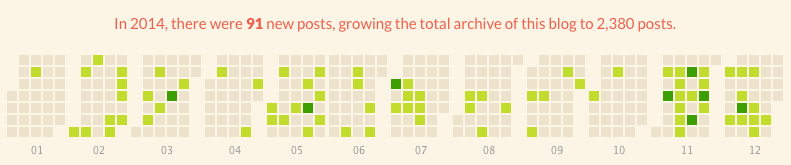
The last 2 months of 2014 saw a return to regular blogging after some quiet periods earlier in the year

2014 was the 10th anniversary of the Online Journalism Blog, so I thought I’d better begin keeping track of what each year’s most-read posts were.

In 2014 the overriding themes for this blog were programming for journalists, web security, and social media optimisation. Here are the most-read posts of the year, plus one surprisingly popular new page with some background and updates. Continue reading

A review of online journalism in 2014 – and predictions for 2015

Every December Nic Newman asks me and a bunch of other people for their thoughts on the year just passed, and the year to come. This year, it seems to me, has been particularly seminal, so I’m reproducing my responses here.

1. What surprised you in 2014?

How many news organisations finally began to write web-native copy: linking and embedding multimedia (often from YouTube, Flickr, Twitter or Vine).

The rise of visual journalism has been the most notable trend of 2014 for me, driven by the algorithms of Facebook and changes to Twitter, and the integration of SMO staff and best practice into news organisations.  Continue reading

This Christmas, encrypt your emails and make the haystack bigger

Why should journalists be interested in web security? You may not fear your social media accounts being hacked by propagandists, your email hacked by companies you write about, or your phone records being seen by police, but there is another good reason for adopting security measures.

“Anonymity loves company,” security researcher Ross Anderson reminded attendees at this month’s Logan Symposium on secrecy, surveillance and censorship. “You can only hide in a crowd.”

In other words, the more people who use encryption in their email, or other security measures, the less unusual it becomes.

And the more widespread these practices are, the harder it is for the contents of messages to be used to identify whistleblowers – whether that is with journalists, charities, or even whistleblowing services (remember that only the message is encrypted, not the identity of the sender or recipient).

So if you have some spare time over the festive period, why not get yourself set up with an email client like Thunderbird with a plugin like Enigmail, and get started.

3 reasons why 2014 was the year news organisations finally ‘got’ web-native production

obama multimedia story

This Independent story includes two embedded YouTube videos and a Flickr photo gallery

Something remarkable happened this year. Something I’ve been waiting for for a long time.

News reports on the web finally started to look more and more like… well, web-native articles.

Not print articles online, not broadcast journalism online, but online journalism, online. I’m talking about journalism which isn’t just text: whether that means linking and embedding or mixing text with images, video or audio.

So what changed in 2014? Here are three factors I’ve noticed growing in influence over the last 12 months. Continue reading

Serial: all good journalism is voyeurism – and bad journalism too (but it’s still journalism)

serial podcast people map

After reporting on online journalism for some time you tire quickly of people saying “this is not journalism“. On Tuesday Brian C. Jones leveled this accusation at the podcast sensation Serial:

Sarah Koenig, the lead producer and narrator … used the tools of legitimate reporting — the right to public records, access to experts, the goodwill of interviewees, compelling soundbites, stylish storytelling … — to intrude into and disrupt real lives for the fun of it. It’s voyeurism, not journalism.”

Serial follows Koenig as she attempts to get to the bottom of a murder conviction she suspects may be a miscarriage of justice. The fact that she does not know whether it is or not is the basis of Jones’s misgivings:

“Real-life stories hurt the peopled involved … When the reporting phase is exhausted, it’s crucial to understand what kind of a story it is, and maybe whether it is a story at all.”

I think Jones makes a mistake common to those used to traditional journalistic production practices: firstly to mistake the subject for the purpose; and secondly to misunderstand modern journalism techniques. Continue reading

How The Cambodia Daily went HTTPS to protect its readers – guest post

Last month The Cambodia Daily announced it was going HTTPS. In a guest post for OJB Joshua Wilwohl explains why they decided to go secure, and how they did it. (Disclosure: Joshua is a student of mine on the MA in Online Journalism by distance learning at Birmingham City University).

During the past year, The Cambodia Daily has witnessed an increase in government interest in monitoring the Internet.

This week, the newspaper revealed a government plan to inspect the network equipment, billing and data files of mobile phone operators and internet service providers.

Government officials argued this was to help with investigations into crime committed over Voice Over Internet Protocol, or VoIP.

But computer crime experts said the Government’s planned tactics could also be used to monitor people’s phone calls and Internet data. As one expert said: Continue reading