Tag Archives: 21st century newsroom

Launching an environmental news website – four weeks in

As you have probably worked out, this year’s Online Journalism students have been building up towards launching an environmental news website. This week the site went public, and I thought I’d take the opportunity to reflect on the lessons learned so far…

The Background

The site is the final year project of two final year journalism degree students – Azeem Ahmad and Rachael Wilson. The decision was made to launch an environmental site because of the increase of investment in this area from a number of news organisations, and also because of a local connection – more of which later.

Azeem is responsible for the more technical side of the site, which he has built from scratch using the open source content management software Joomla.

Azeem has been blogging his progress with the software, including the frightening experience of having the site hacked into by the creator of a theme Azeem installed.

Rachael has the responsibility for editorial, which means writing for the site herself, but more importantly managing 14 second year students on the Online Journalism module as they try to build a news site on a subject most have never written about. She’s also been blogging her experiences.

Week One: Choosing a name, assigning beats, making connections

After some cheesy brainstorming, the very literal name ‘Environmental News Online‘ was chosen for the site for the simple reasons of search engine optimisation and domain name availability. The abbreviation ‘ENO’ lent it more character. Continue reading
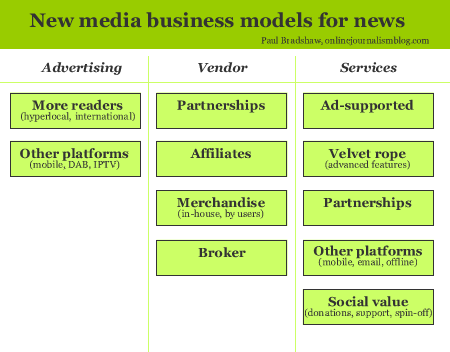
Business models for free content (A model for the 21st century newsroom pt5 addendum)

If you read the final part of my model for the 21st century newsroom concerning new media business models, I strongly recommend ‘Free! Why $0.00 Is the Future of Business‘, an article by Chris Anderson, author of The Long Tail. Have you not clicked yet? Here are some quotes to persuade you:

“To follow the money, you have to shift from a basic view of a market as a matching of two parties — buyers and sellers — to a broader sense of an ecosystem with many parties, only some of which exchange cash.

“… There are dozens of ways that media companies make money around free content, from selling information about consumers to brand licensing, “value-added” subscriptions, and direct ecommerce (see wired.com/extras for a complete list). Now an entire ecosystem of Web companies is growing up around the same set of models.”

Anderson maps out a ‘Taxonomy of free’ including Continue reading

Making money from journalism: new media business models (A model for the 21st century newsroom pt5)

In the final part of the Model for the 21st Century Newsroom I look at how new media has compounded problems in news organisations’ core business models – and the new business models which it could begin to explore.

Let’s start by looking at the traditional newspaper business model. This has rested on selling, in a broad simplification, three things:

  • Advertising. Put more explicitly: selling readers to advertisers.
  • Selling content to readers, and, twinned with that:
  • Selling the delivery platform to readers – i.e. the paper

Developments in the past few decades have eaten into each of those areas as follows: Continue reading

News distribution in a new media world (A model for the 21st century newsroom pt4)

The fourth post of the Model for the 21st Century Newsroom looks at how distribution is changing from a push/pull model to a tripartite, push-pull-pass, one.

In the 20th century, commercial distribution of news was relatively straightforward: if you worked in print, you published a newspaper or magazine at a particular time, it was transported to outlets, and people picked it up (or it was delivered). If you worked in broadcast, you broadcast it at a particular time, and people watched or listened.

Simple.

In the 21st century, the picture is a little more complicated. Continue reading

iPM: have they been reading my model for a 21st century newsroom?

Over at BBC Radio 4’s iPM website there’s an interesting experiment going on – and some good examples of my 21st century newsroom ideas in practice.

  1. Firstly, their ‘Rough Notes’ blog is a good example of the ‘draft’ stage of my News Diamond, with members of the team talking about what they’re working on (and comments facility for people to suggest stories – some very good ideas there, BTW). Also, posts labelled ‘In Production‘ allow you to see the work so far, while you can comment on the current running orders.
  2. Secondly, they have a Flickr page where users can upload images. Distributed Journalism, perhaps? Well, more like simple community.
  3. Thirdly, and perhaps best of all, they’ve made their del.ico.us account public, so readers can see what they’re reading. That’ll be the ‘What’ of my Five Ws and a H, then.

The blurb, BTW, is: “We’ll source what we do through the best blogs, passionate ‘ear catching’ online debate as well as comments and recommendations of others. So what ends up on air will be shaped by listeners and bloggers.”

Help make ‘5Ws+H’ happen

I felt so strongly about the Five W’s and a H that should come *after* every story that I pitched an idea based on it to the Knight Foundation. It’s called the ‘Conversation Toolkit’, and it’s through to the second round of the Knight News Challenge. Think it sounds like a good idea? Have any improvements? Want to help make it happen, or test it out? Then log on to the idea wiki at http://bidideas.pbwiki.com/conversationtoolkit (password: idea) and add what you can, or contact me directly.

Here’s the text so far: Continue reading

Five W’s and a H that should come *after* every story (A model for the 21st century newsroom: pt3)

So far this model has looked at sourcing stories in the new media age, and reporting a news story in the new media age. In this third part I look at what should happen after a news story has been reported, using a familiar framework: the 5 Ws and a H – who, what, where, why, when and how.

Five W’s and a H that should come *after* every story

A web page – unlike a newspaper, magazine or broadcast – is never finished – or at least, can always be updated. Its permanence is central to its power, and relates directly to its connectivity (and therefore visibility).

Once out there it can be linked to, commented on, discussed, dissected, tagged, bookmarked and sent to a friend. That can take place on the original news site, but it probably doesn’t. The story is no longer yours. So once the news site has added comments, a message board, ’email to a friend’ boxes and ‘bookmark this’ buttons, what more can it do? Continue reading

From the inverted pyramid to the tumbled pyramid (João Canavilhas)

When I published the news diamond model, a number of commentators from Brazil and Portugal compared it with João Canavilhas’ ‘Tumbled Pyramid’ model, which looks at online reading patterns and suggests a new way to structure online journalism. João very kindly agreed to write a post for the OJB summarising this model – here it is:

The inverted pyramid model as the prime writing technique is usually implied when we discuss journalism. The emergence of the web, with its hypertext potentialities, opens new windows of opportunities. Now, journalists are able to provide new and immediate reading horizons by creating links between texts or other multimedia components which can be organised into layers of information.
But how will readers react when faced with several optional reading paths? Do they follow a reading pattern or does each individual have their own way of reading? Continue reading

A model for the 21st century newsroom pt2: Distributed Journalism

In the first part of my model for the 21st century newsroom I looked at how a story might move through a number of stages from initial alert through to customisation. In part two I want to look at sourcing stories, and the role of journalism in a new media world.

The last century has seen three important changes for the news industry. It has moved… Continue reading