Tag Archives: citizen journalism

Virginia Tech: the speed of news online

If ever proof were needed of the increased speed which the internet and blogs bring to news, yesterday Wired was already looking at the implications of the Virginia Tech shooting after a blog post:

“After Columbine, there was a nationwide backlash against geeks and goths — kids were being suspended, and worse, for wearing Marilyn Manson tee shirts. What will the Virginia Tech backlash look like, if it comes?

“Given all the emphasis on Cho’s creative writing, I’d guess student fiction-writers will be feeling the heat. Turning in dark, tortured, soul-searching fiction will be a good way to get sent to a counselor, or wind up interviewed by the local police.

“Kimberly Lacey, a graduate teaching instructor at Wayne State University, has a thoughtful blog post on the position creative writing teachers are in now.”

The article even links to two of Cho’s plays: “Richard McBeef and Mr. Brownstone are here, along with an account of one his former classmates.”

Sky News’ serendipitous website relaunch

Sky News has relaunched its website on what may prove the biggest day for online video this year.

It’s no surprise to see the Virginia Tech gunman’s self-filmed video dominating the homepage, which has a strong focus on video generally, as well as adopting what are becoming conventional features in news websites: the ‘most read’ stories list; podcasts; and blogs.

The most interesting feature – and it’s not clear whether this will be repeated for other major stories – is that ‘Campus Shooting’ is actually one of the main navigation options, alongside more conventional categories ‘world news’, ‘UK news’, ‘business’ etc.

Journalism.co.uk has more on the relaunch, including some notable organisational changes:

“”In the past few months alone, a number of senior journalists have joined Sky News Online from Sky News,” a statement read. “Phil Wardman, Sky News’ head of home news, has been seconded for nine months to sky.com/news to head up online intake, and executive producer Julian March and news editor John Gripton are also bringing their experience to Sky News Online.

“Simon Bucks has been appointed associated editor to put Sky News Online at the forefront of audience participation, encouraging online users to collaborate further in areas such as voting, commenting charing views and contributing to stories. He will continue to solidify the integration of Sky News’ TV and online news services.

“BSkyB is currently trialling a user-generated content portal, SkyCast, with the aim of taking videos from viewers of Sky News and other channels for use on air.”

You can see what Sky News’ website looked like in 2005 at the Web Archive.

UPDATE: as of 12.35 the Sky News website is down, presumably from too many visitors during the UK lunchtime surge. If your glass is half empty, perhaps it wasn’t the best day to relaunch; if it’s half full, well, they got the best day to test the site they could have asked for.

Virginia Tech shooting: another citizen journalism milestone?

Poynter Online has a mind-boggling roundup of how students at Virginia Tech have told their story through mobile video, blogs, and forums. Unlike previous user generated content milestones like 9/11 and the Asian tsunami, this story took place in the heart of the new media generation, and the resulting coverage is more comprehensive, more accessible, and takes in more new media forms, including social networking. “Look at this collection from CNN’s I-Report.,” urges Poynter:

“Students text messaged one another while hiding under desks. Read some of those messages here.

Some students are gathering on Facebook. CollegeMedia.com has a collection of cell pictures taken by students. More than 150 tribute groups have formed on Facebook.

“Other students went right to their blogs and wrote about what they saw.”

As this generation ages it’s reasonable to expect such coverage to become the norm, and this presents two challenges for journalists: 1) the need to develop the awareness of, and skills to find, this material; 2) in the face of such comprehensive and accessible first-person reporting, the need to develop new roles, perhaps as gatewatchers, facilitators and filters rather than reporters.

Then there’s a third issue: ethics. When reporting on the MySpace and Facebook content of murdered students, how far can journalists go? Is it OK to quote dead students’ ‘About Me’ sections? Channel 5 did so last night, including one who was summed up by her favourite flavour of ice cream and the fact that her “favourite colour is blue”.

Tony Harcup, a writer on journalism ethics, told me “my gut reaction is that it is perfectly acceptable to quote from the About Me sections that people have placed in the public domain. It’s not as if a journalist has broken into a dead person’s house and stolen their private diary.” But when we live our lives in the public domain, do our virtual selves have different rights? I have no answers, I’m just posing the question.

UPDATE: Shane Richmond includes these points in his blog. He slightly misunderstands my second point above, and I’ve posted a comment clarifying this.

UPDATE 2 (Apr 21 07): I’ve posted a further post on the ethics issue.

BBC, UGC and online video

Some insights into the workings of the BBC, UGC and online video from Shane Richmond’s latest post:

“At a time when most newspapers, including this one, are trying to encourage user participation and comments on their sites, the BBC is questioning the need to host those conversations.

“Instead they’re linking their content out to the likes of YouTube, Flickr, Technorati and del.icio.us. Encourage the conversation but let it happen elsewhere.

“The burden of moderation is simply too great. Like us, the BBC moderates comments received from readers, mostly for legal reasons, but as Tom pointed out: “What we call moderation, readers call censorship.”

“The more successful you are at attracting reader responses, he explained, the bigger the problem gets.”

Also:

“One week in November last year, the BBC news site published around 500 pieces of video.

“Analysing the traffic for those clips later, they found that just 30 of them accounted for about half the traffic. They have learned some lessons about what type of video clips work online but mostly they learned to focus on doing less better.”

Defining and conceptualising interactivity

A conversation with a radio colleague yesterday about a new course that I’m involved in – a Masters in Television and Interactive Content – threw up the question of how people define interactivity.

“What you mean by interactivity is probably not what I think of,” he said.

“I see interactivity as giving the user control,” I replied.

“Well OK then, we both think of interactivity in the same way. But to most people interactivity is video on the web and flashy things, which couldn’t be less interactive.”

I began thinking about this idea of how you define interactivity. “Giving the user control” is a nice summary, but what does that mean? How do you conceptualise it to make the process easier? Rolling it over in my head I’ve come up with two dimensions along which interactivity operates. Firstly:

  • Time: where broadcast required the user to be present at a particular time, and print to wait for the next edition, technologies such as Sky+, podcasts, mobile phones and websites allow the audience to consume at a time convenient to them. The PDF newspaper is an interesting development that also allows readers to avoid the dependence on print cycles.
  • Space: where television required the user to be physically present in front of a static set, mobile phones, mp3 players and portable mpeg players and wifi laptops allow the audience to consume in a space convenient to them. Portable radio and portable newspapers have always had this advantage.

Both these seem to be about hardware, and miniaturisation. The second level of interactivity is more about software:

  • Control over output: With linear media like TV, radio and print, the consumer relies on the ability of the producer, editor, etc. to structure how content is presented, or output. New media allows the audience to take some of that control.
    • At a basic level, for instance, hyperlinks allow the reader to dictate their experience of ‘content’.
    • With online video and audio, the user can pause, fast-forward, etc. – and if it has been split into ‘chunks’, the user can choose which bit of a longer video or audio piece they experience.
    • RSS, meanwhile, allows users to create their own media product, combining feeds from newspapers, broadcasters, bloggers, and even del.icio.us tags or Google News search terms.
    • Database-driven content allows the user to shape output based on their input – e.g. by entering their postcode they can read content specific to their area. At a general level search engines would be another example.
    • And Flash interactives allow the user to influence output in a range of ways. This may be as simple as selecting from a range of audio, video, text and still image options. It may be playing a game or quiz, where their interaction (e.g. what answers they get right, how they perform) shapes the output they experience.
  • Control over input: Again, the old media model was one that relied on the producer, editor, etc. to decide on the editorial agenda, and create the products. The audience may have had certain avenues of communication – the letter to the editor; the radio phone-in; the ‘Points of View‘. The new media model, as Dan Gillmor points out, is one that moves from a lecture to a conversation. So:
    • Blogs, podcasts, vlogs, YouTube, MySpace, etc. allow the audience to publish their own media
    • Forums, message boards, chatrooms and comments on mainstream media blogs allow the audience to discuss and influence the content of mainstream media, as well as engaging with each other, bypassing the media
    • Live chats with interviewees and media staff do the same.
    • User generated content/citizen journalism sees mainstream publishers actively seeking out input from consumers, from emails to mobile phone images, video and audio.
    • Wikis allow the audience to create their own collaborative content, which may be facilitated by mainstream media
    • Social recommendation software like del.icio.us, Digg, etc. allow users to influence the ‘headline’ webpages through bookmarking and tags.
    • A similar but separate example is how page view statistics can be used by publishers to rank content by popularity (often displayed side by side with the editorial view of what are the ‘top stories’)
    • I hesitate to add the last example but I will anyway: email. Although we could always, in theory, contact producers and editors by telephone, they didn’t publish their numbers on the ten o’clock news. Email addresses, however, are printed at the end of articles; displayed on screen alongside news reports; read out on radio; and of course displayed online.

I’m sure I’ve missed examples, or entire other dimensions. If you have an input to make, comment away.

More TV stations incorporate CJ video – as long as it attracts advertising

Given my comments yesterday about the motivations behind online video, it’s interesting to see a piece in Broadcasting & Cable about a similar move with citizen journalism video:

“Starting this week, television stations owned by Fisher Communications, Journal Broadcast Group and Granite Broadcasting will join the ranks of MSNBC, Reuters and The Weather Channel by inviting “citizen journalists” to produce anything from online news footage to complete reports. The coverage could find its way onto local news broadcasts as well.”

But here’s the interesting bit:

“This is a revenue-driving initiative,” says Timur Yarnall, president/CEO of Broadcast Interactive. “If the video is not suitable to have advertising or is copyrighted material, it is not going up.”

Better make sure those starving orphans are sponsored by Nike, then…

Online journalism documentary – and why video blogging is ‘a good thing’

PBS have been doing a TV series called “News War: What’s Happening to the News”, which is a comprehensive history of journalism in the US. Of interest to us OJ types, however, are parts 19 and 20, ‘The New Universe of Online  Media’, and ‘The Revolution’s New Synergies’ which are available to watch on this page.

‘The New Universe of New Media’ features interviews with the team behind online TV news service Rocketboom, the founder of massively successful blog the Daily Kos, and Jeff Jarvis, as well as stuff about important events like the Trent Lott story (kept alive by bloggers) and Rathergate (a documentary’s veracity being questioned by bloggers).

‘The Revolution’s New Synergies’ is about how mainstream media have incorporated new media forms like blogs, and taken up leads through new media.

Bill Cammack gives a more thorough overview of the series, and the accusations that blogs lack original material, from a videoblogging perspective:

“With video blogs, I think [the lack of original reporting] is much less true. Granted, there are video blogs that are really videotaped versions of text blogs. Instead of typing the information they got from search engines, people sit in front of a video camera or webcam and talk about it. Not much difference from text blogs there in terms of lack of originality. ANYONE could do it who chooses to use a search engine to look up their chosen topic. What I’m talking about is the ability to show someone, anyone… somewhere, ANYWHERE (that has a viable internet connecton) something that they otherwise would not have been able to see. I don’t see any way that anyone could deny that visual and audio documentation of something that happened can be AS relevant and important, if not MORE SO than a shot, produced, scripted and edited news piece, such as the Frontline piece I’m currently commenting on.”

In other words, the very fact that you are filming video – assuming it is not of you talking – means you are creating original content. This is probably the most persuasive argument I’ve heard for bloggers taking up their video cameras and audio recorders – it (hopefully) forces you to leave the desk, and find material. Of course, it will not be searchable, and it will be harder for someone to scan. So it had better be good.

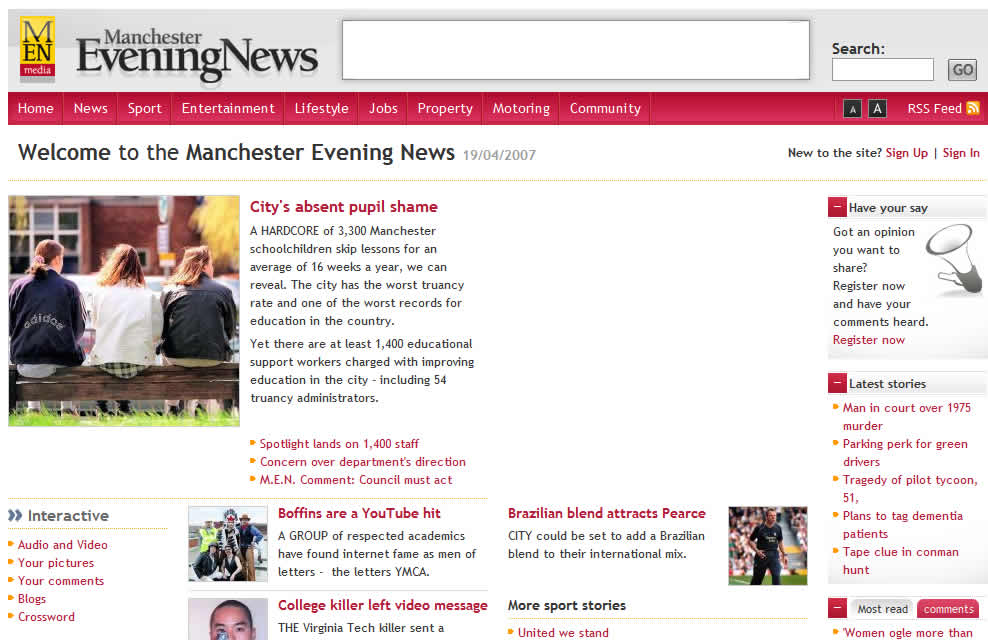
I love MEN (for purely journalistic reasons)

MEN April 19 07Sorry, I couldn’t resist that headline. The Manchester Evening News (MEN) has been relaunched and – forgive me for not knowing which bits are new and which are not, but this really does look very good. Aside from the lovely clean navigation there’s clearly some attention been paid to the strengths of the web:

  • Have Your Say is one of the top boxes
  • There’s a ‘most read/commented’ box as well;
  • ‘your pictures’ and ‘your comments’ are prominent links,
  • there’s a raft of blogs.
  • There’s a ‘community’ section,
  • and audio and video (yes, they’re under ‘interactivity’ which isn’t really that true, but where else would they put it?). At the moment this is still ‘journalist reads headlines over still images’ but at least they’re plugging the forums (not that I could find them). The audio shows promise – an interview with Michael Ball includes a link to the full 12 minute audio.

MediaWeek reports the site has also dumped pop-ups:

“As part of the revamp, which has been a year in development, the site will also introduce more user- generated content and simplify its navigation after complaints it was too cluttered.
“The MEN’s head of online editorial, Sarah Hartley, said the dumping of pop-up and pop-under ads was a big move for the site.”

Citizen journalism discussion

There’s a fairly lengthy discussion about citizen journalism available over at the BBC’s Digital Planet. It’s entry-level stuff – if you’ve heard the phrases “filtering role” and “democratisation” you’ve heard most of it before, although Bill Thomson’s distinction between user generated content (UGC) and citizen journalism (CJ) is interesting: UGC has no commercial value; CJ does.

MSNBC.com shows how to do the citizen journalism thing

FirstPerson, an MSNBC.com project, looks like one of the best mainstream CJ projects I’ve ever seen, combining a number of imaginative requests for user generated content and backing them up with editorial support and filtering, user votes to “engender a sense of ownership and loyalty”, and exposure on TV, as MediaPost reports:

“In recent weeks, FirstPerson tied in with NBC Nightly News’ feature “Trading Places,” a series of reports on adult children caring for their aging parents. Viewers submitted more than 6,000 videos, stories, and photos to FirstPerson editors about dealing with the issue. “

And by the way:

“MSNBC.com isn’t the only news organization introducing reader-generated multimedia content.

“Last week, The New York Times initiated a similar feature for its “Weddings and Celebrations” page by inviting readers to submit videos on the newspaper’s Web site. The video of newly engaged couples will become part of the “How We Met” series, marking the first time the site has published user-generated video.

“Times staffers screen all video submissions. And like MSNBC.com, the paper also has a site that invites auto enthusiasts to post photos and personal stories about their collectible cars. Readers can rate each other’s autos and post comments at collectiblecars.nytimes.com.

“CNN.com has “I Report,” in which consumers can send their stories and video reports to the news organization. The Feb. 26 series of reports delivered weather-related video reports from regular folks around the country.”