Tag Archives: comments

Online magazine Monkey goes social

Dennis’s online-only (and hugely successful) magazine Monkey is set to launch another website next Wednesday (at MonkeyMag.co.uk) with a focus on the social. It’s “for readers”, you see.

A press release says the website

“will be centred around the same type of great video found in Monkey, while also encouraging readers to interact with the site by posting their own ratings and exchanging comments on the clips. The website will also offer daily content not found in the mag, competitions and exclusive chances to vote for what you want to see featured in upcoming issues.” Continue reading

What is a publisher’s “duty of care” to bloggers?

Amidst the recent furore over Max Gogarty’s unblog-like/allegedly nepotistic travel blog entry on the Guardian website, a phrase caught my eye: Director of Digital Content Emily Bell’s reference to their “duty of care” to blogger Max.

It particularly interested me because I had a similar experience recently with a student blogger, who was on the receiving end of ferocious (and partly justified) criticism on an Australian alpha blog.

What was my duty of care to her? Continue reading

A web presence without a website?

Sarah* is a final year journalism degree student who has already launched a fanzine and is in the process of turning it into a commercially viable magazine.

She recently popped in for an ad hoc tutorial and I asked her about her web strategy.

“I don’t have a website,” she replied.

“But you have a blog?”

“Yes.”

“Facebook?”

“Yes. And a MySpace page. With 800 friends.”

“So you do have a web strategy.” Continue reading

Student journalists cover the UK earthquake

Kudos to two of my student journalists who had the nous to report on last night’s earthquake as soon as it happened, using Twitter, blogs and the website, and sourcing from forums, Twitter, blogs, and Flickr.

Quickest off the draw was Stephen Nunes, who posted a tweet complete with link to the U.S. Geological Survey (journalistic quandary: to twitter immediately without verification, or to get the facts?)

Meanwhile, Mitchell Jones was also twittering – about his scrambling for information about the earthquake.
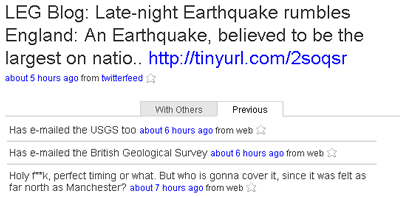
Mitch’s Twitter feed

Once he’d gathered some facts, he blogged it. In addition to the official sources and other news outlets, Mitch had also gathered some original material from blogs and blog comments.

(And the Flickr-sourced image of a bleary-eyed housemate in dressing gown watching the news was an unusual one, but in the absence of the old lump-of-debris snap it kinda works for me as a representation of what was happening across the country – and he gets credit for thinking visually).

Cleverly, he’s obviously set up Twitterfeed to post blog updates to his Twitter account too.

Within two hours the story had gone live on the Environmental News Online website, complete with tags.

Congratulations, Mitchell, on a job well done.

Review: ScribbleSheet (by Darcy Vergara)

scribblesheet.jpg

What do they say it is?

ScribbleSheet is about people expressing their opinions. It’s for people who have something to say but do not have the time to maintain a blog, or a job at their local newspaper. These opinions go unheard. ScribbleSheet wants to give everyday citizen journalism a home by making writing an article as simple as composing an email. Continue reading

Five Ws and a H that should come after every story – update

Since I wrote the Five W’s and a H that should come *after* every story post I’ve been responding to the hugely helpful posts and leads, and developing the idea further. As the deadline for Round 2 of the Knight News Challenge looms on Friday I thought I would post the latest on how the idea is shaping up, including a mockup (click for full size):

Conversation Toolkit mockup

So here’s what’s happened since that first post: Continue reading

Five W’s and a H that should come *after* every story (A model for the 21st century newsroom: pt3)

So far this model has looked at sourcing stories in the new media age, and reporting a news story in the new media age. In this third part I look at what should happen after a news story has been reported, using a familiar framework: the 5 Ws and a H – who, what, where, why, when and how.

Five W’s and a H that should come *after* every story

A web page – unlike a newspaper, magazine or broadcast – is never finished – or at least, can always be updated. Its permanence is central to its power, and relates directly to its connectivity (and therefore visibility).

Once out there it can be linked to, commented on, discussed, dissected, tagged, bookmarked and sent to a friend. That can take place on the original news site, but it probably doesn’t. The story is no longer yours. So once the news site has added comments, a message board, ’email to a friend’ boxes and ‘bookmark this’ buttons, what more can it do? Continue reading

Blogs and investigative journalism: publishing

Part four of this draft book chapter looks at how blogs have changed the publishing of journalism through its possibilities for transparency, potential permanence over time, limitless space, and digital distribution systems (part one is here; part two here; part three here) . I would welcome any corrections, extra information or comments.

Publishing

Traditionally, news has always been subject to the pressures of time and space. Today’s news is tomorrow’s proverbial ‘fish and chip paper’ – news is required to be ‘new’; stories “have a 24 hour audition on the news stage, and if they don’t catch fire in that 24 hours, there’s no second chance” (Rosen, 2004). At the same time, part of the craft of journalism in the 20th century has been the ability to distil a complex story into a particular word count or time slot, while a talent of editors is their judgement in allocating space based on the pressures of the day’s competing stories.

In the 21st century, however, new media technologies have begun to challenge the limitations of time and space that defined the news media in the 20th. Continue reading

Blogs and Investigative Journalism: draft first section

From today I’ll be blogging parts of a book chapter on ‘Blogs and Investigative Journalism’ which will form part of the next edition of ‘Investigative Journalism‘. The following is the first part, which introduces blogging in general and its relationship with journalism. I would welcome any corrections, extra information or comments.

Blogging and journalism

To ask “Is blogging journalism” is to mistake form for content. Blogs – like websites, paper, television or radio – can contain journalism, but may not. They are a platform, albeit – like other media platforms – one with certain generic conventions. Like all conventions, these have advantages and disadvantages for journalism, which this chapter aims to address. Continue reading