
Tag Archives: comments

Cult of the Amateur author fails to do his homework

It’s hard not to feel some schadenfreude when you see ‘Cult of the Amateur’ author Andrew Keen demonstrating a particularly lazy bit of amateur blogging himself. Today’s entry, ‘Anonymity shouldn’t pay (even in Sheffield)’ reads:

“Finally anonymity on the Internet is being punished. The Guardian today reports on anonymous Sheffield Wednesday bloggers who are being sued by the club for their abusive comments. This is heartening news. It is only when anonymous bloggers are made legally liable for their views that the Internet will become a civilized medium for responsible adults.”

Except the case was not about bloggers at all. It was about anonymous posters on a messageboard.

Perhaps he only read the headline – ‘Warning to abusive bloggers as judge tells site to reveal names’ – not a particularly great example of professionalism itself.

I tried to post a comment correcting Keen, but I got an error message.

Amateur.

Citizen journalism: some conclusions from the European Bloggers Unconference

Consider this my first attempt at a photoblog entry. For those who prefer video or text you can see both at http://www.ejc.net/seminars/picnic_2007_3

What is citizen journalism

Continue reading

A model for the 21st century newsroom pt2: Distributed Journalism

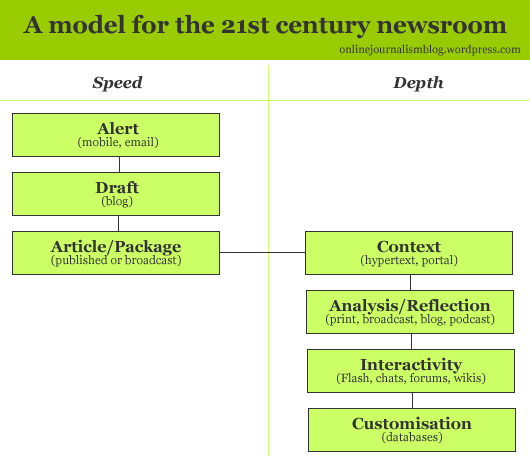
In the first part of my model for the 21st century newsroom I looked at how a story might move through a number of stages from initial alert through to customisation. In part two I want to look at sourcing stories, and the role of journalism in a new media world.

The last century has seen three important changes for the news industry. It has moved… Continue reading

A model for the 21st century newsroom: pt1 – the news diamond

UPDATE: A more up to date version of this post can be found at OnlineJournalismBlog.com, where this blog has moved to.

A month ago, I used the Online Journalism Facebook Group to ask readers to suggest what areas they wanted covering, in an experiment with bottom-up editing (the forum for suggestions is still open by the way). Megan T suggested “Rethinking the production of newspapers”.

After researching, conceptualising and scribbling, I’ve come up with a number of models around the news process, newsgathering, interactivity and business models.

The following, then, is the first in a series of proposals for a ‘model for the 21st century newsroom’ (part two is now here). This is a converged newsroom which may produce material for print or broadcast or both, but definitely includes an online element. Here’s the diagram. The model is explained further below it

21stcnewsroom1.gif

Building on the strengths of the medium

Continue reading

Relaunched Liverpool Trinity Mirror sites: a thumbs-up

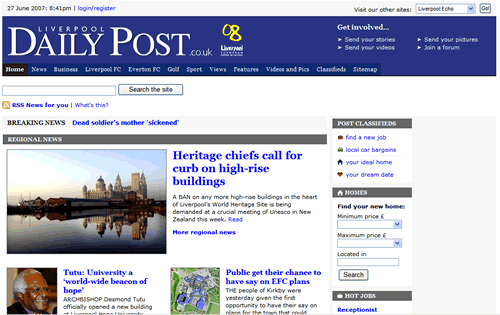
Liverpool Post website

Liverpool Echo website
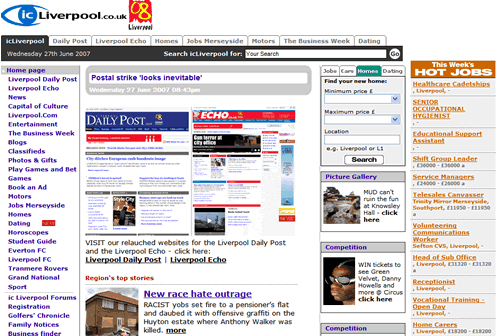
icLiverpool

Trinity Mirror have finally relaunched the first of their local newspaper websites, with the Liverpool Post and Liverpool Echo breaking free of that ‘icLiverpool’ brand and into individually branded sites that reflect their different markets.

It’s been a move the ‘ic’ sites have needed for a long time, and the contrast is considerable. The endless list of vertical navigation options has gone, replaced by a much clearer horizontal bar and the generally ‘bigger canvas’ look that most recent news website relaunches have adopted (larger images, fewer stories).

It’s no surprise to see video getting a stronger placing, while image galleries have become par for the course, although these are given a separate section rather than integrated with stories. And reader involvement is given top billing with four ‘calls to action’ on the banner – “Send your stories/videos/pics” and “Join a forum” (the latter too vague. It would be more productive to see specific forums promoted instead, but maybe that will come in time).

Web 2.0 is a keyword here, and the articles incorporate the facililty to ‘share’ via del.icio.us, Digg or Newsvine (with a helpful ‘What’s This?’ link for the majority of readers who’ll be thinking just that), along with reader comments, prominent RSS feed links and a fantastically comprehensive RSS service generally (well illustrated on the sitemap page).

Blogs are part of the package, and there’s some nice writing there, although someone ought to tell the columnists bloggers about the importance of linking (a music blog that doesn’t link to any band websites/MySpace accounts is pretty criminal – UPDATE Mar 3 ’08: now no longer the case: see comments below), and it would be nice to see more engagement with the blogosphere generally – surely there are some excellent bloggers in Liverpool not on the Trinity Mirror payroll?

The ranking system is a nice idea that hasn’t been thought through enough: as an article’s ranking is only displayed on the article itself it’s not clear how this is useful for readers who have already made the effort to get there. There is a “Most popular” box on the homepage, for instance, but no sign of any place where you can find the “Highest ranked”; it might also be useful for readers to choose only to see stories above a particular rating, as Slashdot does.

And one final weakness is a registration system that doesn’t explain why you should register (elsewhere the call to receive email updates does the job better).

These picky issues aside, the redesign is a massive improvement and much more pleasurable to browse. Aesthetically it beats competitors such as the Lancashire Evening Post and Hull Daily Mail hands-down. Although those newspapers seem to have better grasped the possibilities of new media editorially, this relaunch suggests Trinity Mirror understand the technical possibilities. Most impressive is a tagging system which allows users to click through to articles on the same subject/person – potentially making the accompanying ‘Related articles’ box redundant.

Journalism.co.uk reports that the next websites to get the facelift will be the Journal and the Evening Chronicle in Newcastle, and the Middlesbrough-based Evening Gazette “to be followed by titles in South and North Wales, Yorkshire and Scotland.” Will these follow the template, or will there be more editorial freedom? The Post and Echo seem to be based on the same template, so I’m betting on the former, but there is enough freedom here to at least give the papers more identity than ‘icLiverpool’ ever did.

Exhibition of online journalism (and some other stuff but let’s ignore that)

As the 2006/07 academic year draws to an end, the journalism students at UCE Birmingham have to show off their work at a final year exhibition of all media students’ work. How do you ‘exhibit’ journalism? That’s the challenge.

This year we’ve had three projects involving online journalism: the first was a news magazine and website aimed at 11-14-year-olds – ‘4 You‘. The second, a website to support a television news production, UR-Central, aimed at “under-represented communities in Birmingham”. And the third (not yet finished), is a blog-based service around disaster-related news.

The two that are now finished both had their strengths and weaknesses. UR-Central suffered, it appears, from the common problem of ‘production team not communicating with web person’. The resulting website is patchy, with some empty areas where ideas are suggested but not built. But there’s some Flash video, slideshows, a forum, and feedback opportunities.

The team behind 4 You were much better organised. One member built a content management system, incorporated feedback forms, games, a live weather feed, and a messageboard; there were image galleries, with invites for users to submit content; they blogged during the ‘live’ week (some better than others); and they even produced podcasts.

Particularly clever was the use of hyperlinks and the ‘title’ tag to explain concepts such as ‘Foreign secretary’ to a young audience. There are calls for readers to engage and contribute throughout, and promotion of the printed product.

If you want to see more of these and other projects in journalism, design, photography, television, radio, PR and new media, the exhibition takes place in Birmingham at Gosta Green, Corporation Street from Thursday June 21 to Saturday June 23. The students have set up a Facebook page on the event and, it seems, a media exhibition website too.

And what prompted me to write about all of this? Matt King, top class online journalist that he is, wrote on my Facebook wall to shame me into blogging about it. Clever man.

Students launch kids’ news website

A group of third year students on our journalism degree are running a live website all week. 4 You is aimed at 11-16 year olds and the group are finding writing for the audience hard.

Melissa Marshall, fashion and features editor for the group said: “We are only in our second day of the website but already it is pretty stressful! The hardest thing is trying to write stories that our target audience will be able to digest easily and will actually find interesting; but so far it’s been a great experience.”

Melissa is working with four other final year students – Richard Green, Eliot Mullett, Matthew King and Daniel Bardell – to update the site with breaking news. Each student has a specialist role, ranging from website designer to section editors.

In addition to the news items, the website has a news blog, editor’s blog and a sports blog, where readers are able to interact with the 4 You team and discuss different stories.

To make the site even more interactive, the team have set up message boards and are in the process of recording audio and video both for the blogs and for stories.

But as news editor Eliot Mullett states, this hasn’t been easy: “The more interactive we want to become, or the better we strive the website to be, the less time we seem to have in our editing role.

“Take Tuesday for example: I spent most of it sorting out the technical side of the website and helping the other guys do theirs. But when I finished for the day I hadn’t actually posted any stories at all!”

The students will not only be producing a live website, but also a magazine offering a more reflective angle on the news, as well as numerous features that are of interest to children.

Elliott says the team welcomes any comments or criticism about individual news items or design.

Express relaunches online, Star to follow

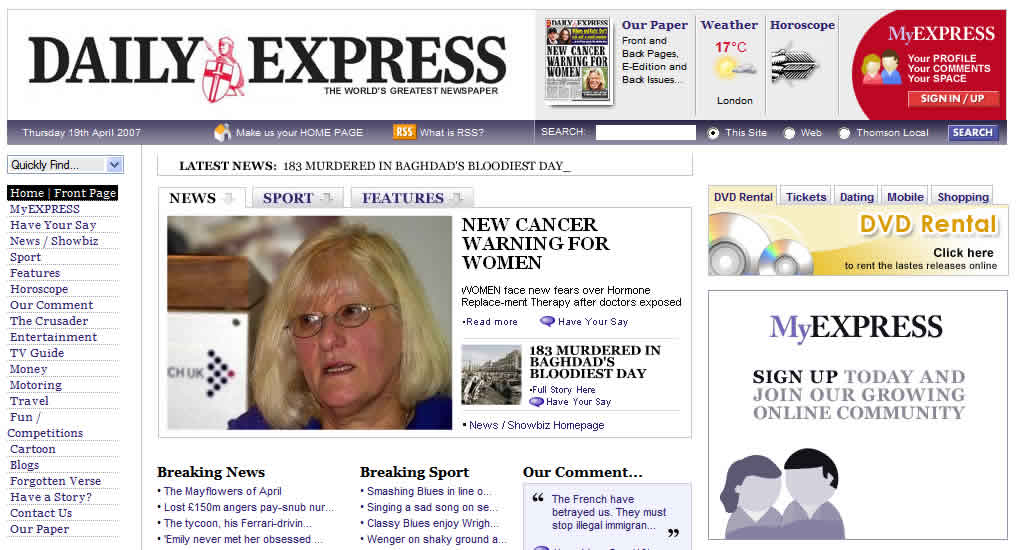
Express website 19 April 07Journalism.co.uk reports on the relaunch of the Express, with the Daily Star to follow, including:

  • “unique content and an archive which allows readers to search past stories and the community areas of the site.
  • “a string of blogs from its Sunday and Daily journalists.
  • “MYExpress facility that enables users to have their own space on the site. This area can be to personalised by filtering some content, such as weather and horoscopes, and uploading pictures. It will also be possible for users to browse through other users’ profiles.”
  • And “a deal had been done with a video supplier and that video and podcasts would be added to the mix in the coming weeks once the initial launch was completed.”

Sounds pretty good for a Desmond-owned publication (not difficult, admittedly), although in reality it’s a website that looks like it was created by someone who was once told what this web 2.0 thing is all about, but wasn’t really listening. Or, in other words, new media through an old media hack’s eyes.

The blogs are basically opinion columns (no links), I can’t find the “community areas”, and of course there’s no video yet. MYExpress is the most impressive – I can imagine Express readers too dazzled by MySpace social networking away with other Disgusteds, although there’s not much to it apart from a blogging service, personalised homepage and ability to search other profiles. Oh, and the online journalists are ghettoised in a separate team.

Anyway, welcome to the 21st century, Express.

BBC, UGC and online video

Some insights into the workings of the BBC, UGC and online video from Shane Richmond’s latest post:

“At a time when most newspapers, including this one, are trying to encourage user participation and comments on their sites, the BBC is questioning the need to host those conversations.

“Instead they’re linking their content out to the likes of YouTube, Flickr, Technorati and del.icio.us. Encourage the conversation but let it happen elsewhere.

“The burden of moderation is simply too great. Like us, the BBC moderates comments received from readers, mostly for legal reasons, but as Tom pointed out: “What we call moderation, readers call censorship.”

“The more successful you are at attracting reader responses, he explained, the bigger the problem gets.”

Also:

“One week in November last year, the BBC news site published around 500 pieces of video.

“Analysing the traffic for those clips later, they found that just 30 of them accounted for about half the traffic. They have learned some lessons about what type of video clips work online but mostly they learned to focus on doing less better.”