Tag Archives: enterprise

JEEcamp is approaching capacity – book your place now

It’s two weeks till JEEcamp – the ‘unconference’ around journalism enterprise and entrepreneurship. There are now over 40 people signed up across the JEEcamp wiki and Facebook event page, representing the national and regional press, tabloid and broadsheet, magazines, bloggers, freelancers, academics and journo startups.

So if you still want to come but haven’t signed up, please add your name to the wiki asap (the password is jee), as I may stop new registrations soon.
Also, sponsorship is available if you’re travelling from afar.

Business models for free content (A model for the 21st century newsroom pt5 addendum)

If you read the final part of my model for the 21st century newsroom concerning new media business models, I strongly recommend ‘Free! Why $0.00 Is the Future of Business‘, an article by Chris Anderson, author of The Long Tail. Have you not clicked yet? Here are some quotes to persuade you:

“To follow the money, you have to shift from a basic view of a market as a matching of two parties — buyers and sellers — to a broader sense of an ecosystem with many parties, only some of which exchange cash.

“… There are dozens of ways that media companies make money around free content, from selling information about consumers to brand licensing, “value-added” subscriptions, and direct ecommerce (see wired.com/extras for a complete list). Now an entire ecosystem of Web companies is growing up around the same set of models.”

Anderson maps out a ‘Taxonomy of free’ including Continue reading

Reviews of the latest journalism startups

Here’s the latest update from the team at JournalismEnterprise.com. This post is part of February’s Blog Carnival of Journalism.

Neaju, says Nicolas Kayser-Bril is “a smart way of making money using other people’s sweat … The total lack of journalistic work is a clever way to reduce costs. But it certainly doesn’t create any value for readers, who would have to fact-check themselves. For writers, the incentive to publish on Neaju instead of blogging is thin, as they lose control over content and leave behind any advertising revenue.

NewsTrust.net, says Alex Gamela, is “A sort of Michelin guide for news media.”

The Panelist, finally, says Kayser-Bril, is “A niche publication for upper-middle class do-gooders, where a bunch of financial bloggers advises parents worried about the world and the assets they leave their children with.

JEEcamp – the Journalism Enterprise and Entrepreneurship unconference

JEEcamp banner

On March 14 I will be hosting an ‘unconference’ around journalism enterprise and entrepreneurship. Rick Waghorn, of MyFootballWriter.com, will make the keynote speech.

JEEcamp is an opportunity for a range of people to get together to talk about how on earth journalists and publishers can make a living from journalism in the era of free information, what the challenges are, and what we’ve learned so far.

It is also an opportunity for people with different skills and experiences to network, share those experiences, and perhaps suggest partnerships or new projects.

Attendees might have launched their own journalism project – or worked on one within a mainstream organisation. Or they might just have lots of great ideas, or knowledge about the area.

Anyone can attend by signing up on the event wiki at http://jeecamp.pbwiki.com/ – first come, first served. To add your name, click ‘Edit Page’ – the password is ‘jee‘.

JEEcamp will take place on

Friday March 14 at The Bond in Digbeth, Birmingham (map)

Attendees will be asked to pay £20 towards the costs of the venue – if sponsorship is acquired that money will go to a charity decided by vote.

UPDATE: The event is now listed on Facebook if you want to add yourself there too.

Journalism enterprise headlines

The team at JournalismEnterprise.com have been busy – here are some of the most recent reviews:

Pownce: a Twitter with bells on.

EveryBlock: Adrian Holovaty’s much-anticipated news mapping service gets a five-star rating.

Newstin: multilingual news search: “Its taxonomy engine goes way beyond the usual keyword and tags approach. For each article, Newstin’s engine is able to tell you what it’s about, who was mentioned, where it happened, etc.

Gnooze:  satirical daily news show for YouTube browsers.

Skewz: “a political Digg that goes both ways. You can submit any news story and the community can vote on how “liberal” or “conservative” the story is.”

As always, the review is only the start of the process: please add your own comments on the sites. And if you want to review sites for JournalismEnterprise.com, what’s stopping you? Send an email to info@journalismenterprise.com to join.

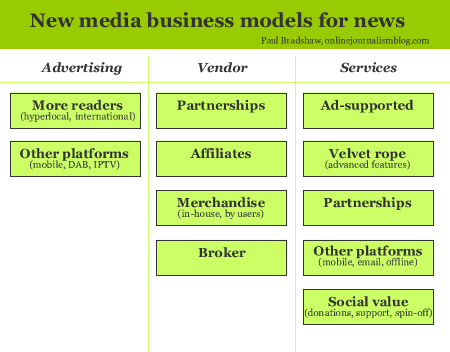
Making money from journalism: new media business models (A model for the 21st century newsroom pt5)

In the final part of the Model for the 21st Century Newsroom I look at how new media has compounded problems in news organisations’ core business models – and the new business models which it could begin to explore.

Let’s start by looking at the traditional newspaper business model. This has rested on selling, in a broad simplification, three things:

  • Advertising. Put more explicitly: selling readers to advertisers.
  • Selling content to readers, and, twinned with that:
  • Selling the delivery platform to readers – i.e. the paper

Developments in the past few decades have eaten into each of those areas as follows: Continue reading

Online Journalism Atlas: Norway

The Online Journalism Atlas continues, with Kristine Lowe looking at online journalism in Norway, where some newspapers make more money online than in print. Got any information about your own country’s online journalism? Add it here.

Norway is one of the most newspaper-reading in countries in the world, a fact also reflected in the country’s online media environment. In contrast to many other countries, Norwegians seem to prefer news-driven sites with journalistic content to all others. 

Early starters

Early adoption has put Norwegian online media at a great at advantage, some of the online players even earn good money.   Continue reading

Announcing the launch of Journalism Enterprise.com

Journalism Enterprise.com

Today I am launching a sister site to the Online Journalism Blog: Journalism Enterprise.com will review websites that are attempting to make money from journalism in the new media age. Consider it a TechCrunch of journalism startups.

Why am I doing this? Because journalism is changing, not only as a job and a process, but as an industry. How journalism – particularly good journalism – is going to survive in a world of free content is perhaps one of the biggest and most difficult questions of the moment.

There are so many experiments by so many people in so many fields – from journalists going it alone to large news organisations trying new projects, from amateurs who feel passionately about their field to non-profit organisations who see the potential of the web, and from internet startups to established new media players, I thought we needed a blog to keep track of it all and provide a place for debating the issues involved.

And I say “we”, because this is a team blog – in fact, I won’t be doing much of the writing at all. Reviews – which are done to a simple six-question format – are written by a team of bloggers from all over the world, who I’ve either invited to contribute, or who approached me as part of my appeal for virtual interns.

Membership of that team is very much open – if you want to contribute to Journalism Enterprise.com (or indeed OJB), please contact me. You will then be invited to join a mailing list, through which leads will circulate. You volunteer for whatever you’re able to do, or interested in reviewing. 

You’ll notice that there are already almost a dozen reviews on the site.

If you know of a project you’d like us to review, contact info@journalismenterprise.com. In the meantime, please browse through the site, post your comments, and hope you find it stimulating.

The idea, by the way, is shamelessly stolen from my colleague Andrew Dubber’s similar site for music startups, New Music Ideas. I was toying with using a wiki to do this before Dubber knocked on my door, and his way of doing things seemed so much better. Thanks Andrew.

This post is part of a Carnival of Journalism, hosted this month by Adrian Monck.

Pay-for online venture aims at dethroning Le Monde

Former Le Monde editor, Edwy Plenel, is launching an ambitious news website, Mediapart. He aims at “reinventing journalism” and offering “information of record”, Le Monde-style. No less.

The pun in “Mediapart” refers to “participation”, but also to “à part”, French for “different”. Difference lies first and foremost in the price: Access to the site requires a 9€ (£7, $13) monthly subscription. Quality journalism must be paid for, they say. These subscriptions will feed forty journalists, many of them coming from major traditional outlets.

The barrier is also supposed to allow for more qualitative contributions. Trolls must all be greedy, then.

Continue reading

Review: FreshTies.com

Melissa Edwards takes a look at community journalism/activism site FreshTies 

What do they say it is?

FreshTies main aim is to encourage individuals, charities and businesses alike to actively participate in their local community. It gives individuals the chance to swap things, find local news and ways to help their community; buinesses the chance to promote their services, news to classifieds and initiatives;charities the chance to reach more people for support, resources and funds. It gives budding journalists/writers in need of experience, and those who would like a higher profile, the opportunity to write about their local community in various roles, as editor, reporter or features writer on local content, as well as content for a national audience.” Continue reading