Tag Archives: Guardian

The OJB guide to open news APIs – part 1: Guardian, NYT and Daylife

In the first of a series, Peter Clark, founder of Broadersheet, takes a look at three of the leading APIs for people looking to build news-based web projects and mashups.

About six months ago, a friend of mine released a new search engine called Duckduckgo. Duckduckgo was based on the much hyped (free) Yahoo BOSS search engine platform, it was well received and now serves hundreds of thousands of searches a day.

Yahoo recently announced BOSS was going to be a paid-for service – surprising a lot of developers. When you’ve built a popular (albeit non-profitable) service on a free platform, and that platform suddenly becomes rather expensive – that eats into your ramen budget.

So when various news agencies announced content delivery developer platforms, I was particularly interested in where they were headed.

There are various services – some free, some paid-for – that developers can use to extract content and valuable information from news agencies. My friend was developing a web application that took content from The Guardian, and automatically printed a bespoke newspaper each day about your favourite topics. He expressed displeasure about The Guardian restricting developers from doing this:

“You will not: Use Open Guardian Platform Content in any printed format”

We’re entering a new age of restrictions and jumping through hoops and loopholes to make awesome content platforms for users.

There are three top platforms for news content which I explore below. I’ll discuss what you can and can’t do technically. Continue reading
Is free news really killing newspapers?

Those newspaper executives who seem to be casting around for someone to blame for the downfall of their empires may want to look at the lessons learned by the music industry. Of particular interest is this from today’s Guardian:

“The Norwegian study looked at almost 2,000 online music users, all over the age of 15. Researchers found that those who downloaded “free” music – whether from lawful or seedy sources – were also 10 times more likely to pay for music. This would make music pirates the industry’s largest audience for digital sales.”

Then, take a look at this from the 2008 Pew study:

“Newspapers would have suffered even greater losses without their online versions. Most of the loss in readership since 2006 has come among those who read the print newspaper; just 27% say they read only the print version of a daily newspaper yesterday, down from 34% in 2006.”

So what is really killing newspapers?

Newspaper websites need to improve their readability

Most newspaper websites are doing a bad design job in making their stories readable. Too many are using:

  • small fonts,
  • long off-putting paragraphs,
  • no subheadings,
  • no in-content boxes or pictures, and
  • no in-content links.

To explain more, I’ve written a companion post on online readability (design, not writing – and this post was first published here). And here’s an example each of their news stories so you can see the issue: Daily Mail, Express, FT, Guardian, Independent, Mirror, Sun, Telegraph, Times.

Main readability design mistakes

This table summarises the main ways they are going wrong.

Tiny fonts

They are all using font sizes that are too small for comfortable reading on copy-heavy pages. Only the Guardian, Independent, Mirror and Telegraph offer obvious controls for resizing text.

But most of the sites use 12 or 13px fonts for body copy. I think this is too small to be the default – 16px is a much more readable size. Only the Guardian comes anywhere near this. Continue reading

Could moderators collect potential leads from comments?

Guardian community moderator Todd Nash* makes an interesting suggestion on his blog about the difficulties journalists face in wading through comments on their stories:

“there is potential for news stories to come out of user activity on newspaper websites. Yet, as far as I know, it is not a particularly well-utlised area. Time is clearly an issue here. How many journalists have time to scroll through all of their comments to search for something that could well resemble a needle in a haystack? It was commented that, ironically, freelancers may make better use of this resource as their need for that next story is greater than their staff member counterparts.

“The moderation team at guardian.co.uk now has a Twitter feed @GuardianVoices which highlights good individual comments and interesting debate. Could they be used as a tool to collect potential leads? After all, moderators will already be reading the majority of content of the publication they work for. However, it would require a rather different mindset to look out for story leads compared to the more usual role of finding and removing offensive content.”

It’s an idea worth considering – although, as Todd himself concludes:

“Increased interactivity with users builds trust, which in turn produces a higher class of debate and, with it, more opportunities for follow-up articles. Perhaps it is now time for the journalists to take inspiration from their communities as well.”

That aside, could this work? Could moderators work to identify leads?

*Disclosure: he’s also a former student of mine

Newspaper sites: do not link to us

How will other newspapers react now The Guardian is giving access to a million articles to developers for free as part of its Open Platform initiative

If their site T&Cs are anything to go by, they have a long way to go to embrace the internet.

It’s fairly standard to forbid people from copying your material. But some papers have gone so far with their site T&Cs that you’re not allowed to link to – or even read – their pages. The quotes below are all from the sites’ T&Cs (and all seem to conflict with the ‘share’ buttons, such as the one enabling the Times to top the StumbleUpon league). Continue reading

It’s the Sun wot won it at Fark

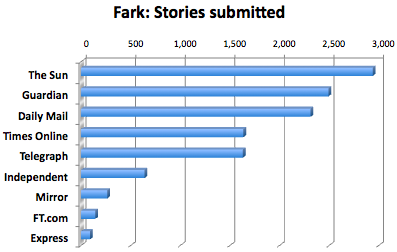
The Sun has had more stories submitted to Fark, the social news site for stranger news stories, than any other UK newspaper. That may be no surprise, but it’s the Guardian wot’s runner up.

The news follows the discovery that the Guardian is top at Reddit, the Times at StumbleUpon, and the Telegraph at Digg.

The graph is based on an analysis of the total submissions for each newspaper site to Fark. It shows that, just as with those other social news sites, the FT, Mirror and Express are trailling in last.

Sun winning at Fark, Guardian second

Sun winning at Fark, Guardian second

Guardian tops Reddit submissions list

The Guardian has had more stories submitted to Reddit.com than any other major newspaper site.

The news follows the Telegraph topping the Digg list and the Times topping the StumbleUpon list.

The graph shows how many pages have been submitted to Reddit for each site. It’s based on an analysis of newspapers’ Reddit submissions that also suggests the Telegraph is catching up with the Guardian – they tied for the number of stories submitted over the last week.

Submissions to Reddit: Guardian wins

Submissions to Reddit: Guardian wins

Times Online tops newspaper Stumble list

All self-respecting newspaper sites have share and social-bookmarking functionality, such as links to Digg, Reddit, Fark etc.

But if the results of StumbleUpon are typical then:

  1. Times Online is miles ahead of its rivals when it comes to users sharing / bookmarking its pages.
  2. The FT has a lot of work to do.
  3. Adding icons for an individual service makes no difference to how often users submit a given page.

Continue reading

Guardian hire YouTube makeup star Lauren Luke

In another sign of their savvy web strategy, The Guardian have signed up YouTube makeup star Lauren Luke to write a column (with accompanying video) in the revamped Weekend section (they also just happened to run a full page story on Luke in Saturday’s paper.)

The importance of people like Lauren – a 27-year-old single mother who lives with her son, mum, sister and nieces – to online news distribution is made pretty clear by the following quote from the article:

“A brief BBC interview with Luke for a local Tyneside news programme has been seen by more than 2.2 million people, becoming one of the most viewed BBC clips on YouTube worldwide.”

And here it is:

I’ve written previously that if you want to get into journalism you should have a blog. I’d add to that: if you want your own column, you should build up a following on YouTube too. News organisations will increasingly not just be looking for people who know what they’re talking about, but how to distribute it effectively online.

Shame the video’s not embeddable though.

UPDATE (of sorts): As if to reinforce my point, the Washington Post “has appointed a new multimedia journalist as a result of his participation in a YouTube contest” – although this was a more traditional reporting job obtained through a YouTube journalism contest – Project:Report.