Tag Archives: Guardian

Sport and data – now it’s more than just ‘interactive’

I’ve written previously on the Online Journalism Blog about ‘Why fantasy football may hold the key to the future of news‘. Now it seems The Guardian has taken things up a notch with the wonderful Chalkboard feature: an interactive database-driven toolkit that allows you to create your own ‘chalkboards’ illustrating whatever point you may wish to make about a team or player’s performance. Here’s my first attempt below:

Cute, yes? But more than just cute. This is an idea that takes sports data and makes it more than just ‘interactive’. This makes it communicative

Because you are not just toying with data but creating it to make a point. Once you create a chalkboard it is published to everyone, with space for comments. You can send it, share it or embed it – as I have.

Clearly there are improvements that can be made – starting with searchability/findability from the chalkboard/team page and the odd bug (the description which I entered was not visible on the test I did above, and limiting it to the final 15 minutes does not seem to have worked – you still see all passes).

But really that would be picking holes in what is a beautifully thought-through piece of work – a piece of work that understands if you’re to make news work online it has to be as much a platform as a destination (a platform which in turn opens up plenty of opportunities for monetisation).

The site claims match stats will be available 15 minutes after the full time whistle. Suddenly the calls to local radio to bemoan the manager’s tactics seem one-dimensional. And spending 60 seconds reading the match report is nothing compared to the time that will be spent carefully constructing your argument as to why your star midfielder should not have been sold to that close relegation rival…

Thanks to Alex Lockwood for the tip-off.

‘Journalists: learn to code’ says Guardian’s Arthur

Charles Arthur of The Guardian makes his point pretty plain: “If I had one piece of advice to a journalist starting out now, it would be: learn to code”

“Let’s be clear that I’m not saying “code” as in “get deep into C++ or Java” … I mean it in the sense of having a nodding acquaintance with methods of programming, and perhaps a few languages, so that when something comes along where you’ll need, say, to transform data from one form to another, you can. Or where you need to make your own life easier by automating some process or other.

” … None of which is saying you shouldn’t be talking to your sources, and questioning what you’re told, and trying to find other means of finding stuff out from people. But nowadays, computers are a sort of primary source too. You’ve got to learn to interrogate them effectively – and quote them meaningfully – too.”

Amen to that.

Are your comments invisible? How about your website?

If your news organisation uses javascript for its comments, or for any other part of the site, you may well be advised to start doing some testing.

Malcolm Coles, the Editor of Which.co.uk, has been highlighting some of the problems with the technology for search engine optimisation and accessibility (the two are often closely related) on his blog. Continue reading

Lessons in community from community editors #2: Mark Fothergill, The Guardian

I’ve been speaking to news organisations’ community editors on the lessons they’ve learned from their time in the job. In the 2nd of the series, the Guardian’s Mark Fothergill:

1. Getting the tools right for the job are ultra-important, both front end and back end:

Too many sites knock together something that ‘will do’ and it always comes back to haunt.

An oft-made mistake is spending lots of time on front end, user-facing functionality and spending no time thinking about how to moderate it.

Additionally, once users have tools/functionality, good or bad, they grow accustomed to them and when you then attempt to ‘improve’ the offering at a later date, they inevitably don’t like it and you can lose a sizeable portion of your community.

2. Define your role (and more specifically, the role of the moderation team):

If it’s not clear to other departments, particularly editorial, that the final decision on the moderation of any piece of user generated content lies with you, it can cause numerous problems. Other departments should have a say in procedures and should have a higher priority when it comes to 50/50 decisions, but they should respect the decisions of the moderation team, that are based on both experience and policy.

This is the only way to maintain consistency across your offering. Users won’t know if they’re coming or going if it appears there are a number of different moderation policies across a site that they see as being one entity.

Slight difffences between moderation on, say, Sport and Politics are to be expected, but not wholesale differences, especially when users are only asked to follow one set of community standards.

3. Deal with user complaints quickly:

If you’re not on top of user complaints within a reasonable time-frame, you’re fostering problems and problem areas. Dealing with a piece of content calling someone a “wanker” within 15 minutes, for instance, can prevent a flame war from ever getting off the ground. Deal with the same complaint after 2 hours and you’re likely to be mopping up for another hours afterwards.

Quick response times help to protect yourselves from a legal standpoint and, at the same time, help to protect the users who are much happier in the knowledge that a piece of reported content, that they deem to be offensive or inappropriate, has been acted upon swiftly. Who wants a system where you report someone telling you to “F off” and, on a regular basis, the comment is still there 8 hours later?

Why fantasy football may hold the key to the future of news

This season, after years of loyalty to the BBC/Channel 4 fantasy football competition, I’ve switched to The Guardian’s. Their game takes advantage of the reams of player data now available to newspapers – not just goals scored, clean sheets and assists, but also clearances, interceptions, tackles, shots on target, and so on, making for a very different challenge indeed.

The move mirrors that made by The Telegraph a year ago when they introduced a Flash element to their match reports that allowed you to look at an incredible range of match statistics. As I wrote at the time: it’s like having your own ProZone.

What’s all this got to do with the future of news? This: data. It’s one of the few advantages that news organisations have, and they should be doing more with it. What the Guardian fantasy football and the Telegraph demonstrate is the flexibility of that data.

And if we can do it in sport, why aren’t we doing it more elsewhere? Schools tables, pollution records, crime data, geotagged information, and election results are just a few that spring to mind – can you add some more?

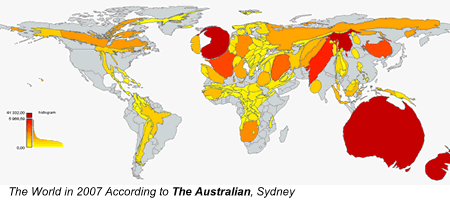
For a good example of a particularly creative use of data (again with a sport twist), see Channel 4’s alternative Olympics medals table, which matches medals results against various other country stats, such as human rights record.

Oh, and by the way, if you want to join my fantasy football friends’ league, search for Game 39 – or just post a comment below…

More database-related posts

Cartoons online – what are news organisations doing? (guest post)

In a guest post for the OJB, The Professional Cartoonists’ Organisation give an overview of how news organisations are treating cartoons online.

Cartoons have long been an essential part of British newspapers, so why do so many of those publications fail to do justice to drawn content on their websites?

The digital display of the web is a visual medium and cartoons and illustrations thrive on it. Yet many newsprint employers have not been quick to develop the advantages that drawn imagery offers as a digital communication tool and as existing sticky content for their sites and products. Continue reading

Crowdsourcing, the Guardian, and international aid programs (guest post by Rick Davies)

I recently invited Rick Davies, external monitor for the Guardian’s Katine project, to provide his insight into how much crowdsourcing has actually taken place – and what issues have arisen around that. This is his response:

In October 2007 Paul wrote an enthusiastic post about the Guardian’s involvement in what could be seen as a crowdsourcing experiment with AMREF, an African NGO working in Katine sub-country in Uganda, and supported by the Guardian.  In that post Paul quoted Guardian editor Alan Rusbridger:

“We’ll need money obviously. But, just as importantly we need advice and involvement. Among our readers are water engineers, doctors, solar energy experts, businessmen and women, teachers, nurses, farmers. We absolutely don’t need a stampede of volunteers, but we would like a technical know-how bank of people who are prepared to offer time and advice. We’ll let you know how to get involved as we go.” Continue reading

What is a publisher’s “duty of care” to bloggers?

Amidst the recent furore over Max Gogarty’s unblog-like/allegedly nepotistic travel blog entry on the Guardian website, a phrase caught my eye: Director of Digital Content Emily Bell’s reference to their “duty of care” to blogger Max.

It particularly interested me because I had a similar experience recently with a student blogger, who was on the receiving end of ferocious (and partly justified) criticism on an Australian alpha blog.

What was my duty of care to her? Continue reading

Mapping news just got a kick up the arse

Meta carta

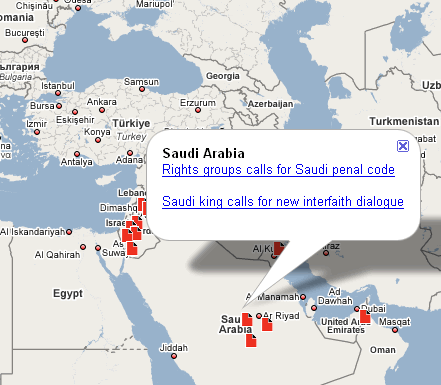
Once again news organisations will be looking over their shoulder at the launch of MetaCarta’s news mapping service. The more I play with this, the better I like it.

The red page icons on the opening page are something of a red herring – those are just the main headlines. A search for “Birmingham” brings up a whole lot more from my home town (and interestingly, not Birmingham, Alabama, meaning the site has worked out where I am).

Perhaps more interestingly, a keyword search gives you a global picture of what’s going on with, say news on the “environment”. How else would I have discovered a story about logging in Indonesia?

You can combine places with keywords, and change the date range of your search (the default is last 24 hours).

There’s a lot of scope for serendipity here, but a few weaknesses.

The most obvious is lack of RSS or bookmarkability. Having to keep checking this site and, worse, repeat a search makes this extra work.

Secondly, the current sources are limited to Reuters, AP and Guardian.co.uk. News organisations should be helping make their content map-friendly to get in on this.

And related to this, locations are currently quite generic, seemingly based on text recognition. Imagine what this could do if it tapped into geotagged stories from local newspapers such as those of Archant?