Tag Archives: Guardian

How journalism has changed – Guardian ‘3 pigs’ video says it better than anything

There’s something almost seminal about this video promoting The Guardian’s ‘open journalism’. I’m not sure whether it’s the unusually honest acknowledgement that news is more complicated than it is often presented; the way that the video itself plays with our preconceptions, drawing attention to them in the process; or the portrayal of a production process in which non-journalists are a vital part.

I lie, of course: it’s all of those things. It’s an image of journalism utterly different from how it presented itself in the 20th century, different – if we’re honest – from the image in most journalists’, and most journalism students’, minds.

I expect I’ll be showing this a lot. Watch it.

[flv:http://cdn.theguardian.tv/brightcove/2012/2/29/120229ThreeLittlePigs-16×9.mp4 autoplay=’false’]

PS: If you have another 3 minutes, here’s Alan Rusbridger giving a slightly less dramatised angle on the same topic:

[flv:http://cdn.theguardian.tv/brightcove/2012/2/29/120229OpenAlanRusbridger-16×9.mp4%5D

…And then move on to these videos linked from this page on how to get involved: from head of news Ian Katz:

[flv:http://cdn.theguardian.tv/brightcove/2012/2/29/120229OpenIanKatzEdit-16×9.mp4%5D

…and on sports journalism:

[flv:http://cdn.theguardian.tv/brightcove/2012/2/29/120229OpenSeanIngleEdit-16×9.mp4%5D

…and culture reporting:

[flv:http://cdn.theguardian.tv/brightcove/2012/2/29/120229OpenCatherineSEdit-16×9.mp4%5D

…and comment:

[flv:http://cdn.theguardian.tv/brightcove/2012/2/29/120229OpenBeckyGardinerEdit-16×9.mp4%5D

“All that is required is an issue about which others are passionate and feel unheard”

Here’s a must-read for anyone interested in sports journalism that goes beyond the weekend’s player ratings. As one of the biggest names in European football goes into administration, The Guardian carries a piece by the author of Rangerstaxcase.com, a blogger who “pulled down the facade at Rangers”, including a scathing commentary on the Scottish press’s complicity in the club’s downfall:

“The Triangle of Trade to which I have referred is essentially an arrangement where Rangers FC and their owner provide each journalist who is “inside the tent” with a sufficient supply of transfer “exclusives” and player trivia to ensure that the hack does not have to work hard. Any Scottish journalist wishing to have a long career learns quickly not to bite the hands that feed. The rule that “demographics dictate editorial” applied regardless of original footballing sympathies.

“[…] Super-casino developments worth £700m complete with hover-pitches were still being touted to Rangers fans even after the first news of the tax case broke. Along with “Ronaldo To Sign For Rangers” nonsense, it is little wonder that the majority of the club’s fans were in a state of stupefaction in recent years. They were misled by those who ran their club. They were deceived by a media pack that had to know that the stories it peddled were false.”

Over at Rangerstaxcase.com, the site expands on this in its criticism of STV for uncritical reporting: Continue reading

2011: the UK hyper-local year in review

In this guest post, Damian Radcliffe highlights some topline developments in the hyper-local space during 2011. He also asks for your suggestions of great hyper-local content from 2011. His more detailed slides looking at the previous year are cross-posted at the bottom of this article.

2011 was a busy year across the hyper-local sphere, with a flurry of activity online as well as more traditional platforms such as TV, Radio and newspapers.

The Government’s plans for Local TV have been considerably developed, following the Shott Review just over a year ago. We now have a clearer indication of the areas which will be first on the list for these new services and how Ofcom might award these licences. What we don’t know is who will apply for these licences, or what their business models will be. But, this should become clear in the second half of the year.

Whilst the Leveson Inquiry hasn’t directly been looking at local media, it has been a part of the debate. Claire Enders outlined some of the challenges facing the regional and local press in a presentation showing declining revenue, jobs and advertising over the past five years. Her research suggests that the impact of “the move to digital” has been greater at a local level than at the nationals.

Across the board, funding remains a challenge for many. But new models are emerging, with Daily Deals starting to form part of the revenue mix alongside money from foundations and franchising.

And on the content front, we saw Jeremy Hunt cite a number of hyper-local examples at the Oxford Media Convention, as well as record coverage for regional press and many hyper-local outlets as a result of the summer riots.

I’ve included more on all of these stories in my personal retrospective for the past year.

One area where I’d really welcome feedback is examples of hyper-local content you produced – or read – in 2011. I’m conscious that a lot of great material may not necessarily reach a wider audience, so do post your suggestions below and hopefully we can begin to redress that.

The strikes and the rise of the liveblog

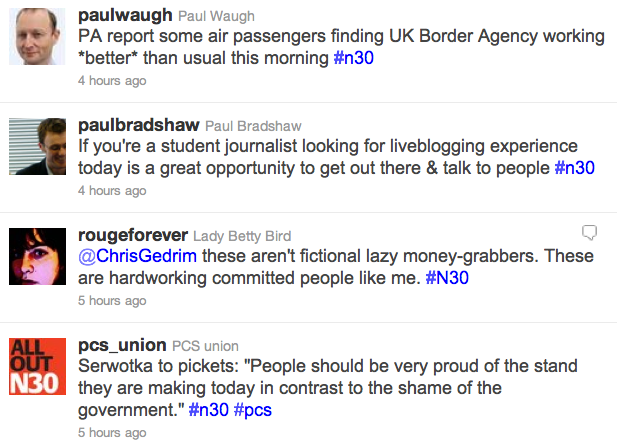
Liveblogging the strikes: Twitter's #n30 stream

Liveblogging the strikes: Twitter's #n30 stream

Today sees the UK’s biggest strike in decades as public sector workers protest against pension reforms. Most news organisations are covering the day’s events through liveblogs: that web-native format which has so quickly become the automatic choice for covering rolling news.

To illustrate just how dominant the liveblog has become take a look at the BBCChannel 4 News, The Guardian’s ‘Strikesblog‘ or The TelegraphThe Independent’s coverage is hosted on their own live.independent.co.uk subdomain while Sky have embedded their liveblog in other articles. There’s even a separate Storify liveblog for The Guardian’s Local Government section, and on Radio 5 Live you can find an example of radio reporters liveblogging.

Regional newspapers such as the Chronicle in the north east and the Essex County Standard are liveblogging the local angle; while the Huffington Post liveblog the political face-off at Prime Minister’s Question Time and the PoliticsHome blog liveblogs both. Leeds Student are liveblogging too. And it’s not just news organisations: campaigning organisation UK Uncut have their own liveblog, as do the public sector workers union UNISON and Pensions Justice (on Tumblr).

So dominant so quickly

The format has become so dominant so quickly because it satisfies both editorial and commercial demands: liveblogs are sticky – people stick around on them much longer than on traditional articles, in the same way that they tend to leave the streams of information from Twitter or Facebook on in the background of their phone, tablet or PC – or indeed, the way that they leave on 24 hour television when there are big events.

It also allows print outlets to compete in the 24-hour environment of rolling news. The updates of the liveblog are equivalent to the ‘time-filling’ of 24-hour television, with this key difference: that updates no longer come from a handful of strategically-placed reporters, but rather (when done well) hundreds of eyewitnesses, stakeholders, experts, campaigners, reporters from other news outlets, and other participants.

The results (when done badly) can be more noise than signal – incoherent, disconnected, fragmented. When done well, however, a good liveblog can draw clarity out of confusion, chase rumours down to facts, and draw multiple threads into something resembling a canvas.

At this early stage liveblogging is still a form finding its feet. More static than broadcast, it does not require the same cycle of repetition; more dynamic than print, it does, however, demand regular summarising.

Most importantly, it takes place within a network. The audience are not sat on their couches watching a single piece of coverage; they may be clicking between a dozen different sources; they may be present at the event itself; they may have friends or family there, sending them updates from their phone. If they are hearing about something important that you’re not addressing, you have a problem.

The list of liveblogs above demonstrates this particularly well, and it doesn’t include the biggest liveblog of all: the #n30 thread on Twitter (and as Facebook users we might also be consuming a liveblog of sorts of our friends’ updates).

More than documenting

In this situation the journalist is needed less to document what is taking place, and more to build on the documentation that is already being done: by witnesses, and by other journalists. That might mean aggregating the most important updates, or providing analysis of what they mean. It might mean enriching content by adding audio, video, maps or photography. Most importantly, it may mean verifying accounts that hold particular significance.

Liveblogging: adding value to the network

Liveblogging: adding value to the network

These were the lessons that I sought to teach my class last week when I reconstructed an event in the class and asked them to liveblog it (more in a future blog post). Without any briefing, they made predictable (and planned) mistakes: they thought they were there purely to document the event.

But now, more than ever, journalists are not there solely to document.

On a day like today you do not need to be journalist to take part in the ‘liveblog’ of #n20. If you are passionate about current events, if you are curious about news, you can be out there getting experience in dealing with those events – not just reporting them, but speaking to the people involved, recording images and audio to enrich what is in front of you, creating maps and galleries and Storify threads to aggregate the most illuminating accounts. Seeking reaction and verification to the most challenging ones.

The story is already being told by hundreds of people, some better than others. It’s a chance to create good journalism, and be better at it. I hope every aspiring journalist takes it, and the next chance, and the next one.

Disproving the police account of Tomlinson’s death (How “citizen journalism” aided two major Guardian scoops part 2)

This is the second of a three-part guest post by Paul Lewis that originally appeared in the book Investigative Journalism: Dead or Alive? You can read the first part here.

The investigation into Tomlinson’s death began in the hours after his death on 1 April 2009, and culminated, six days later, in the release of video footage showing how he had been struck with a baton and pushed to the ground by a Metropolitan police officer, Simon Harwood. The footage, shot by an American businessman, was accompanied by around twenty detailed witness accounts and photographs of the newspaper seller’s last moments alive and successfully disproved the police’s explanation of the death.

The result was a criminal investigation, a national review of policing, multiple parliamentary inquiries and, by May 2011, an inquest at which a jury concluded Tomlinson had been “unlawfully killed”. At the time of writing, Harwood, who was on the Met’s elite Territorial Support Group, was awaiting trial for manslaughter.

In media studies, the case was viewed as a landmark moment for so-called “citizen journalism”. Sociologists Greer and Laughlin argue the Tomlinson story revealed a changing narrative, in which the powerful – in this case, the police – lost their status of “primary definers” of a controversial event.

Significantly, it was the citizen journalist and news media perspective, rather than the police perspective, that was assimilated into and validated by the official investigations and reports. Ultimately, it was this perspective that determined “what the story was”, structured the reporting of “what had happened and why” and drove further journalistic investigation and criticism of the Metropolitan Police Services.

The initial account of Tomlinson’s death put out by police was that he died of a heart attack while walking home from work in the vicinity of the protests, and that protesters were partly to blame for impeding medics from delivering life-saving treatment. Neither of these claims were true, but they fed into coverage that was favourable to police.

A public relations drive by the Met and City of London police was bolstered by “off the record” briefings to reporters that suggested – also wrongly – that Tomlinson’s family were not surprised by his death and upset by internet speculation it could be suspicious. These briefings contributed to a broader media narrative that endorsed police and criticised protesters.

How the police account left so many questions unanswered

The morning after father of nine died, the newspaper he had been selling outside Monument tube station, the Evening Standard, carried the headline: “Police pelted with bricks as they help dying man.” But it was plain to us, even at an early stage, that there could be more to the story. The overlydefensive police public relations campaign gave the impression there was something to hide. Embedded in the small-print of press releases, there were clues – such as the Independent Police Complaints Commission’s notification of the death – that left unanswered questions.

Most obviously, anyone who had ventured near to the protests near the Bank of England on the evening Tomlinson died would have known he collapsed in the midst of violent clashes with police. It seemed implausible, even unlikely, that the death of a bystander would not have been connected in some way to the violence. But pursuing this hunch was not easy, given the paucity of reliable information being released by police, who at times actively discouraged us from investigating the case.

All that was known about Tomlinson in the 48 hours after his death was that he had been wearing a Millwall football t-shirt. That, though, was enough to begin pursuing two separate lines of inquiry. One involved old school “shoe leather”; trawling through notepads to identify anyone who may have been in the area, or know someone who was, who could identify Tomlinson from press photographs of him lying unconscious on the ground.

That yielded one useful eye-witness, with photographic evidence of Tomlinson alive, with images of him walking in apparent distress, and lying at the feet of riot police 100 yards from where he would eventually collapse. Why was Tomlinson on the ground twice, in the space of just a few minutes? And if those photographs of the father of nine stumbling near police officers, moments before his death, were put online, would anyone make the connection?

Becoming part of a virtual G20 crowd

The answer was yes, as a direct result of the second line of inquiry: by open sharing information online, both through internet stories and Twitter, we became part of a virtual G20 crowd that had coalesced online to question the circumstances of his death. In this environment, valuable contributions to the debate, which were more sceptical in tone than those adopted by other media organisations, worked like online magnets for those who doubted the official version of events. Twitter proved crucial to sharing information with the network of individuals who had begun investigating the death of their own accord.

I had signed-up to the social media website two days before the protest, and became fascinated with the pattern of movement of “newsworthy” tweets. For example, a YouTube video uploaded by two protesters who did not see the assault on Tomlinson, but did witness his collapse minutes later and strongly disputed police claims that officers treating him were attacked with bottles, was recommended to me within seconds of being uploaded. Minutes later, Twitter investigators had identified the protesters in the film and, shortly after that, found their contact details.

Similarly, those concerned to document Tomlinson’s last moments alive, including associates of the anarchist police-monitoring group Fitwatch, were using the internet to organise.

Through Twitter I discovered there were Flickr albums with hundreds of photographs of the vicinity of this death, and dissemination of blog-posts that speculated on how he may have died. None of these images of course could be taken at face value, but they often contained clues, and where necessary the crowd helped locate, and contact, the photographer.

Journalists often mistakenly assume they can harness the wisdom of an online crowd by commanding its direction of travel. On the contrary, in digital journalism, memes (namely, concepts that spread via the internet) take their own shape organically, and often react with hostility to anyone who overtly seeks to control their direction. This is particularly the case with the protest community, which often mistrusts the so-called mainstream media. Hence it was incumbent on me, the journalist, to join the wider crowd on an equal playing-field, and share as much information as I was using as the investigation progressed.

Establishing authenticity and context

There were times, of course, when we had to hold back important material; we resisted publishing images of Tomlinson at the feet of riot police for four days, in order to establish properly their authenticity and context.

Internet contact usually does not suffice for verification, and so I regularly met with sources. I asked the most important witnesses to meet me at the scene of Tomlinson’s death, near the Bank of England, to walk and talk me through what they had seen. We only published images and video that we had retrieved directly from the source and later verified.

A different standard applies to sharing images already released on Twitter, where journalists such as National Public Radio’s Andy Carvin in the US have proven the benefits from sharing information already in the public domain to establish its significance and provenance. The break, though, as with most scoops, was partly the result of good luck, but not unrelated to the fact that our journalism had acquired credibility in the online crowd.

Chris La Jaunie, an investment fund manager, who had recorded the crucial footage of Harwood pushing Tomlinson on a digital camera, had become part of that crowd too, having spent days monitoring coverage on the internet from his office in New York. He knew the footage he had was potentially explosive. The options available to Mr La Jaunie were limited. Fearing a police cover-up, he did not trust handing over the footage. An alternative would have been to release the video onto YouTube, where would it lack context, might go unnoticed for days and even then could not have been reliably verified.

He said he chose to contact me after coming to the conclusion that ours was the news organisation which had most effectively interrogated the police version of events. It was more than a year later that my colleague Matthew Taylor and I began inquiring into the death of Mubenga. By then we had recognised the potential reach of Twitter for investigative journalism and our decision to openly investigate the death of the Angolan failed asylum seeker was a deliberate one.

Not all investigations are suited to transparent digging, and, indeed, many stories still demand top secrecy. This has been true for the three outstanding UK investigations of our times: the Telegraph’s MPs’ expenses scandal and, at the Guardian, the investigations into files obtained by WikiLeaks and phone-hacking by the News of the World. However, Tomlinson had shown that open investigations can succeed, and there were parallels with the death of Mubenga.

In the third and final part, published tomorrow, Lewis explains how he used Twitter to pursue that investigation into the death of Jimmy Mubenga, and the crucial role of verification.

New Facebook news apps: bring the news to your users, or invite users to your news?

There’s a salient quote in Journalism.co.uk’s report on Facebook’s  “new class of news apps” launched today:

“As we worked with different news organisations there were two camps: people that wanted to bring the social experience onto their sites, like Yahoo [News] and the Independent; and those that wanted the social news experience on Facebook, like Guardian, the Washington Post and the Daily,” director of Facebook’s platform partnerships Christian Hernandez told Journalism.co.uk.

So which is better? An initial play with the apps of The Independent and The Guardian appears to demonstrate the difference well. Here, for example, is the Facebook app widget as it appears on The Independent – or rather, as it almost appears: various other editorial and commercial choices push it onto the fold:

The Independent's new Facebook App in action

The Guardian app, meanwhile, hands over editorial control to the users in a customarily clean design:

Guardian Facebook app

But hold on, what’s this in my news/activity/information overload stream next to The Guardian’s article?

The Guardian news app with Independent stories in the user's news stream

It appears that The Independent app takes the news to the users as well. Continue reading

Why we need open courts data – and newspapers need to improve too

Justice

Justice photo by mira66

Few things sum up the division of the UK around the riots like the sentencing of those involved. Some think courts are too lenient, while others gape at six month sentences for people who stole a bottle of water.

These judgments are often made on the basis of a single case, rather than any overall view. And you might think, in such a situation, that a journalist’s role would be to find out just how harsh or lenient sentencing has been – not just across the 1,600 or more people who have been arrested during the riots, but also in comparison to previous civil disturbances – or indeed, to similar crimes outside of a riot situation.

As Martin Belam argues:

“Really good data journalism will help us untangle the truth from those prejudiced assumptions. But this is data journalism that needs to stay the course, and seems like an ideal opportunity to do “long-form data journalism”. How long will these looters serve? What is the ethnic make-up and age range of those convicted? How many other criminals will get an early release because our jails are newly full of looters? How many people convicted this week will go on to re-offend?”

And yet, amazingly, we cannot reliably answer these questions – because it is still not possible to get raw data on sentencing in UK courts, not even through FOI. Continue reading

How a musician and a Sikh TV channel dominated coverage of the Birmingham riots

Man holding bag of Tesco value rice

One image from last night guaranteed not to have made it onto the front page - via Birmingham Riots 2011

It’s one thing to cover rioting on the doorstep of the national press – it’s quite another when squeezed regional newsrooms have to do the same. And as rioting in the UK spread from London to Birmingham and then other cities, some unlikely suspects showed how to cover a riot online even when you don’t have a newsroom.

Dominating online coverage in Birmingham was not a local newspaper or broadcaster but a Tumblr site – Birmingham Riots 2011 – set up by musician Casey Rain. Over dozens of entries Casey posted countless reports of what was taking place, and a range of photos and video footage which dwarfed the combined coverage of regional press and broadcast.
Continue reading

FAQ: How can broadcasters benefit from online communities?

Here’s another set of questions I’m answering in public in case anyone wants to ask the same:

How can broadcasters benefit from online communities?

Online communities contain many individuals who will be able to contribute different kinds of value to news production. Most obviously, expertise, opinion, and eyewitness testimony. In addition, they will be able to more effectively distribute parts of a story to ensure that it reaches the right experts, opinion-formers and eyewitnesses. The difference from an audience is that a community tends to be specialised, and connected to each other.

If you rephrase the question as ‘How can broadcasters benefit from people?’ it may be clearer.

How does a broadcaster begin to develop an engaged online community, any tips?

Over time. Rather than asking about how you develop an online community ask yourself instead: how do you begin to develop relationships? Waiting until a major news event happens is a bad strategy: it’s like waiting until someone has won the lottery to decide that you’re suddenly their friend.

Journalists who do this well do a little bit every so often – following people in their field, replying to questions on social networks, contributing to forums and commenting on blogs, and publishing blog posts which are helpful to members of that community rather than simply being about ‘the story’ (for instance, ‘Why’ and ‘How’ questions behind the news).

In case you are aware of networks in the middle east, do you think they are tapping into online communities and social media adequately?

I don’t know the networks well enough to comment – but I do think it’s hard for corporations to tap into communities; it works much better at an individual reporter level.

Can you mention any models whether it is news channels or entertainment television which have developed successful online communities, why do they work?

The most successful examples tend to be newspapers: I think Paul Lewis at The Guardian has done this extremely successfully, and I think Simon Rogers’ Data Blog has also developed a healthy community around data and visualisation. Both of these are probably due in part to the work of Meg Pickard there around community in general.

The BBC’s UGC unit is a good example from broadcasting – although that is less about developing a community as about providing platforms for others to contribute, and a way for journalists to quickly find expertise in those communities. More specifically, Robert Peston and Rory Cellan-Jones use their blogs and Twitter accounts well to connect with people in their fields.

Then of course there’s Andy Carvin at NPR, who is an exemplar of how to do it in radio. There’s so much written about what he does that I won’t repeat it here.

What are the reasons that certain broadcasters cannot connect successfully with online communities?

I expect a significant factor is regulation which requires objectivity from broadcasters but not from newspapers. If you can’t express an opinion then it is difficult to build relationships, and if you are more firmly regulated (which broadcasting is) then you take fewer risks.

Also, there are more intermediaries in broadcasting and fewer reporters who are public-facing, which for some journalists in broadcasting makes the prospect of speaking directly to the former audience that much more intimidating.

The death of the News Of The World

What an incredible few days. The PCC’s statement yesterday was extraordinary – even if it turns out to be merely a cosmetic exercise. Today’s announcement that the News of the World will end as a brand is, as its mooted replacement would say, a “stunner”.

It took almost exactly 3 days – 72 hours – to kill off a 168-year-old brand. Yes, there were other allegations and two years in the lead up to The Guardian’s revelation that Milly Dowler was targeted by the newspaper. But Milly Dowler and the various other ordinary people who happened to be caught up in newsworthy events (kidnappings, victims of terrorist attacks, families of dead soldiers), were what turned the whole affair.

That story was published at 16.29 on Monday. Incredible.

We talk a lot about the disintermediation of the press – the fact that companies, governments and celebrities can communicate directly with the public. The targeting of the News Of The World’s advertisers, and the rapid mobilisation of thousands of signatures supporting an inquiry, demonstrated that that disintermediation works the other way too. Where once the media could have acted as a dampener on how public protest appeared to advertisers and Parliament, their powers to do so now are more limited. [UPDATE: Paul Mason puts this particularly well here]

So while The Sun may be moving to 7-day production, that doesn’t make this a rebranding or a relaunch. As of Monday, The News of the World brand is dead, 168 years of journalistic history (not to mention 200 jobs) offered up as a sacrifice.

Whether that sacrifice is accepted, and to what extent, is yet to be seen. In the meantime, the significance of this shouldn’t be underestimated.

This post originally appeared on the blog Facebook page