There’s the image, here’s the post. (via SteveBridger)

There’s the image, here’s the post. (via SteveBridger)
On the evening of Thursday May 29th I’ll be at ‘Power Your Business with Web 2.0’, on a discussion panel. That’s at the Technology Innovation Centre in Birmingham B4 7XG from 6pm till 10pm. Email creative.networks@tic.ac.uk or register online at www.creativenetworksonline.com
On Friday June 13th I’ll be in London at the Investigative Journalism Goes Global conference at Westminster University. The day will include the official launch of the second edition of the book Investigative Journalism, for which I’ve written a chapter on ‘Investigative Journalism and Blogs‘. I’ll be on a panel discussing “What is the point of investigative journalism in the online media world?”
Part four of this five-part series looks at how interactivity forms the basis of true online journalism, and explores ways to think about interactivity in practice. This will form part of a forthcoming book on online journalism – comments very much invited.
In his 2001 book Online Journalism, Jim Hall argues that, in the age of the web, interactivity could be added to impartiality, objectivity and truth as a core value of journalism. It is that important.
Interactivity is central to how journalism has been changed by the arrival of the internet. Whereas the news industries of print, radio and TV placed control firmly in the hands of the publishers and journalists, online you try to control people at your peril.
It is important to remember that people use the web on devices – whether a computer, mobile phone or PDA – with cultural histories of usefulness or utility, very different to the cultural histories of television, radio or even print.
People go online to do something. Companies that help with that process tend to prosper online. Those that attempt to curtail users’ ability to do things with their content often find themselves on the end of a backlash.
News is, of course, a service. But up until now news organisations have been under the mistaken impression that it is a product. The web is reminding them otherwise.
Interactivity is not video, or ‘multimedia’; it is not flashy bells and whistles. At its core, it is about giving the user control. Continue reading
What happens when you bring together local journalists, bloggers, web publishers, online journalism experts and new media startups – and get them talking?
That was the question that JEEcamp sought to answer: an ‘unconference’ around journalism enterprise and entrepreneurship that looked to tackle some of the big questions facing news in 2008: how do you make money from news when information is free? Where is the funding for news startups? How do you generate community? What models work for news online? Continue reading
In an attempt to reconnect with its readers, German newspaper Frankfurter Allgemeine Zeitung (FAZ) introduced a thematic and participatory website a few weeks ago.
The translation of The Kindly Ones, a blockbuster book wherever it’s been released, landed in German bookstores last Saturday, February 23. Its controversial content (sex, Nazis and sadism) makes it a favorite conversation topic among the quality-newspaper-reading population. FAZ decided to organize this conversation. Continue reading
In the second part of this five-part series, I explore how adaptability has not only become a key quality for the journalist – but for the information they deal with on a daily basis too. This will form part of a forthcoming book on online journalism – comments very much invited.
The adaptable journalist
A key skill for any journalist in the new media age, whatever medium they’re working in, is adaptability. The age of the journalist who only writes text, or who only records video, or audio, is passing. Today, the newspaper and magazine, the television and the radio programme all have an accompanying website. And that website is, increasingly, filled with a whole range of media, which could include any of the following:
This does not mean that the online journalist has to be an expert in all of these fields, but they should have media literacy in as many of these fields as possible: in other words, a good online journalist should be able to see a story and think:
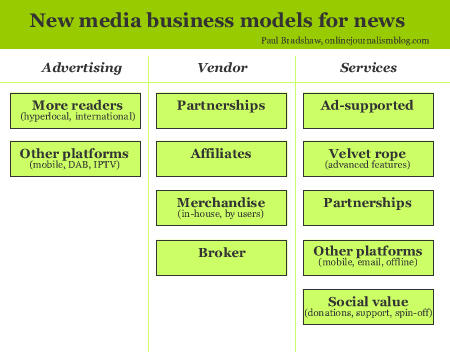
In the final part of the Model for the 21st Century Newsroom I look at how new media has compounded problems in news organisations’ core business models – and the new business models which it could begin to explore.
Let’s start by looking at the traditional newspaper business model. This has rested on selling, in a broad simplification, three things:
Developments in the past few decades have eaten into each of those areas as follows: Continue reading
Since I wrote the Five W’s and a H that should come *after* every story post I’ve been responding to the hugely helpful posts and leads, and developing the idea further. As the deadline for Round 2 of the Knight News Challenge looms on Friday I thought I would post the latest on how the idea is shaping up, including a mockup (click for full size):
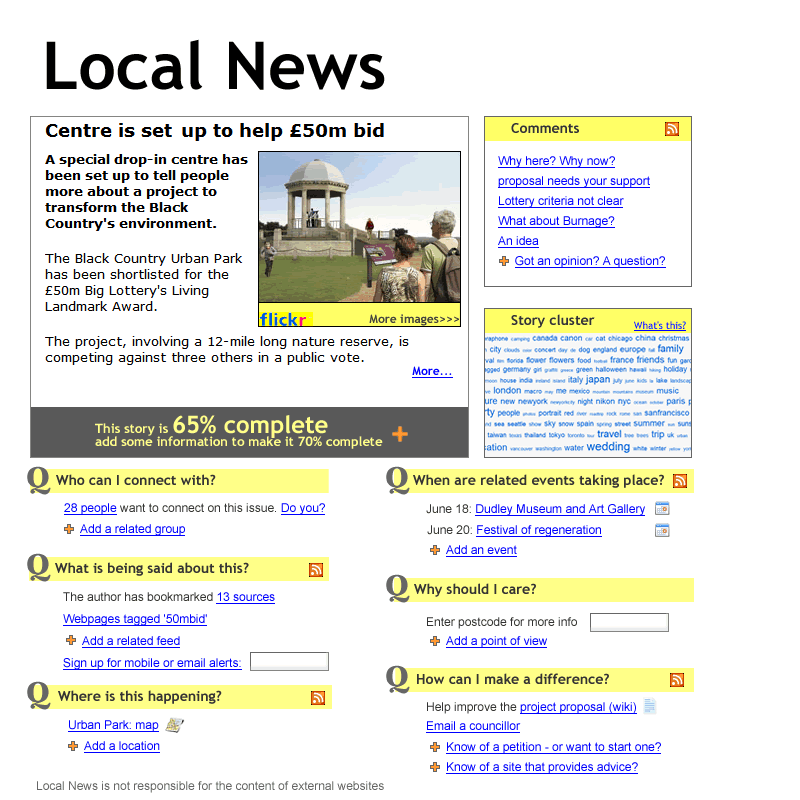
So here’s what’s happened since that first post: Continue reading
I felt so strongly about the Five W’s and a H that should come *after* every story that I pitched an idea based on it to the Knight Foundation. It’s called the ‘Conversation Toolkit’, and it’s through to the second round of the Knight News Challenge. Think it sounds like a good idea? Have any improvements? Want to help make it happen, or test it out? Then log on to the idea wiki at http://bidideas.pbwiki.com/conversationtoolkit (password: idea) and add what you can, or contact me directly.
Here’s the text so far: Continue reading
So far this model has looked at sourcing stories in the new media age, and reporting a news story in the new media age. In this third part I look at what should happen after a news story has been reported, using a familiar framework: the 5 Ws and a H – who, what, where, why, when and how.

A web page – unlike a newspaper, magazine or broadcast – is never finished – or at least, can always be updated. Its permanence is central to its power, and relates directly to its connectivity (and therefore visibility).
Once out there it can be linked to, commented on, discussed, dissected, tagged, bookmarked and sent to a friend. That can take place on the original news site, but it probably doesn’t. The story is no longer yours. So once the news site has added comments, a message board, ’email to a friend’ boxes and ‘bookmark this’ buttons, what more can it do? Continue reading
 Online Journalism Blog