Online Journalism Blog

Avatar

This is a conversation.

adobe photoshop cs2 tryout for mac Buy Premiere Pro CS4 MAC adobe premiere elements forums adobe photoshop cs2 prefences Buy Acrobat 9 Pro Extended adobe premiere elements 2.0 torrent adobe photoshop instructions Buy After Effects CS4 MAC adobe photoshop cs2 serial adobe illustrator serial code Buy After Effects CS4 caterpillar symbol adobe illustrator install adobe creative suite Buy Creative Suite 4 Design Standard adobe photoshop tutorials free adobe illustrator turorial Buy Creative Suite 4 Master Collection for Mac adobe photoshop cs crack mac adobe illustrator graphic styles download Buy Creative Suite 4 Master Collection adobe flash driver adobe photoshop 6 brushes Buy Creative Suite 4 Web Premium basics of adobe illustrator convert adobe illustrator ia jpg Buy Creative Suite 4 Web Standard adobe technote dreamweaver emerging issues mp3 in adobe premiere Buy Dreamweaver CS4 adobe indesign mac student album adobe photoshop product Buy Fireworks CS4 adobe photoshop font adobe photoshop vs corel Buy Flash CS4 Professional academic student adobe illustrator adobe illustrator cs3 crop marks Buy Illustrator CS4 adobe after effects 8.0 system requirements flash lite authoring adobe labs Buy InDesign CS3 adobe fireworks cs3 help on adobe indesign glyph count Buy InDesign CS4 MAC adobe illustrator cs2 crack adobe photoshop cs2 photomerge tutorial panorama Buy InDesign CS4 adobe after effects warez adobe creative suite 3 family pack Buy Photoshop CS3 Extended adobe illustrator cs3 crack serial number adobe premiere with crack Buy Photoshop CS4 Extended MAC adobe fireworks 8 cdkey adobe illustrator cs trial Buy Photoshop Elements 8 free download adobe after effects full free adobe flash player download install Buy Premiere Pro CS3 adobe photoshop cs3 oem

Paul Bradshaw
Hull Daily Mail hyperlocal ’smear’ job backfires

March 5th, 2010 by Paul Bradshaw

The Hull Daily Mail’s article accusing a hyperlocal competitor of having a ‘porn business’ has been misfiring spectacularly over the past 24 hours.

The article ‘reveals’ that the founder of HU17.net has designed sites for the porn industry.

At the time of writing it has over 300 comments overwhelmingly critical of what is variously described as a “smear campaign”, “set up” and “character assassination” by HDM.

Some point to the hypocrisy of the attack from a newspaper which recently launched a campaign to back local businesses, while others point out that the newspaper has previously published glowing articles about a local sex shop.

A distinction is also drawn by some commenters between operating a ‘porn business’ and building websites for companies who then use them to publish porn. (I wonder if they’ve investigated their own printers to see if they are running a ‘porn business’?)

And many, of course, point out that the newspaper itself is happy to provide a platform for sex industry advertising in its own pages.

A commenter on Hold The Front Page remarks:

“Maybe some proper journalist should ring up the ad booking services at all Northcliffe titles and ask to place ad for personal services. Perhaps ask those who take the calls if they beleive that some of the girls who advertise are working girls. Ask for some anecdotal tales of girls canceling their adverts one week in 4 … I beleive there might be a story there worthy of a DPS in the the Mail on Sunday !”

That comment is particularly salient when reading the Hull Daily Mail’s justification for running the story:

“What Mr Smith has done is not illegal, but it is certainly not consistent with publishing a responsible local website carrying reports, pictures and videos of community events and activities, many featuring children. It is in the public interest that people know the truth about the man behind HU17.net”

Replace ‘Mr Smith’ with ‘the Hull Daily Mail’ and you get an idea where the backlash is coming from.

The comments spill over onto a response on HU17.net itself, which the publicity has clearly brought to a wider audience locally.

One comment suggests that ads for escort adverts are being removed from the Hull Daily Mail website as they are being highlighed in the comments – certainly there are a lot of dead links, which seems odd given that the Classifieds have a whole section devoted to ‘Escort Agencies’ (image above).

Whatever you feel about the story, the comments across both sites provide a real insight into how people perceive their local paper and the attempts of hyperlocal publishers to run a business and serve a specific community.

More coverage at Journalism.co.uk and The Register. And Journopig’s post pulls out some of the unnecessary and unsupported paedophile-innuendo running through the story.

UPDATE: Hull Daily Mail editor defends the story.

Paul Bradshaw
Experiments in online journalism

February 25th, 2010 by Paul Bradshaw

Last month the first submissions by students on the MA in Online Journalism landed on my desk. I had set two assignments. The first was a standard portfolio of online journalism work as part of an ongoing, live news project. But the second was explicitly branded ‘Experimental Portfolio‘ – you can see the brief here. I wanted students to have a space to fail. I had no idea how brave they would be, or how successful. The results, thankfully, surpassed any expectations I had. They included:

There are a range of things that I found positive about the results. Firstly, the sheer variety – students seemed to either instinctively or explicitly choose areas distinct from each other. The resulting reservoir of knowledge and experience, then, has huge promise for moving into the second and final parts of the MA, providing a foundation to learn from each other. [Read more]

Paul Bradshaw
Why was Simon Perry ejected from Newport coroner’s court?

February 24th, 2010 by Paul Bradshaw

Very odd scenes at the coroner’s court at Newport in the Isle of Wight, where VentnorBlog’s Simon Perry was ejected by the coroner’s officer – at first, according to Perry, on the grounds that he had suddenly ceased to be a journalist (VentnorBlog have a fine record of attending meetings and hearings), then as a member of the public on the grounds that the court was full; and finally, “Telling him that someone had offered to step out of the court to make a space for us, he said that would make no difference. [Read more]

Karthika Muthukumaraswamy
Augmenting reality through journalism

February 3rd, 2010 by Karthika Muthukumaraswamy

It should come as no surprise that “augmented reality” " the technology that overlays virtual layers of data upon the real world – could be useful for journalism. If Yelp’s augmented reality application downloaded to your smartphone can generate a digital screen with ratings and reviews of a restaurant even as you enter it,  it’s not hard to envision a time in the future when your handheld could offer real-time news from your surroundings, almost as it unfolds.

Not surprisingly, news organizations are jumping on the bandwagon. In the past couple of months, Esquire magazine in the US and Wallpaper in Europe unveiled fancy “augmented reality” editions. Robert Downey Jr. came to life on the cover of Esquire, and videos and animation augmented text through the pages of Wallpaper. Last summer, Popular Science used a GE-powered augmented-reality feature with 3-dimensional wind turbines on its cover.

While all of this is “cool,” allowing publications to improve reader experience and perhaps, revenue, by providing interactivity and entertainment, none of them specifically utilized the potential of augmented reality to enhance delivery of serious content, as the Guardian’s Mercedes Bunz eloquently pointed out. While these publications have provided a good prelude to how the technology can be utilized, news organizations should segue into actually doing journalism with augmented reality instead of merely offering it as dessert.

Event reporting

One of the obvious uses of the technology would be in the reporting of live events. This has particular relevance in planned or staged events, which can range anywhere from international climate summits to polling booth stats to reporting from live games, and by extension, perhaps, award shows and concerts. Similar to the superimposed first-down line on NFL football fields, which has often been used to describe how augmented reality can overlay virtual information on real objects, stats about the distance of a quarterback’s pass, the speed of a tennis player’s serve, exit poll results on election days, or data released at international summits can be virtually generated so people can view them on their smartphones even as the event transpires.

Mixed media
Another way to utilize the technology more relevantly for journalism is a method employed by the company Moving Brands for its paper, Living Identity. Holding up the print edition of a story in front of a webcam in this case generates a live feed of the latest news and updates about the content in question. Such an integration of various forms of media might indeed be one of the biggest benefits of the technology " allowing users to engage and interact online through special tags and markers in the print product would enable news organizations to not necessarily charge for online content, but offer additional features accessible only through the print version. This might be an avenue to generate profit for an otherwise dying print product.

Localizing content
Augmented reality thrives on hyperlocal content, as seen by applications like Yelp’s Monocle and Mobilizy’s Wikitude, which can offer a user facts on a restaurant or site of interest, based on his location. Such applications utilize a smartphone’s GPS coordinates in conjunction with localized data garnered from the Web in order to provide information. If you can wave a smartphone in front of the Niagara Falls to get stats about the popular destination, why not point it in the general direction of a location of interest and generate a digital screen of the latest news from the region in question? It would be nice to see publications invest in providing local, breaking news through applications downloaded on smartphones, for instance. This would also allow national publications to “localize” themselves. Some radio stations already do this by providing news and traffic updates based on the location of a user’s handheld device.

User-generated content
Another important point to note is that many augmented reality apps are based on social sites, so much of the content for data points is user-generated; Wikitude even allows users to integrate to their Facebook and Twitter accounts, thus making the application socially aware. This concept brings up a whole host of possibilities for news organizations to not only provide more local information to readers, but also to seek user-contributed content. The New York Times, rightly taking a leaf out of the books of these companies, plans to implement augmented reality for its movie and restaurant reviews. While it’s at it, what the Times might also consider is reader input. It would be cool to whip out a mobile phone and see what Sam Sifton has to say about a restaurant, but in keeping with the ways of social media and technology, it would be somewhat wanting if users aren’t allowed to offer their own views and ratings.

Explaining concepts and background
Augmented reality also allows an interactive, engaging way for publications to explain background and concepts for issues they report on. Mainstream media entities like the Times and the BBC, and independent online startups like Flyp media have effectively used multimedia to elaborate on complex principles – from climate issues to African history.  Augmented reality could add a new dimension, quite literally, to this format of content delivery, without a reader having to navigate hyperlinks or popup windows.

In addition, it can enhance charts and graphical representations of information and localize them to make them more pertinent to a reader. Layar, the first-ever augmented reality browser, has developed an application that can help users track bailout money that was given to US banks by the Obama administration, for instance. News organizations would do well to augment their reporting in similar fashion; reading about a big bank miles away from where readers live can be informative, but knowing that a local company received federal money is often more relevant to people.

Apart from content, however, augmented reality’s more important potential might be in the area of revenue generation. Despite being a brainchild of technology, one essential factor in case of both the Esquire and Wallpaper augmented-reality issues is, of course, that readers need to have a print edition of the magazine to be able to experience the features. In addition, the features are interactive and engaging, and regardless of whether they offer exclusive information, they have the potential to keep readers riveted.

Advertising and revenue generation
Much has been said about the success of rich media ads in driving purchase intent; augmented reality can and is providing more effective strategies for advertising. In addition to making advertisements fun and engaging, publications could also use the technology to provide targeted advertising, which would be less rather than more disruptive for the user.  In a simple case, only users interested in purchasing that BMW would hold up the print ad in front of their computer screens to generate a virtual car that shows off all its features, for instance (though who in their right mind wouldn’t want a digitally-generated Z4 to zip in front of their very eyes?). The great potential of this technology for advertising is already being seen, as more and more brands jump on the augmented reality bandwagon. In fact, companies have perhaps implemented it most innovatively and effectively in order to help consumers get a real sense of the values and functions of their products.

With the growing number of paid smart phone apps, news organizations are beginning to understand that the audience is more likely to pay for technology than for content. Augmented reality (and mobile phones) have a long way to go before the technology can become mainstream, but it certainly has the potential to be one of several revenue streams that the media can begin to employ.

What augmented reality can do above and beyond everything else is make information relevant and tangible to a reader or viewer. For years, media puritans have worried about the Internet causing fragmented communities, and taking citizens away from their local communities. Smartphones enabled with augmented reality might be the answer to bridge that divide, as they provide a necessary interface between the real and virtual realms, offering as they do virtual information in a very real world. Geotags and location-aware digital maps not only unleash Web 2.0 information in front of the user, but also keep him or her firmly rooted to the ground he’s standing on.

benlamothe
What I expect at news:rewired — and what I hope will happen

January 6th, 2010 by benlamothe

Screen shot 2010-01-06 at 11.23.20Next Thursday is the news:rewired event at City University London, which is being put on by the good people at journalism.co.uk. I’ll be on hand as a delegate.

All of the bases will be covered, it seems: Multimedia, social media, hyperlocal, crowdsourcing, datamashups, and news business models.

[Read more]

Paul Bradshaw
Hyperlocal websites? They’re just ‘tittle tattle’ says MP

December 9th, 2009 by Paul Bradshaw

The final select committee on ‘The future for local and regional media’ took place Tuesday, with Liberal Democrat MP Adrian Sanders apparently writing off the whole of the web as being incapable of holding power to account.

Here’s some of the rather bizarre exchange with Creative Industries Minister Sion Simon, who was giving evidence before the committee (also on BBC’s Today in Parliament around 18 minutes in – worth listening to for the tone with which Sanders delivers his dismissal):

Sion Simon MP (Labour, Birmingham Erdington)
Who will go to the council? Hyper-local news-sites like Pits n Pots in Stoke on Trent will go to the council meetings – as they do. Stoke on Trent has got a successful local newspaper but it also has a very successful hyperlocal news site in Pits n Pots who, if you want to know, what’s happening in the council and behind the back stairs in the council and everything to do with local government in Stoke on Trent you’re at least as likely to go to Pits n Pots as you are to go to the Stoke Sentinel.

Adrian Sanders MP (Liberal Democrat, Torbay) – Interrupts
I’m not convinced. [Read more]

Paul Bradshaw
Presentation from AOP Microlocal Forum

December 9th, 2009 by Paul Bradshaw

Below are the slides from my presentation at today’s Association of Online Publishers Microlocal Media Forum, where I was asked to talk on the subject of ‘Monetising Microlocal’.

You can read Dan Davies’ notes on the forum here (with a link to a further post with notes from the panel discussion).

Paul Bradshaw
FAQ: How can news organisations compete at a hyperlocal level? (and other questions from AOP)

November 30th, 2009 by Paul Bradshaw

These questions were submitted to me in advance of the next AOP meeting, on ‘Microlocal Media’, and have been published on the AOP site. As usual, I’m republishing here as part of my FAQ series.

Q. How can publishers compete with zero-cost base community developed and run sites?

They can’t – and they shouldn’t. When it comes to the web, the value lies in the network, not in the content. Look at the biggest web success story: Google. Google’s value – contrary to the opinion of AP or Rupert Murdoch or the PCC – is not in its content. It is in its connections; its links; its network. You don’t go to Google to read; you go there to find. The same is true of so many things on the internet. One of the problems for publishers is that people use the web as a communications channel first, as a tool second, and as a destination after that. The successful operations understand the other two uses and work on those by forging partnerships, and linking, linking, linking. [Read more]

Paul Bradshaw
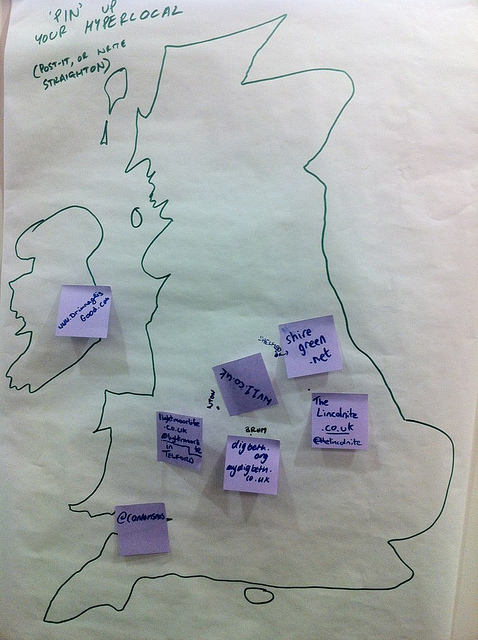
C&binet: The mice that roared. Or at least wrote some things on Post-Its.

October 30th, 2009 by Paul Bradshaw

I spent today at the hyperlocal C&binet event, organised by Creative Industries MP Sion Simon at the Department for Culture, Media & Sport. I’ve already blogged my thoughts leading up to event but thought I would add some more links and context.

For me, it is significant that this happened at all. Normally these sorts of events are dominated by large publishers with lobbying muscle. Yet here we had a group combining hyperlocal bloggers, successful startups like Facebook, Ground Report, Global Voices and the Huffington Post, social media figures like Nick Booth and Jon Bounds, and traditional organisations like The Guardian, BBC, RSA and Ofcom. Jeff Jarvis pitched into the mix via Skype.

As for the event itself, it began the previous afternoon with a presentation from Enders Analysis, embedded below: [Read more]

Paul Bradshaw
Help us map local blogs

August 12th, 2009 by Paul Bradshaw

Matt Wardman and I are trying to put together a map of UK blogs. Please help by entering any you know in the form below.

Next,