Monthly Archives: March 2009

Online journalism in Uruguay

Maite Fernandez provides an overview of how news organisations have taken to the web in Uruguay

In Uruguay there are nearly 50 information websites, of which only five are considered as the main competitive news websites in Uruguay:


Two of them are part of newspaper companies (El Pais.com and Observa.com), one is from a news radio company (El Espectador.com), and the other two are independent. 180.com.uy started last October.

I studied El Pais.com, comparing it to the Argentinian news website Clarin.com. I’ve found that, in general, news companies in Uruguay do not yet see the Internet as a field to invest in, and they still invest money and hire employees for the paper publication (in the case of websites that come from newspapers). Continue reading
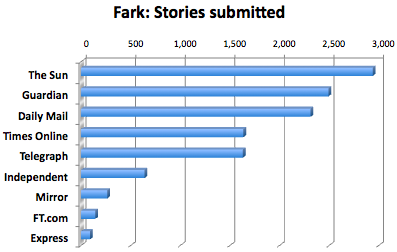
It’s the Sun wot won it at Fark

The Sun has had more stories submitted to Fark, the social news site for stranger news stories, than any other UK newspaper. That may be no surprise, but it’s the Guardian wot’s runner up.

The news follows the discovery that the Guardian is top at Reddit, the Times at StumbleUpon, and the Telegraph at Digg.

The graph is based on an analysis of the total submissions for each newspaper site to Fark. It shows that, just as with those other social news sites, the FT, Mirror and Express are trailling in last.

Sun winning at Fark, Guardian second

Sun winning at Fark, Guardian second

NewsCred founder Shafqat Islam about startups and the future of media

While everybody in journalism is wondering how the future of media looks like, entrepreneurs try to shape it. They develop new products and services that maybe could be the next big thing in journalism. OJB asks those entrepreneurs three simple questions in a series of interviews. First up: Shafqat Islam from NewsCred.

For everyone who has never heard of NewsCred: it’s an online platform that aggregates articles from lots of media – newspapers, magazines, blogs. NewsCred users can build a personalised online newspaper by selecting media and topics they want to read from and about. Continue reading

#twask : Help teach twitter

If you have a few minutes to spare this afternoon, log in to Twitter and look for the hashtag #twask. What is #twask? Well, anyone wanting to ask a question about Twitter can use the tag – and anyone answering those questions can do the same.

Questions find answers.

Hopefully.

The whole thing is the idea of final year journalism degree student Kasper Sorensen, who wanted to help online journalism students find their feet on Twitter. I think it’s pretty great. Read more at his site.

A possible explanation for blogging’s appeal as ‘Estate 4.5’

Here’s a quote from Peter Wilby in The Guardian on why most UK newspapers ignored the News of the World hacking story:

What accounts for this reluctance to run with stories that involve the highest circulation UK paper, the world’s biggest media corporation and a key aide to the possible next prime minister? First, newspapers prefer to ignore each other’s exclusives if they can. Second, they observe the rules of “mutually assured destruction”: like nuclear powers, they don’t attack the enemy for fear of retaliation. Indeed, News International and the Telegraph agreed a sort of test ban treaty in 2007 when the latter’s owners, the Barclays, withdrew a libel claim against the Times. Third, if Coulson becomes Cameron’s press aide in Downing Street, he will become a vital source of political information.

Above all, journalists prefer to keep the plumbing of their trade – the unglamorous details of how they obtain information – out of public scrutiny.

So while the ‘Fourth Estate’ holds power to account and has become increasingly powerful themselves in turn, this ‘test ban treaty’ not to hold each other to account has created a power vacuum of sorts – so it’s no surprise that blogs seem to have taken on the mantle of ‘Estate 4.5‘ with glee and no small amount of success.

And the complaints of some journalists when bloggers ‘Fact check your ass’ come to sound strangely similar to politicians that complain the media are undermining the public’s faith in democracy, or restricting their ability to focus on running the country…

h/t Adrian Monck