
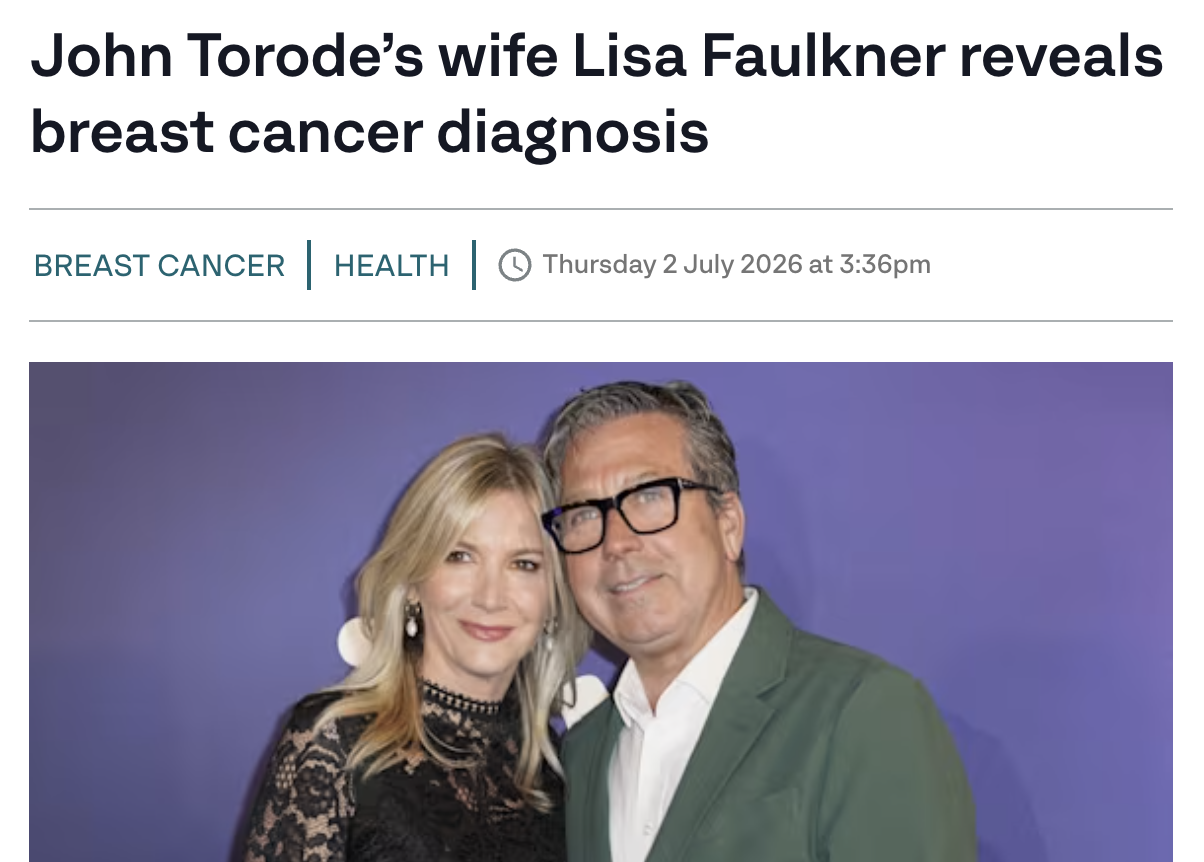
The latest “wife of” headline — ITV News’s report on the actor Lisa Faulkner revealing that she has undergone surgery after a cancer diagnosis — is an opportunity to get journalism students exploring how different forms of bias might shape news reporting — and not just the obvious ones.
An opening question might be why a reporter or editor would put another person’s name at the front of the headline “John Torode’s wife Lisa Faulkner reveals breast cancer diagnosis”.
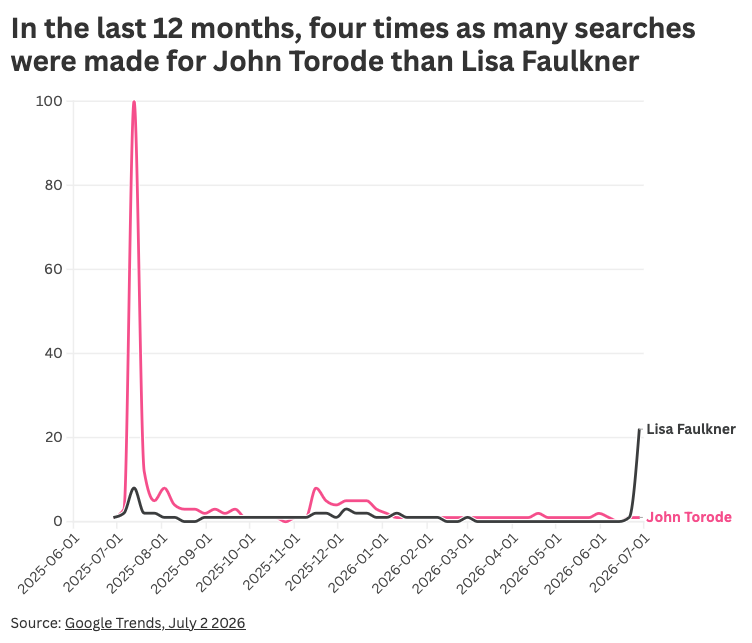
A male-dominated newsroom might be one answer. Another might be a newsroom that is more likely to watch a middle-class cooking programme (Masterchef) than a working-class soap opera (Eastenders). It might also be driven by search analytics: four times as many searches were made for Torode in the last 12 months than Faulkner.
Search analytics are closely related to bias around news values: why, for example, might reporting lead on “Taylor Swift’s boyfriend” or “Nicole Kidman’s husband” instead? How do news values come into play with Amal Clooney or Meghan Markle or The Chicago Tribune leading on the bronze medal-winning “Wife of a Bears’ lineman“? And how do they intersect with other forces?
Increasingly, there will also be the potential for algorithmic bias: might the headline have been AI-generated or -selected? What training data might have informed that? Could A/B testing have shaped it?
A role may be played by cognitive bias too: the availability heuristic means people are more likely to connect new information with what happened most recently and was most widely reported (e.g. John Torode’s sacking, responsible for the spike in searches at the start of that chart above).
It’s important to emphasise that no one escapes the trap of cognitive biases, either: an opportunity for reflection around confirmation bias can do this. Compare the initial reaction to the headline (did it ‘confirm’ existing assumptions?) with the potential for a more complex picture with multiple social and cultural forces at work.
The point here is not what the ‘real’ cause of the headline was: it’s that confirmation bias prevents us from exploring counter hypotheses or less simple explanations before drawing that conclusion.
Each of those biases is a force to name and address, in both critical and practical terms. We can ask what forces act to introduce bias into reporting, and at what levels (individual, team, culture, technology, audience, institution, business model)? What is considered best practice in this area? How should journalists balance chasing search traffic with their duty to avoid prejudice, to be objective and accurate? How do we design prompts to avoid (or identify) bias? How do we recruit or source in ways that reduce the opportunities for bias? And how do we slow down to prevent cognitive biases driving our behaviour?

