Author Archives: Paul Bradshaw

Unknown's avatar

About Paul Bradshaw

Paul teaches data journalism at Birmingham City University and is the author of a number of books and book chapters about online journalism and the internet, including the Online Journalism Handbook, Mobile-First Journalism, Finding Stories in Spreadsheets, Data Journalism Heist and Scraping for Journalists. From 2010-2015 he was a Visiting Professor in Online Journalism at City University London and from 2009-2014 he ran Help Me Investigate, an award-winning platform for collaborative investigative journalism. Since 2015 he has worked with the BBC England and BBC Shared Data Units based in Birmingham, UK. He also advises and delivers training to a number of media organisations.

What are we talking about when we say the “ethics” of AI and journalism?

A path forking into three
There are three broad paths in ethics. Image by pfly CC BY-SA 2.0

Many people — including me — are quite uncomfortable with generative AI. Most of this discomfort can be traced to the various ethical challenges that AI raises. But an understanding of the different schools of ethics can help us both to better address those challenges and what to do about them.

Three different ethical approaches

The first thing to say about the ethics of AI is that there is no single ‘ethics’. When we engage with ethical issues there are typically at least three different systems that might be in play:

Continue reading

The Art of Disagreement — lessons for journalists

Why Are We Yelling?
Learn the life-changing art of productive disagreement.

Journalists are no strangers to disagreement: the job regularly involves reporting on conflicts, putting one party’s point of view to another, or engaging with audience challenges around bias and veracity.

So I was curious whether Buster Benson’s book, Why Are We Yelling? The Art of Disagreement, might have some lessons to offer for reporters.

Spoiler alert: I think it does.

Continue reading

Niamh McIntyre: tips from a career in data journalism

Niamh McIntyre

The Bureau of Investigative Journalism’s Big Tech Reporter Niamh McIntyre has been working with data for eight years — but it all stemmed from an “arbitrary choice” at university. She spoke to MA Data Journalism student Leyla Reynolds about how she got started in the field, why you don’t need to be a maths whizz to excel, and navigating the choppy waters of the newsroom. 

Starting out on any new path can be daunting, but in the minutes before my phone call with Niamh McIntyre, I’m acutely aware that upping sticks to Birmingham and training in data journalism at the grand old age of 29 is nothing less than a tremendous luxury.

A younger me might have — would have — quaked at such a scenario, so I’m keen to know more about Niamh’s work, which ranges from investigating the gig work industry to private children’s homes.

Continue reading

VIDEO: Developing ideas for factual storytelling

Strong factual storytelling relies on good idea development. In this video, part of a series of video posts made for students on the MA in Data Journalism at Birmingham City University, I explain how to generate good ideas by avoiding common mistakes, applying professional techniques and considering your audience.

The links mentioned in the video include:

Related post: Here’s how we teach creativity in journalism (and why it’s the 5th habit of successful journalists)

Identifying bias in your writing — with generative AI

Applications of genAI in the journalism process 
Pyramid with the third 'Production' tier highlighted: 

Identify jargon and bias; improve spelling, grammar, structure and brevity

In the latest in a series of posts on using generative AI, I look at how tools such as ChatGPT and Claude.ai can help help identify potential bias and check story drafts against relevant guidelines.

We are all biased — it’s human nature. It’s the reason stories are edited; it’s the reason that guidelines require journalists to stick to the facts, to be objective, and to seek a right of reply. But as the Columbia Journalism Review noted two decades ago: “Ask ten journalists what objectivity means and you’ll get ten different answers.”

Generative AI is notoriously biased itself — but it has also been trained on more material on bias than any human likely has. So, unlike a biased human, when you explicitly ask it to identify bias in your own reporting, it can perform surprisingly well.

It can also be very effective in helping us consider how relevant guidelines might be applied to our reporting — a checkpoint in our reporting that should be just as baked-in as the right of reply.

In this post I’ll go through some template prompts and tips on each. First, a recap of the rules of thumb I introduced in the previous post.

Continue reading

How to improve story ideas using the SCAMPER method

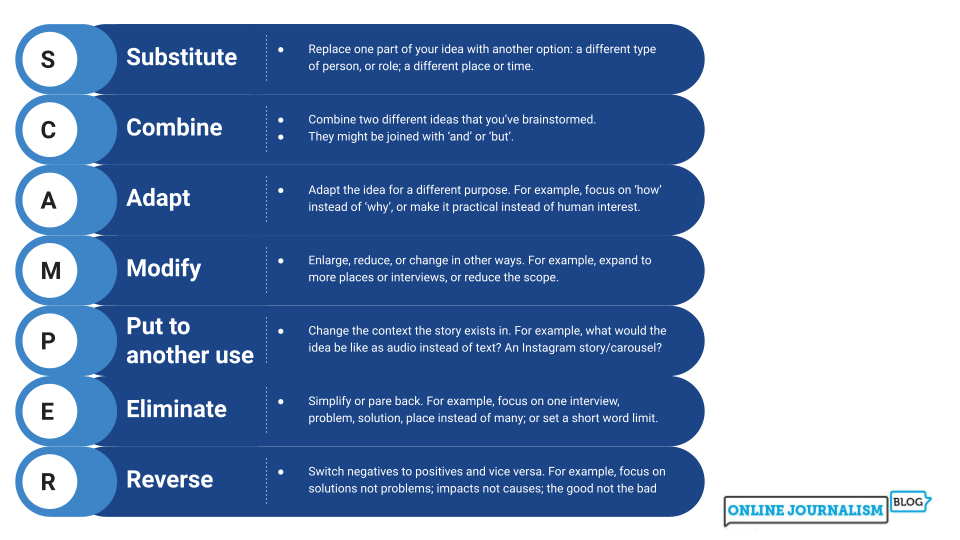
SCAMPER: Substitute, Combine, Adapt, Modify, Put to another use, Eliminate, Reverse

One of the techniques that can be used to come up with more creative story ideas is the SCAMPER method.

SCAMPER is a mnemonic for seven different actions that can be applied to ideas in order to improve those ideas or generate more interesting alternatives. It is a technique adapted from design and engineering circles — but with just a little thought it can be applied to journalism too.

Continue reading

Using generative AI to help review your reporting: subbing, jargon, brevity and factchecking

Applications of genAI in the journalism process 
Pyramid with the third 'Production' tier highlighted: 

Identify jargon and bias; improve spelling, grammar, structure and brevity

In the fifth of a series of posts from a workshop at the Centre for Investigative Journalism Summer School, I look at using generative AI tools such as ChatGPT and Google Gemini to help with reviewing your work to identify ways it can be improved, from technical tweaks and tightening your writing to identifying jargon.

Having an editor makes you a better writer. At a basic level, an editor is able to look at your work with fresh eyes and without emotional attachment: they will not be reluctant to cut material just because it involved a lot of work, for example.

An editor should also be able to draw on more experience and knowledge — identifying mistakes and clarifying anything that isn’t clear.

But there are good editors, and there are bad editors. There are lazy editors who don’t care about what you’re trying to achieve, and there are editors with great empathy and attention to detail. There are editors who make you a better writer, and those who don’t.

Generative AI can be a bad editor. Ensuring it isn’t requires careful prompting and a focus on ensuring that it’s not just the content that improves, but you as a writer.

Continue reading

Using generative AI as a scraping assistant

Applications of genAI in the journalism process 
Research
Pyramid with the second 'research' level highlighted: Scope diverse sources, explore documents, form advanced searches, and write/fix code for scraping and analysis
Scraping is part of the research phase of a project

In the fourth of a series of posts from a workshop at the Centre for Investigative Journalism Summer School (the first part covered idea generation; the second research; the third spreadsheets), I look at using generative AI tools such as ChatGPT and Google Gemini to help with scraping.

One of the most common reasons a journalist might need to learn to code is scraping: compiling information from across multiple webpages, or from one page across a period of time.

But scraping is tricky: it requires time learning some coding basics, and then further time learning how to tackle the particular problems that a specific scraping task involves. If the scraping challenge is anything but simple, you will need help to overcome trickier obstacles.

Large language models (LLMs) like ChatGPT are especially good at providing this help because writing code is a language challenge, and material about coding makes up a significant amount of the material that these models have been trained on.

This can make a big difference in learning to code: in the first year that I incorporated ChatGPT into my data journalism Masters at Birmingham City University I noticed that students were able to write more advanced scrapers earlier than previously — and also that students were less likely to abandon their attempts at coding.

You can also start scraping pretty quickly with the right prompts (Google Colab allows you to run Python code within Google Drive). Here are some tips on how to do so…

Continue reading

Using generative AI as a spreadsheet and data cleaning assistant

Applications of genAI in the journalism process 
Research
Pyramid with the second 'research' level highlighted: Scope diverse sources, explore documents, form advanced searches, and write/fix code for scraping and analysis
Spreadsheet analysis is part of the research phase of a story

Generative AI tools like ChatGPT and Gemini can be a big help when dealing with data in spreadsheets. In this third of a series of posts from a workshop at the Centre for Investigative Journalism Summer School (the first part covered idea generation; the second research), I outline tips and techniques for using those tools to help with spreadsheet formulae and reshaping data.

Whether you come across data as part of story research, or compile data yourself, chances are that at some point you will need to write a formula to ask questions of that data, or make it possible to ask questions (such as creating a column which extracts data from another).

If you find yourself coming up against the limits of your spreadsheet knowledge, then genAI tools can be useful both in breaking through those — while expanding your knowledge of functions and formula writing.

Writing spreadsheet formulae with ChatGPT or other genAI tools

Continue reading

Investigative journalism and ChatGPT: using generative AI for sourcing and story research

Applications of genAI in the journalism process 
Research
Pyramid with the second 'research' level highlighted: Scope diverse sources, explore documents, form advanced searches, and write/fix code for scraping and analysis
Generative AI can be used at all points in the journalism process: this post focuses on the research stage

In the second of a series of posts from a workshop at the Centre for Investigative Journalism Summer School (read the first part on idea generation here), I look at using generative AI tools such as ChatGPT and Google Gemini to improve sourcing and story research.

Research is arguably the second-highest risk area (after content generation) for using generative AI within journalism. The most obvious reason for this is AI’s ability to make things up (“hallucinate“) — but there are other reasons too.

Continue reading