Category Archives: online journalism

How easy is it for your readers to tip you off?

Here’s a case study in making it easy for your readers to tip you off.

Earlier today I was sent a link to a YouTube clip of former Bolton Wanderers and Villa midfielder Sasa Curcic, made up of clips from the Serbia, Bosnia and Herzegovina and Montenegro version of Celebrity Big Brother, in which he was competing.

A quick Google later, and I discover that not only has he been competing – he actually won the thing this week.

Spotting a quirky story when I see it, and being the nice journalist that I am, I decided to inform the Bolton News and the Birmingham Mail – but through their websites rather than through personal contacts.

The difference in accessibility is interesting: the Bolton News make it easy for people to contact them, with a range of contacts on a ‘Contact Us’ page. The Birmingham Mail, on the other hand, is not so straightforward. Being part of the ‘icBirmingham’ site means you have to drill down to the Mail section, and then the less obvious ‘About Us’ page.

So I email both sports editors, and see what happens.

Within three hours, the Bolton News has a story up – ‘Former Wanderers star wins Big Brother‘. The Birmingham Mail… well, I wait with bated breath.

So, two lessons: have a very obvious ‘contact us’ link on your news site – and secondly: when you report a tip-off story like this, credit the tipster at the end*, or send an email to let them know their tip was appreciated. If you’re looking to engender a sense of community, and build relations, you need to give something back to reinforce that behaviour.

*UPDATE: Turns out I was credited – on another page. Thanks to Chris Sudlow for letting me know (see comment), and credit for being savvy enough to monitor incoming links.
Speech to Trinity Mirror Midlands

I’ve been at it again. Last night I presented a speech to editors and ad directors at Trinity Mirror Midlands (Birmingham Mail and Post, Coventry Telegraph, Sunday Mercury and various weeklies throughout the region). Given that they’d been exploring digital ideas all day I tried to keep it light to begin with – so the linked Powerpoint below begins with a mock awards, with the more hard hitting stuff coming after.

The hard-hitting stuff consists of lots of pithy phrases – the headlines were:

  • It’s no longer about content, it’s about services
  • It’s no longer about publishing, it’s about communication

I talked about how the news industry is having to shift from a 19th century production-based system to a 21st century service-based industry, and how online advertising alone is not going to plug the gap left by dropping print revenues (a number of new business models are covered that may provide other sources of revenue).

And I tackled this common phrase that the newspaper is now ‘one of many channels’. I think that’s still a ‘broadcaster’ mindset, and that instead we should think of print as ‘one way of helping people communicate’.

And I revisited some of the elements from my Vienna speech about the strengths that journalism needs to play to: investigative journalism, database-driven journalism, interactive journalism, and multimedia journalism; and reader-driven forms such as wikis and crowdsourcing.

Here’s the PowerPoint. Comments welcome.

Speech to Trinity Mirror Midlands

Speech to the 8th Vienna Globalisation Symposium

Last week I was in Vienna speaking to the most diverse audience I’m ever likely to address: 120 or so people from organisations including the European Commission, Amnesty International, the European Space Agency, the United Nations, Princeton University and the World Trade Organisation, as well as students from universities in Serbia, Ukraine, Italy, Poland, Germany, Austria, and America.

They were there to attend the Vienna Globalisation Symposium, and I was speaking as part of the first panel, on ‘Web 2.0: The return of the internet’. The topic of the presentation was Blogs and journalism – click on the link for the Word document. It’s 15-20 minutes long. I may upload audio and/or video later.

Guardian wins the Blair coverage battle

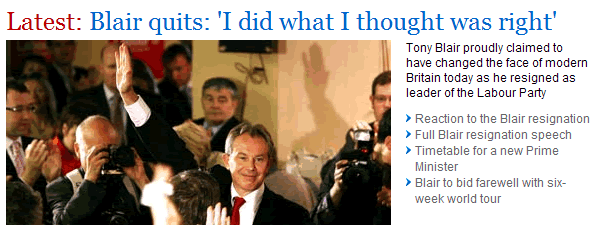
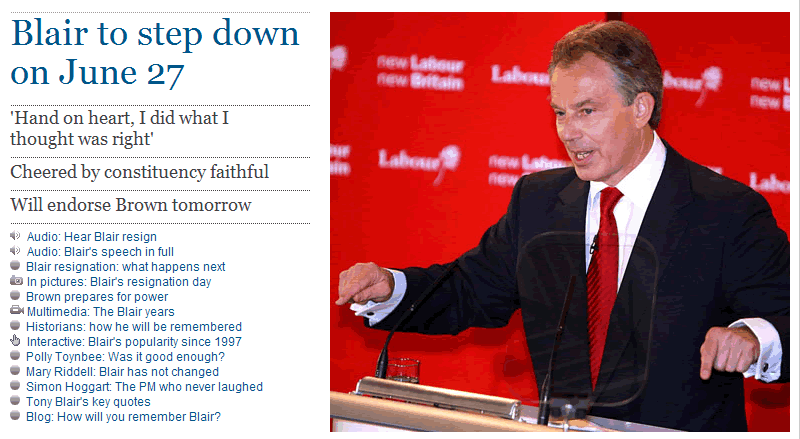
Blair resignationThe Guardian’s new site has gotten off to a great start, with impressive coverage of the Blair resignation. Alongside the main story is lengthy promotion of audio, galleries, video, interactive and analysis. The depth of treatment backs up Mark Porter’s point that the new design “allows us to respond dynamically to events, by varying the layout as the news agenda develops.”
Blair resignationThe Telegraph’s treatment is much smaller, giving the impression of less depth…
Blair resignation…and The Times is pretty similar. The tabloids’ treatment is even smaller, although their editorial agenda is obviously different.
Blair resignationSky is worth a look, though- their new design gives the capability to add a story to the main navigation – so ‘The Blair Years’ becomes an option alongside ‘Sport’. This is a screengrab of the Blair Years page, not the homepage.

What makes a good Podcast…tips and tricks

Steve Hill picks apart The Sony Radio Academy Awards podcast award comments for the following tips:

1. Have “pace and energy”
2. Capture “the intimacy of internet radio”
3. Choose a niche which would “never be accommodated on a mainstream radio station”
4. “First-class radio production techniques”
5. “Have an intelligent and witty tone”

Why can’t newspapers get linking right?

Most newspapers have had websites for a decade now. They’ve gone from shovelling print content onto a webpage to hosting video bulletins and podcasts, blogs and galleries, and even social networking.

And yet they still can’t seem to get one thing right: linking.

Take one basic story from this weekend that’s very close to my heart: the resignation of Bolton Wanderers boss Sam Allardyce. The club announced the resignation on Sunday afternoon with two statements: one from the chairman, and one from Sam himself. The coverage in most newspaper websites at the time consisted, essentially, of extracts from those statements plus a little history from the journalist. It was clear there was no extra information to be had.

In a story like this – bread-and-butter press release/statement material that fills a large proportion of newspapers and news websites – you would expect a link to the original material. Yes..? Well here’s a rundown:

So much for the new transparency in online journalism. So much for linking to your sources – or, indeed, to anything outside of your own site. So much for Jeff Jarvis’ column this week that argues “during big news stories … the role of the journalist now [is] to link, it seems.”

Linking is, of course, central to the web. It is the point. There was a period, years ago, when some website owners were afraid of including external links because they feared people would leave their site. Then they realised that links are a selling point of your site: your ability to provide helpful links elsewhere is part of what brings people to your site in the first place.

It’s one of the reasons blogs are so popular: they link profusely, habitually, and easily. And people come back again and again for more.

So please, stop pretending you’re some great newshound with access to the chairman and manager of Bolton Wanderers. You read the statements on a website we can all access. Save us the trip to Google and give us the links, please. Then we might just come back next time for more.

ABCNews.com relaunches with citizen journalism

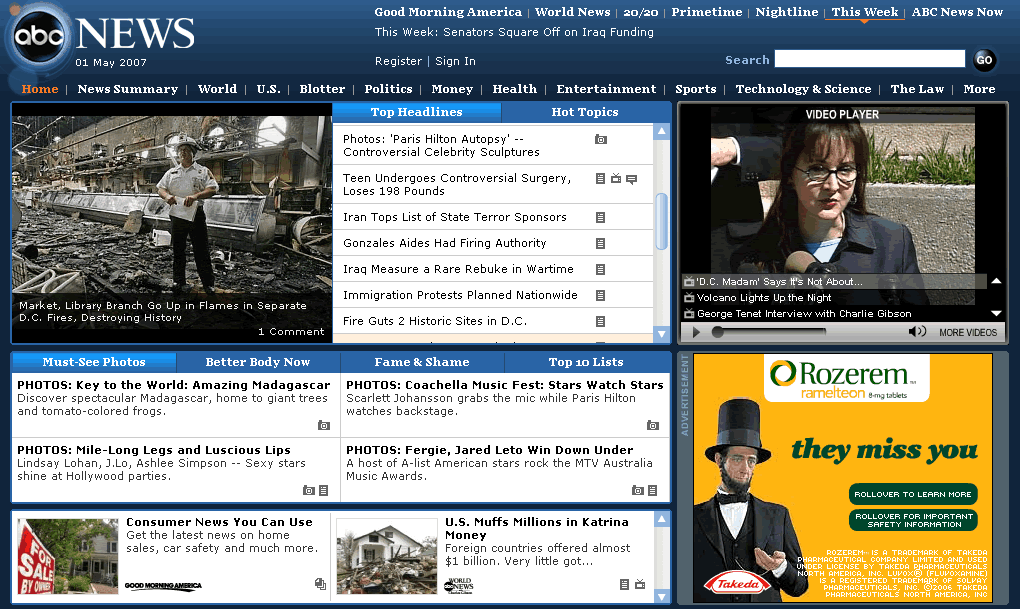
ABC News May 1 07Another day, another relaunch. Micro Persuasion reports on the ABCNews.com relaunch:

According to Michael Clemente, Senior Executive Producer, the new site, which it launched last night, is designed to harness the power of what they call “citizen reporters.” Viewers and readers can now help ABC help report the news by feeding in news and leaving comments. The new site also supports video uploads from cell phones and video cameras, some of which will make it on to air.”

It’s pretty snazzy looking, if a little overloaded with navigation. The option to click on a story or photos or video or even ‘full coverage’ is a nice touch, but it’s a missed opportunity for the most part when compared to other relaunches.

The video journalist’s next purchase

Flip VideoThe New York Post reports on a clever (and relatively inexpensive) device which allows videographers to film, edit and upload material without spending large amounts of time on a computer:

“The little spy-corder device, named Flip Video, is being billed as the first camcorder to upload directly to sites such as YouTube and Grouper – eliminating the step of putting video on a computer to edit before uploading.”

At $119 and $149 it’s clearly aimed at the consumer market, but the instant publishing element makes it an appealing buy for journalists, although it seems you still need to go onto a computer to ‘instantly’ upload to the web.

Here’s the press release.

Stop asking me “Is blogging journalism?”

As students around the world scramble for final quotes for their dissertations, I’ve had to answer the same inane question three times in a week. Here’s my response for anyone thinking of emailing/phoning/doorstepping me for theirs:

Q: Do you consider blogging a form of journalism? Why or why not?

A: Is television a form of journalism? Are words on a page a form of journalism? Are sounds a form of journalism? Blogs are a platform. They can contain journalism, just as TV, radio and print can. Many bloggers practice journalism, many do not. To ask if blogging is a form of journalism is to confuse form with content.

Q: Professional journalists are taught the principles and ethics of their profession. Since a lot of bloggers are not professional journalists, how do you think blogging can be made more credible?

A: Firstly, not all professional journalists are taught the principles and ethics of their profession. Secondly, many journalists ‘forget’ or have those teachings are ‘overwritten’ by professional experience. And thirdly, professional journalists do not have exclusive rights to principles and ethics – in fact, one of the reasons for the explosion in blogs is a perception that professional journalists lack principles and ethics (in the UK few professions are seen as less trustworthy and they are trusted even less than politicians). Some of the best bloggers represent the most principled and ethical journalists you will read – for instance, their refusal to accept advertising on the basis that it might undermine the credibility of what they write.

Blogging can gain more credibility through one thing: time. Many blogs already have strong credibility because they have built a reputation over time, just as news products on other platforms have. I also notice that a lot of blogs have begun looking for more first hand material and doing more analysis as the individual bloggers have gained in confidence, experience, ability and contacts – which again has increased credibility. Just as some newspapers suffer from credibility issues (e.g. tabloids) and some have strong reputations for credibility, over time you would expect some blog ‘brands’ to build credibility and others to suffer damaging exposes. Some blogs will also gain credibility through association with more established brands such as mainstream news operations – and in fact, many already do.

By the way, you might want to check out Chambers’ definition of journalism – “the profession of writing for newspapers and magazines, or for radio and television” – which settles it: blogging is not journalism.

But hold on, here’s G. Stuart Adam’s rather more scholarly definition (PDF):

“Journalism is an invention or a form of expression used to report and comment in the public media on the events and ideas of the here and now. There are at least five elements in such a definition: (1) a form of expression that is an invention; (2) reports of ideas and events; (3) comments on them;(4) the public circulation of them; and (5) the here and now.”

If the definition of journalism bothers you so much, I strongly recommend you read the rest of his paper.