Category Archives: online journalism

Here are 7 story types that can be used to help organise investigations

7 story types and investigations

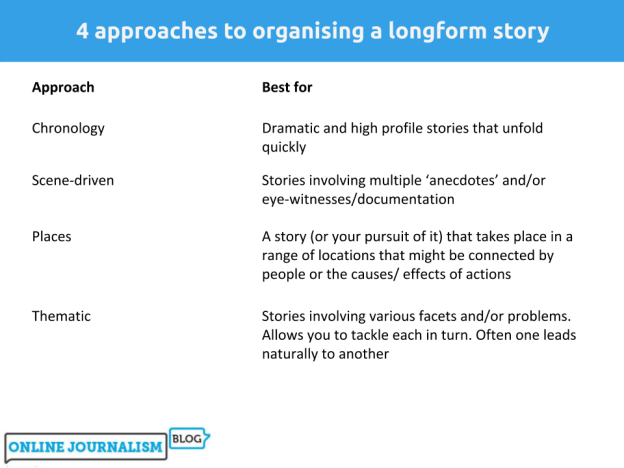
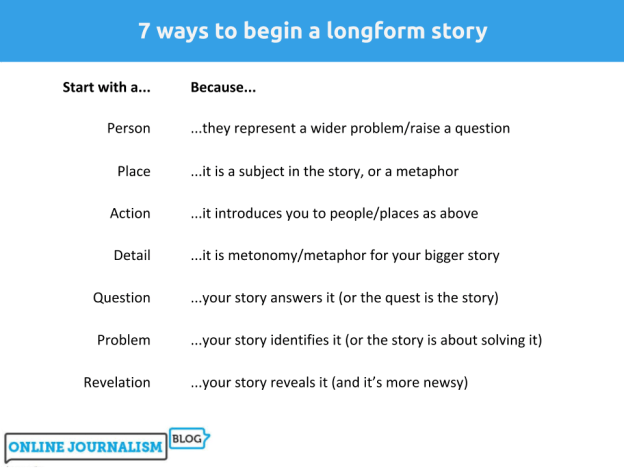
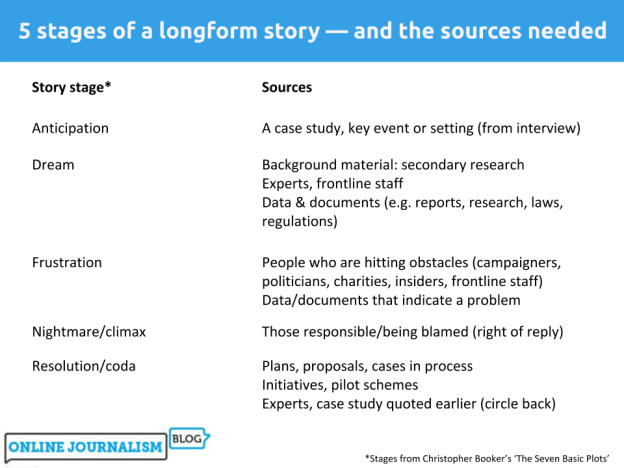
This year I’ve been working with my MA Data Journalism and MA Multiplatform and Mobile Journalism students on techniques for telling longer form stories. In this post I explain how a consideration of seven common plot types can help you clarify what story it is you’re telling – and what you might need to tell that.

There are many ways to tell a story, and many stories to tell. An investigation can be trying to establish the cause of a problem, or solutions to that problem; it can be revealing previously hidden unethical behaviour, or shining a light on issues which are ‘hidden in plain sight’; it can be holding a mirror up to a part of society to reveal its scale; or giving a voice to that part of society as a step towards a more sophisticated understanding of problems affecting it. And depending on the type of story, you might adopt different approaches to telling it. Continue reading

FAQ: What are the essential computational skills that a journalist should develop?

Blue skyscrapers

Recognising patterns is a key skill in computational journalism (image by Stanley Zimny)

This latest group of frequently asked questions comes from an interview with Source, published here in full just in case it’s — you know — useful or something…

1. What are the essential computational skills that a journalist should develop?

Firstly, an ability to recognise patterns, or structured information. Spreadsheets are explicitly ‘data’ but some of the most interesting applications of computational journalism are where someone has seen data where others don’t.

Continue reading

GEN 2019 round-up: 4 videos to watch on the potential of data and AI

Krishna Bharat

This year’s Global Editor’s Network (GEN) Summit, in Athens, Greece, had a big focus on the use of verification and automation. BBC News data scientist and PGCert Data Journalism student Alison Benjamin went along to see what was being said about artificial intelligence (AI), data and technology in the news industry. Here are her highlights…
Continue reading

FAQ: How has social media changed journalism – and what does the future hold?

tools on a shed wall

Tools image by Lachlan Donald

This latest set of frequently asked questions comes from a MA student at Coventry University who is researching Instagram. Their questions revolve around the impact of social media on journalism and Instagram in particular.

How are the new social media apps changing the way journalism is produced, distributed and consumed?

There’s a lot of scope in that question so in breaking it down it’s firstly worth making a distinction between apps (i.e. tools, used by producers to capture, publish and share) and platforms (i.e. a place where content is hosted).

So for example Instagram is a platform that hosts content which can be accessed on a tablet, or on mobile, or a desktop or laptop computer, but can also be published to through an app on mobile or tablet. Continue reading

I’m holding a taster day for anyone interested in studying data or multiplatform journalism (part time or full time)

MA journalism taster day

I’ll be holding a special ‘Taster Day’ on June 11 for anyone interested in studying journalism at postgraduate level — specifically data journalism (which includes a part time PGCert option for those already working in the industry) and multiplatform journalism (full time only).

  • In the morning (10am-12.30pm), I will be running a taster of the MA and part time PGCert courses in Data journalism. I’ll be covering introductory data journalism techniques and also discussing some tips, tricks and trends to watch out for
  • In the afternoon (2pm-4.30pm), I’ll be hosting a taster session of the MA in Multiplatform and Mobile Journalism. This will cover reporting news for multiplatform audiences, and how to use mobile journalism to report stories

I’ll be making time in both sessions for questions and discussion about postgraduate study and developments in journalism.

If you are interested in attending either event, please sign up on the Eventbrite page here. Drop me a line on Twitter @paulbradshaw or email paul.bradshaw@bcu.ac.uk if you have any questions!

From making data physical to giving journalists confidence (and a few other things too): Data Journalism UK 2019

marie segger at data journalsm uk 19

Last week saw the third Data Journalism UK conference, an opportunity for the country’s data journalists to gather, take stock of the state of the industry and look at what’s ahead.

The BBC Shared Data Unit’s Pete Sherlock kicked off the event, looking back at the first 18 months of the unit’s existence. In that period the unit has trained 15 secondees and helped generate over 600 stories across more than 250 titles in the regional press.

Sherlock highlighted two stories in particular to demonstrate how the data unit had helped equip regional reporters in holding power to account: the Eastern Daily Press’s Dominic Gilbert‘s story on legal aid deserts, and JPI Media’s Aimee Stanton‘s report on electric car charging points.

Both stories resulted in strong pushback – from the Ministry of Justice and the electric car industry respectively – but their new data journalism skills gave them the confidence to persist with the story. Continue reading

I’m organising a data journalism conference next month (come!)

data journalism uk 2018

The Guardian, Times, BBC, Telegraph and Reach (formerly Trinity Mirror) will all be speaking at the third Data Journalism UK conference on May 3 at the BBC in Salford.

Tickets are available here including early bird and afternoon-only options. There are also bursaries available for people on low incomes or from under-represented groups.

As well as industry panels there will be practical sessions to help skill up in data journalism.

The event has sold out in its first two years, so it’s worth booking early if you can. Continue reading

Data journalism tips in Albanian (Të gjesh histori në faqet e Excel-it)

Data journalism book Stories with Spreadsheets

I spent some time recently in Albania delivering some training in data journalism to journalists. While I was there, the translator Ermal Como translated two chapters of my data journalism book Finding Stories in Spreadsheets, and a 14-page cribsheet for Excel formulae, into Albanian.

In addition, there is an exercise on learning spreadsheet techniques by finding stories in European Investment Bank data.

With his permission I’ve made the three documents available for anyone who might find them useful. You can find them embedded below: Continue reading

Journalism ethics as a mobile app: why one Turkish student journalist decided to venture into game journalism

Furkan

Game journalism — using games to inform audiences about current news events — has become an established form. But few games are created to simulate the experience of journalists themselves — and even fewer still are launched while the author is still a student. In a guest post for OJB, Sania Aziz spoke to Turkish journalism student Ömer Furkan Aktaş, the creator of one such game: Ethics: Journalist’s Way. Continue reading

Kevin Anderson: “Nuzzel newsletters can help journalists build their profile and serve audiences better”

Kevin Anderson

Kevin Anderson photo by Arttu Silvast

Kevin Anderson has been working in the digital space for two decades, holding managerial roles at the BBC, the Guardian and Gannett. His online network is one of the foundations of a must-read daily email newsletter rounding up developments in the field. In a special guest post for OJB, Emily Lowes speaks to the freelance journalist and digital strategist about email newsletters and his advice for others looking to get started.

Kevin Anderson has been publishing a daily email newsletter on Nuzzel — an online service which offers news discovery and curation based on users’ interests — for over two years now. He says that Nuzzel newsletters “can help journalists build their profile and intentionally serve their audiences better”. Continue reading