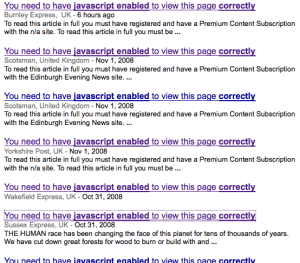
Malcolm Coles asks a reasonable question of Johnston Press Digital Publishing: have they looked at their own pages in Google News? It seems a reliance on javascript is making their pages invisible to search engines.

Malcolm Coles asks a reasonable question of Johnston Press Digital Publishing: have they looked at their own pages in Google News? It seems a reliance on javascript is making their pages invisible to search engines.

Last year I had surprising success with the Knight News Challenge, making the final shortlist of 29 before the winners were announced.
This year I’m at it again, with Help Me Investigate.com – a platform for ‘open source investigative journalism’, to be actively piloted in Birmingham, UK, but usable by anyone in the world. You can vote for it here, and read more about it.

Once you’ve done that, any ideas, useful articles or funds you could suggest would be very much welcomed.
From the Baghdad Blogger to Twittering the Chinese Earthquake, plenty has been written about the potential of blogs to allow Western readers access to foreign voices: the ‘Parachute Journalism’ of ‘Our Man in Tehran’ is appearing increasingly anachronistic and paternalistic next to the experiences and thoughts of those caught in the crossfire.
Despite this, mainstream media portrayals of countries like Iran, Syria, Egypt, Saudi Arabia, Cuba and China remains largely superficial.
This is the problem that Antony Loewenstein seeks to address with The Blogging Revolution (Amazon US) – a book which is as much about bloggers as it is a demonstration of what blogging has made possible. Continue reading
For the past 2 weeks BBC Have Your Say have been using Seesmic, Qik, Phreadz and 12seconds to invite viewer opinions. It’s clearly a slow learning process, as they try to crowbar broadcast styles into a more conversational medium. Here’s a recent post on Seesmic:
BBC Have Your Say – President Obama![]()
Here they are on Phreadz: Continue reading
I’ll be at the Society of Editors conference in Bristol on Monday. I’m promised wifi so I’ll try to Twitter away and Qik too if a suitable opportunity arises. If you’ll be there too, let me know in the comments below, or on Twitter.
Demonstrating once again why journalists should not only blog but monitor incoming links, the BBC’s response to the recent story about ‘holding back Google juice’ in its linking came to my attention as I was scanning the incoming links to this blog. John O’Donovan, Chief Architect, BBC FM&T Journalism, says “nothing sinister”, and:
“We are rolling out improvements to the way this works, as already used on some other parts of the website. Essentially we use JavaScript to retain SEO (“Search Engine Optimisation“) and Google juice for external sites, while we will still be able to track external links. Search Engines, casual observers and those without JavaScript will still see the original URL.”
That’s the question bumping around my mind after reading this post at SEObook.com:
“if you are not an AdWords advertiser, are not in universal search verticals (like news and video), and are not wikipedia, then you don’t have many organic search results that you can rank for on the first page.”
The image makes it clearer:

In some ways, blogs are better placed than ordinary websites, as Google may be indexing your blog as part of its news search. But that isn’t particularly comforting. The wider move towards mainstream results that keep you within Google doesn’t look particularly healthy.
Here’s what SEObook suggests:
The only upside? Google may be making itself less relevant, and more open to competition.
Elections bring out the best in online journalism. News organisations have plenty of time to plan, there’s a global audience up for grabs, and the material lends itself to interactive treatment (voter opinions; candidates’ stances on various issues; statistics and databases; constant updates; personalisation).
Not only that, but the electorate is using the internet for election news more than any other medium apart from television (and here are some reasons why).
PaidContent has a good roundup of various UK editors’ views, and decides blogs, Twitter and data are the themes (more specifically, liveblogging and mapping). Continue reading
Written by Wilbert Baan
Today is the day of the US elections. I don’t think we ever had a live event on the web that will get so much live coverage. This means incredible amounts of information will be published over all kind of services and social networks. Websites like Facebook, Twitter, Flickr, WordPress, Blogger and many more.
Most popular web services have programmable interfaces. These interfaces allow developers to extract information out of the system. This creates a whole new genre of storytelling: storytelling with public databases. You can aggregate the information you need and sort it the way you want.
To prove the concept I made three small mock-ups. They all use search.twitter.com to see how people voted.
When I made the first the first animation Erik Borra replied by developing the idea into something that stores the data retrieved from Twitter in a database. I made a new interface that shows a graph based on what people say they voted on Twitter. And the result is a Twitter Poll.
These three examples are not representative data, it is extracted from Twitter. But it shows you how much personal and valuable information is in the public database. All you have to do is ask yourself what you want to tell to your readers and if this information is available.
I voted
This animation gets the latest twitter message where someone says they voted on McCain or Obama. It automatically refreshes. Continue reading