Tag Archives: accessibility

Visualisation as an editorial process

In the second part of this extract from a book chapter in the new Routledge Companion to Visual Journalism, I look at the editorial processes involved in data visualisation, along with the ethical considerations and challenges encountered along the way.
Decisions around what data to visualise and how to visualise it involve a range of ethical considerations and challenges, and it is important to emphasise that data visualisation is an editorial process just as much as any other form of factual storytelling.

Journalists and designers employ a range of rhetorical devices to engage an audience and communicate their story, from the choice of the chart and its default views or comparisons, to the use of colour, text and font, and animations and search suggestions (Segel and Heer 2011; Hullman & Diakopoulos 2011).

Chart types are story genres

The chart that a journalist chooses to visualise data plays a key role in suggesting the type of story that is being told, and what the user might do with the data being displayed.

If a pie chart is chosen then this implies that the story is about composition (parts of a whole). In contrast, if a bar chart is used then the story is likely to be about comparison.

Line charts imply that the reader is being invited to see something changing over time, while histograms (where bars are plotted along a continuum, rather than ranked in order of size) invite us to see how something is distributed across a given scale.

Scatterplots — which plot points against two values (such as the cancer rate in each city against the same city’s air pollution) — invite us to see relationships.

Continue reading
The third edition of the Online Journalism Handbook is now out!

The online journalism handbook: skills to survive and thrive in the digital age, by Paul Bradshaw

A new, third, edition of the Online Journalism Handbook is now out.

A comprehensive update to the 2017 second edition, it sees the addition of a new chapter on writing for email and chat.

There are new sections on formats from scrollytelling and charticles to threads, vertical Stories, social audio and audiograms, plus advice on how to use gifs, memes and emoji professionally as a journalist.

One notable development of the last few years reflected in the book is the improvement in accessibility provision — which is covered alongside techniques for better inclusivity and diversity in journalism practice.

Developments around harassment and online abuse, misinformation, news avoidance, and trust are all covered — and, of course, the impact of the pandemic on journalistic practices, including remote interviewing tips.

I’ll be publishing extracts and the material I had to leave out (it’s 20,000 words longer than the last edition) in the coming months.

“This is him here”: Laura Kuenssberg and the ethics of social linking

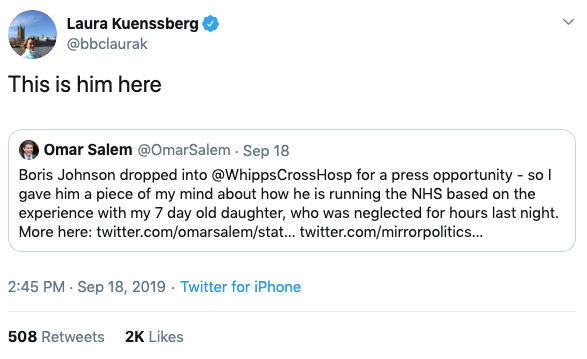
This is him here

This week Twitter got angry.

Again.

It was angry because BBC political editor Laura Kuenssberg identified the father of a sick baby who confronted the prime minister as a political activist, embedding one of his tweets in her own.

Then it was angry because people were attacking a journalist for doing her job.

Somewhere between the heated accusations and counter-accusations, however, there was an important lesson to be learned — and a reasonable discussion to be had.

It is a lesson about understanding very different online cultures, about new journalistic practices, and an emerging  dimension of journalistic ethics that few reporters have truly gotten to grips with. Continue reading

Removing Nofollow on blog links and meta – and invisible comments

A couple months ago I installed a plugin on the blog that meant search engines would index links in comments: by default WordPress uses ‘nofollow‘ on comments to stop spammers abusing them to boost search engine rankings, but that prevents genuine commenters getting credit for their contributions.

One problem: as one commenter pointed out, the blog as a whole was set to ‘noindex-nofollow’ “which equals a no trespasing sign for search engines for ALL of the site’s links. It’s Google suicide.” Continue reading

Are your comments invisible? How about your website?

If your news organisation uses javascript for its comments, or for any other part of the site, you may well be advised to start doing some testing.

Malcolm Coles, the Editor of Which.co.uk, has been highlighting some of the problems with the technology for search engine optimisation and accessibility (the two are often closely related) on his blog. Continue reading

Listen to this blog’s posts

So I signed up to automatic podcast generator Odiogo. The result: a podcast feed for all of my posts. Useful for accessibility – and recommended on that basis if nothing else. The automated reading of posts is surprisingly natural. But one big problem: because I use the <more> strip in WordPress to prevent my homepage being dominated by lengthy posts, this also truncates the feed, and so the audio only runs to that point.

UPDATE: Some tips were given below, plus an email from Odiogo themselves as follows:

some WordPress plugins such as DualFeeds or CopyFeed  create a full RSS feed, including the text after the more tag.

“Please note that these plugins have not been tested by Odiogo – we don’t know if they are compatible with WordPress.com and cannot be held responsible if they cause any issue to your blog.