Tag Archives: facebook

20 recent hyperlocal developments (June-August 2011)

Ofcom’s Damian Radcliffe produces a regular round-up of developments in hyperlocal publishing. In this guest post he cross-publishes his latest presentation for this summer, as well as the background to the reports.

Ofcom’s 2009 report on Local and Regional Media in the UK identified the increasing role that online hyperlocal media is playing in the local and regional media ecology.

New research in the report identified that

“One in five consumers claimed to use community websites at least monthly, and a third of these said they had increased their use of such websites over the past two years.”

That was two years ago, and since then, this nascent sector has continued to evolve, with the web continuing to offer a space and platform for community expression, engagement and empowerment.

The diversity of these offerings is manifest in the Hyperlocal Voices series found on this website, as well as Talk About Local’s Ten Questions feature, both of which speak to hyperlocal practitioners about their work.

For a wider view of developments in this sector, you may want to look at the bi-monthly series of slides I publish on SlideShare every two months.

Each set of slides typically outlines 20 recent hyperlocal developments; usually 10 from the UK and 10 from the US.

Topics in the current edition include Local TV, hyperlocal coverage of the recent England riots, the rise of location based deals and marketing, as well as the FCC’s report on The Information Needs of Communities.

Feedback and suggestions for future editions – including omissions from current slides – are actively welcomed.

When will we stop saying “Pictures from Twitter” and “Video from YouTube”?

Image from YouTube

Image from YouTube

Over the weekend the BBC had to deal with the embarrassing ignorance of someone in their complaints department who appeared to believe that images shared on Twitter were “public domain” and “therefore … not subject to the same copyright laws” as material outside social networks.

A blog post, from online communities adviser Andy Mabbett, gathered thousands of pageviews in a matter of hours before the BBC’s Social Media Editor Chris Hamilton quickly responded:

“We make every effort to contact people, as copyright holders, who’ve taken photos we want to use in our coverage.

“In exceptional situations, ie a major news story, where there is a strong public interest in making a photo available to a wide audience, we may seek clearance after we’ve first used it.”

(Chris also published a blog post yesterday expanding on some of the issues, the comments on which are also worth reading)

The copyright issue – and the existence of a member of BBC staff who hadn’t read the Corporation’s own guidelines on the matter – was a distraction. What really rumbled through the 170+ comments – and indeed Andy’s original complaint – was the issue of attribution.

Continue reading

Can we go beyond ‘Share on Facebook’?

ProPublica have created a rather wonderful news app around education data. As Nieman reports:

“The app invites both macro and micro analysis, with an implicit focus on personal relevance: You can parse the data by state, or you can drill down to individual schools and districts — the high school you went to, or the one that’s in your neighborhood. And then, even more intriguingly, you can compare schools according to geographical proximity and/or the relative wealth and poverty of their student bodies.”

This is exactly what data journalism is great at.

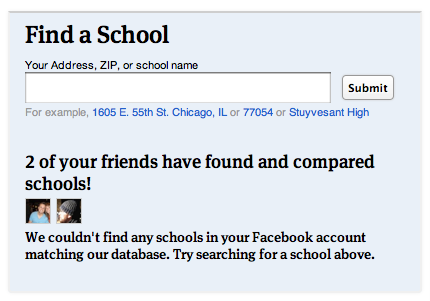
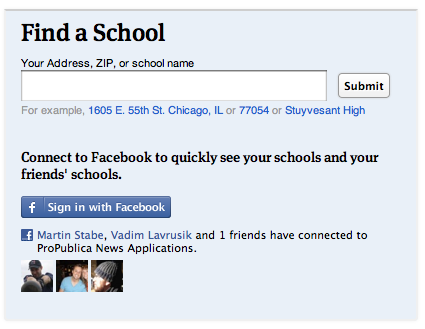
What’s more, the Nieman article talks breathlessly about ProPublica aiming to make data “more social”. What they describe is basically an embedded ‘Share this’ text box (admittedly nicely seamless) and a hashtag. But the news app page actually has a lot more to it: for example, once you’ve given it permission to access your Facebook account, it tells you how many friends have used the app, and appears to try to connect you to schools in your profile. This is how that’s presented on the homepage:

This came as a refreshing relief, because the ‘share this’ strategy reminds me of organisations who say their social media strategy is to ‘get everyone on Twitter’.

Still, it made me think of the range of challenges that Facebook and other social media platforms present. For example, if you land on one of the comparison pages, the offering isn’t so compelling: the reason to install the Facebook app is just “Share this”.

As I’ve written before, technology is a tool, not a strategy, so here are some other opportunities that might be explored:

  1. Publish your school’s scores to Facebook graphically, not just the generic link. Images work particularly well in news feeds, and would be much better than the dry list of names that is generated by the ‘Share this’ button.
  2. Turn conventional news values on their head: be positive. This is a curious one: positive headlines seem to get shared more on social media, so could users celebrate their school’s ratings as much as bemoan them? Could they generate a virtual report card with a ‘Try harder!’ line? Imagine a Facebook editor who asks “Where can we put the exclamation mark?” Yes, I know, it makes me feel uncomfortable too – but I also hear Yoda’s voice saying “You must unlearn what you have learned…”
  3. Build on where they’ve come from: if a friend has used the app to send them to a comparison page, can you build on that in the way you invite the user to connect through Facebook? Could they add something to what the friend has done, and correspond back and forth?
  4. A Facebook-based quiz which sees how well you guess where your school rates on different scales. Perhaps you could compete against your current or former classmates…
  5. A campaigning tool that would allow people to use data on their local school to petition for more support –
  6. Or a collaboration tool to help parents and students raise money, or organise provision.

Competition, fun, campaigning, conversation, collaborating – those are genuinely social applications of technology. It would be interesting to start a discussion about what else might suit a news app’s integration with Facebook. Any ideas?

What I learned from the Facebook Page experiment – and what happens next

Paul Bradshaw Facebook page

Cross-posted from the BBC College of Journalism blog:

Last week my experiment in running a blog entirely through a Facebook Page quietly came to the end of its allotted four weeks. It’s been a useful exercise, and I’m going to adapt the experiment slightly. Here’s what I’ve learned:

It suits emotive material

The most popular posts during that month were simple links that dealt with controversy – Isle of Wight council talking about withdrawing accreditation if a blogger refused to pre-moderate comments; and the wider issue of being denied access to public documents or meetings on the basis of blogging.

This isn’t a shock – research into Facebook tends to draw similar conclusions about the value of ‘social’ content.

That said, it’s hard to draw firm conclusions because the Insights data only gives numbers on posts after June 9 (when I posted a book chapter as a series of Notes), and the network effects will have changed as the page accumulated Likes.

UPDATE: Scrolling down the page each update does have impressions and interaction data on it in light grey – I’m not sure why these are not included in the Insights data (perhaps that service only kicks in after a certain number of Likes). But they do confirm that links get much higher traffic than Notes.

It requires more effort than most blogs

With most blogging it’s quite easy to ‘just do it’ and then figure out the bells and whistles later. With a Facebook Page I think a bit of preparation goes a long way – especially to avoid problems later on.

Firstly, there’s the choice whether to start one from scratch or convert an existing Facebook account into a Page.

Secondly, there’s the page name itself: at first you can edit this, but after 100 Likes you can’t. That leaves my ‘Paul Bradshaw’s Online Journalism Blog on FB for 1 month‘ looking a bit silly 5 weeks later. (It would be nice if Facebook warned you that this was happening)

Thirdly, if you want write more than 420 characters, you’ll need to use Notes (ideally, when logged on as the Page itself, which will result in the Note being auto-posted to the wall). And if you want to link phrases without leaving littering the note with ugly URLs, you’ll need to use HTML code.

Next, there’s integration with other online presences. Here are the apps I used:

  1. RSS Graffiti (for auto-posting RSS feeds from elsewhere)
  2. Slideshare (adds a new tab for your presentations on that site)
  3. Cueler YouTube (pulls new updates from your YouTube account)
  4. Tweets to Pages (pulls from your Twitter account into a new tab)

There’s also Smart Twitter for Pages which publishes page updates to Twitter; or you can use Facebook’s own Twitter page to link pages to Twitter.

Finally, I was thankful that I had used a Feedburner account for the Online Journalism Blog RSS feed. That allowed me to change the settings so that subscribers to the blog would still receive updates from the Facebook page (which also has an RSS feed) – and change it back afterwards.

It’s not suited for anything you might intend to find later

Although Vadim Lavrusik pointed out that you can find the Facebook page through Google or Facebook’s own search, individual posts are rather more difficult to track down.

The lack of tags and categories also make it difficult to retrieve updates and notes – and highlight the problems for search engine optimisation.

This created a curious tension: on the one hand, short term traffic to individual posts was probably higher than I would normally get on the blog outside Facebook. On the other, there was little opportunity for long term traffic: there was no footprint of inbound links for Google to follow.

This may not be a problem for local, hard news organisations which have a rapid turnover of content, no need to rank in Google News, and little value in the archives.

But there are too many drawbacks for most to move (as Rockville Central’s blog recently did) completely to Facebook. It simply leaves you too isolated, too ephemeral, and too vulnerable to changes in Facebook’s policies.

Part of a network strategy

So in short, while it’s great for short term traffic, it’s bad for traffic long-term. It’s better for ongoing work and linking than more finished articles. It shouldn’t be viewed in isolation from the rest of the web, but rather as one more prong in a distributed strategy: just as I tweet some things, Tumblelog others, and just share or bookmark others, Facebook Pages fit in somewhere amidst all of that.

Now I just need to keep on working out exactly how.

Which blog platform should I use? A blog audit

When people start out blogging they often ask what blogging platform they should use – WordPress or Blogger? Tumblr or Posterous? It’s impossible to give an answer, because the first questions should be: who is going to use it, how, and what and who for?

To illustrate how the answers to those questions can help in choosing the best platform, I decided to go through the 35 or so blogs I have created, and why I chose the platforms that they use. As more and more publishing platforms have launched, and new features added, some blogs have changed platforms, while new ones have made different choices to older ones. Continue reading

How to create a Facebook news feed for a journalist (or anything else)

James Ball articles Facebook page

I’ve been enjoying The Independent’s individual Facebook feeds for journalists, football teams and other ‘entities’ of their news coverage. So much so that I wanted the work of journalists on other news organisations to be brought to me in the same way.

But other newspapers are not offering the same functionality, so I thought I’d do it myself. Here’s how you can do it too:

Create a Facebook page for the journalist

Go to the Facebook Pages page and click ‘Create Page‘ in the upper right corner. Continue reading

Hyperlocal Voices: Ian Wylie, Jesmond Local

JesmondLocal

Yessi Bello continues the Hyperlocal Voices series with an interview with JesmondLocal‘s Ian Wylie, who decided to dabble in local journalism after taking voluntary redundancy from a national newspaper. Still viewed as a “pro-bono”, ” good thing to do” Jesmond Local has now become an integral part of the Jesmond Community.

1)Who were the people behind the blog, and what where their backgrounds?

After 15 years working for The Guardian as a reporter, features writer and finally section editor, I took voluntary redundancy in 2009, and began thinking about what I would do with the next chapter of my career. I’d been involved mostly in national newspaper and magazine journalism, so local journalism was something I hadn’t dabbled in before.

The concept of “hyperlocal” fascinated me as an area for me to explore and an opportunity for me also to “give something back”. I discovered that Newcastle University lecturer David Baines had a research interest in the subject. We met to discuss and he suggested I offer some of his students the chance to launch a hyperlocal website, which we did almost exactly a year ago. Continue reading

Is social capital dehumanising? (comment call)

Following on from my post about teaching community-based journalism, I had an interesting correspondence with James Brooks, who found terms like “social capital” dehumanising, refused to join Facebook and many other web platforms on ethical grounds (that they conflate the professional and private), and took issue with the idea that my assignment suggested that he “should become an active member” of certain “communities”.

I wanted to explore this further, because I think this is a complex area that deserves fleshing out. So, is social capital dehumanising? Should journalists refuse to join social networks on ethical grounds? And does a journalist have to engage with communities to do their job?

PS: James is happy for me to blog about it.

Content, context and code: verifying information online

ContentContextCode_VerifyingInfo

When the telephone first entered the newsroom journalists were sceptical. “How can we be sure that the person at the other end is who they say they are?” The question seems odd now, because we have become so used to phone technology that we barely think of it as technology at all – and there are a range of techniques we use, almost unconsciously, to verify what the person on the other end of the phone is saying, from their tone of voice, to the number they are ringing from, and the information they are providing.

Dealing with online sources is no different. How do you know the source is telling the truth? You’re a journalist, for god’s sake: it’s your job to find out.

In many ways the internet gives us extra tools to verify information – certainly more than the phone ever did. The apparent ‘facelessness’ of the medium is misleading: every piece of information, and every person, leaves a trail of data that you can use to build a picture of its reliability.

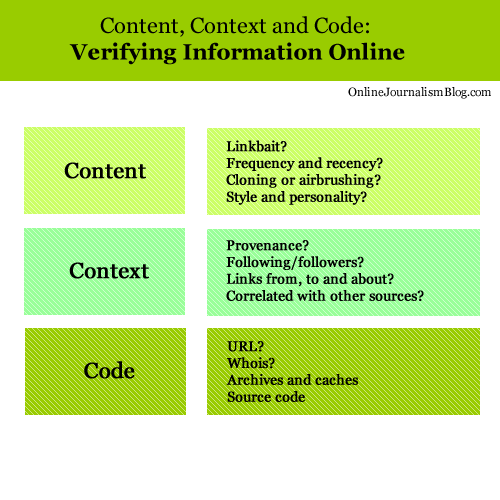
The following is a three-level approach to verification: starting with the content itself, moving on to the context surrounding it; and finishing with the technical information underlying it. Most of the techniques outlined take very little time at all but the key thing is to look for warning signs and follow those up. Continue reading

Content, context and code: verifying information online

The full version of this post can be found here (this is a duplicate).

When the telephone first entered the newsroom journalists were sceptical. “How can we be sure that the person at the other end is who they say they are?” The question seems odd now, because we have become so used to phone technology that we barely think of it as technology at all – and there are a range of techniques we use, almost unconsciously, to verify what the person on the other end of the phone is saying, from their tone of voice, to the number they are ringing from, and the information they are providing.

Dealing with online sources is no different. How do you know the source is telling the truth? You’re a journalist, for god’s sake: it’s your job to find out.

In many ways the internet gives us extra tools to verify information – certainly more than the phone ever did. The apparent ‘facelessness’ of the medium is misleading: every piece of information, and every person, leaves a trail of data that you can use to build a picture of its reliability. Continue reading