Tag Archives: google

Mexican Senate uses Google Moderator for a Q&A session with citizenship

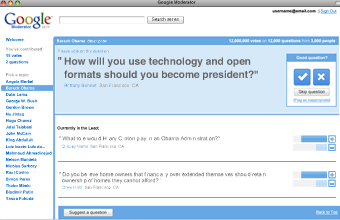
Built upon the Google Apps Engine, Google Moderator is the tool used by the Mountain View company’s executives to hold their town hall meetings that sometimes include Q&A sessions with thousands of people from all over the world. The software allows participants to submit questions and vote for those who want to meet with priority.

Google has announced on its official Latin American blog that the President of the Mexican Senate will use Google Moderator to answer questions to the citizenship next June 14th.

“El Senado Responde” (The Senate answers) is the site that will host all the questions from the Mexican public to Carlos Navarrete, President of Senate.

The Q&A session will also be broadcast live through the Senate Channel and website, and later will be uploaded to YouTube.

What does John Terry’s case mean for superinjuntions?

The superinjunction obtained by England Captain John Terry was overturned on Friday – and the case raises some interesting issues (cross posted from John Terry: another nail in the superinjunction coffin):

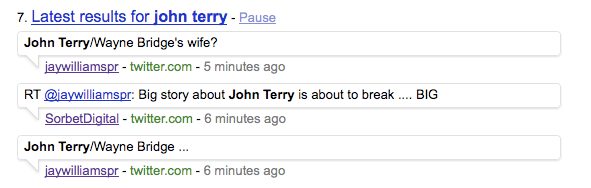
  • Ecen when the superinjunction was in force, you could find out about the story on Twitter and Google – both even promoted the fact of Terry’s affair – via the Twitter trends list and the real-time Google search box.
  • No one got the difference between an injunction and a superinjunction – the former banned reporting of Terry’s alleged affair, the latter banned revealing there was an injunction. They weren’t necessarily both overturned, but there was a widespread assumption you could say what you liked about Terry once the superinjunction was overturned. This wasn’t necessarily the case …
  • The Mail and Telegraph seemed to flout the superinjunction – as did the Press Gazette which decided if wasn’t bound as it hadn’t seen a copy. This seemed risky behaviour legally – which makes me wonder if the papers were looking for a weak case to try to discredit superinjunctions.
  • This superinjunction should never have been granted. What was the original judge thinking?

Google and Twitter ignored the superinjunction

Tweets from while the superinjunction was in force

Tweets from while the superinjunction was in force

The superinjunction was overturned at about 1pm or 2pm on Friday. Needless to say, the papers had a field day over the weekend. Continue reading

Google will give Murdoch what he wants if he renames the Sun as the Wapping News Journal

Has anyone pointed out the workings of Google Scholar to Rupert Murdoch? He’s going to have a fit when he finds out (first published here) …

Imagine if Google offered a deal like this to news publishers (as you’ll have guessed, this is exactly how Google Scholar works):

  • Where content is behind a paywall, Google will index it all and include it in its web results even if searchers who click through to the page are then told they can’t read the story without subscribing.
  • Google will work out which is the authoritative source of a story and show that – so newspapers breaking exclusives get priority over bloggers etc.
  • Google won’t differentiate these results in any way – searchers will think they’re going to see the content they can see in the Google results, but actually they’ll hit a paywall.

As I say, that’s exactly how Google Scholar works – but it’s not a deal that Google’s offering to newspapers Continue reading

Living Stories: NYT and Google produce jaw-dropping online journalism form

How good is this? While Murdoch and Sly complain about Google, The New York Times and Washington Post have been working with the search engine behemoth on a new form of online journalism. I’m still getting my head around the results, because the format is brimming with clever ideas. Here’s the obligatory cheesy video before I get my teeth into it:

So what’s so special about this? Firstly, it is built around the way people consume content online, as opposed to how they consumed it in print or broadcast. In other words, the unit of entry is the ‘topic’, not the ‘article’, ‘broadcast’ or ‘publication’. If you look at search behaviour, that’s often what people search for (and why Wikipedia is so popular). Continue reading

What’s your problem with the internet? A crib sheet for news exec speeches

When media executives (and the occasional columnist on a deadline) talk about ‘the problem with the web’ they often revert to a series of recurring themes. In doing so they draw on a range of discourses that betray assumptions, institutional positions and ideological leanings. I thought I’d put together a list of some common memes of hatred directed towards the internet at various points by publishers and journalists, along with some critical context.

If you can think of any other common complaints, or responses to the ones below, post them in the comments and I’ll add them in. I’ll also update this blog post whenever I come across new evidence on any of the topics.

Meanwhile, here’s a table of contents for easy access:

  1. Undemocratic and unrepresentative (The ‘Twitterati’)
  2. ‘The death of common culture’
  3. The ‘echo chamber’/death of serendipity (homophily)
  4. ‘Google are parasites’
  5. ‘Bloggers are parasites’
  6. ‘You don’t know who you’re dealing with’
  7. Rumour and hearsay ‘magically become gospel’
  8. Triviality
  9. ‘Unregulated’ lack of accountability
  10. Cult of the amateur

Undemocratic and unrepresentative (the ‘Twitterati’)

The presumption here is that the media as a whole is more representative and democratic than users of the web. You know, geeks. The ‘Twitterati’ (a fantastic ideologically-loaded neologism that conjures up images of unelected elites). A variant of this is the position that sees any online-based protest as ‘organised’ and therefore illegitimate. Continue reading

Google Latitude’s Location History provides more opportunities for mobile journalism

This was originally published in Poynter’s E-Media Tidbits last week

Google Latitude – a service that allows people to see where you are – has launched 2 new services – Location History and Location Alerts – that provide some interesting potential for mobile journalism.

location history

Location History (shown above) allows you to “store, view, and manage your past Latitude locations. You can visualize your history on Google Maps and Earth or play back a recent trip in order.”

There are obvious possibilities here for then editing a map with editorial information – if you’re covering a parade, a marathon, or a demonstration you could edit placemarks to add relevant reports as you were posting them (or someone else with access to the account could from the newsroom).

Location Alerts is less obviously useful: this sends you a notification (by email and/or text) when you are near a friend’s location, although as Google explains, it’s a little more clever than that:

“Using your past location history, Location Alerts can recognize your regular, routine locations and not create alerts when you’re at places like home or work. Alerts will only be sent to you and any nearby friends when you’re either at an unusual place or at a routine place at an unusual time. Keep in mind that it may take up to a week to learn your “unusual” locations and start sending alerts.”

There is potential here for making serendipitous contact with readers or contacts, but until Latitude has widespread adoption (its biggest issue for me, and one that may never be resolved), it’s not likely to be useful in the immediate future.

The good thing about Latitude is you can enable it and disable it to suit you, and my own experience is that I only enable it when I want to meet someone using GPS on my phone. To sign up to Google Latitude user, go here. To enable the new features, go to google.com/latitude/apps.

Those are 2 uses I can think of, and I’ve yet to have a serious play – can you think of any others?

Google actually makes something potentially useful for publishers

ReadWriteWeb reports on Google’s inclusion of “Real-Time Updates” in selected users’ Gmail messages. Google’s Help explanation says:

“If you’re subscribed to receive email from certain senders, the messages you receive from them will be enhanced with an interactive gadget that has up-to-date content from their website (you’ll also see an icon in your inbox identifying these messages).

“For example, if you receive a Pregnancy Bulletin newsletter from Babycenter, you’ll be able to view up-to-date content, including the baby name of the day, and browse though the current top 100 baby names within the message. Aside from the convenience of being able to interact with certain websites from inside Gmail, the branded content will help identify that your messages are legitimate and not spoofed (we’ll only show branded content when the sender authenticates their mail). We’re currently testing this with a small number of senders and will decide whether to make it widely available based on user and partner feedback.”

This has a two major implications for publishers: the first is the possibilities it opens to create genuinely lucrative email newsletters either for their own publications or – just as likely – for advertisers (think of it as the email equivalent of the corporate magazine). But will they have to get in bed with Google to benefit from them?

The second implication is this: advertisers are already beginning to spend their budgets on their own publishing operations – i.e. websites and viral marketing. This is another possible candidate for those budgets.

Google’s Fast Flip – a cruel joke on the news industry

So Google launched Fast Flip yesterday, a Labs experiment that allows you to ‘experience’ news websites in a similar way to their analogue equivalents. Yes, you can ‘flick’ through pages of news.

Woo-hoo.

Superficially this appears little more than a repeat of many similar experiments in the past decade from publishers who thought readers wanted an analogue experience online and commissioned disproportionately expensive technologies that allowed you to ‘turn the page’ on-screen (I turned down one such technology myself as a magazine editor as long as 10 years ago). Things have moved on so much that anyone can have this flashy technology for themselves for free by going to Issuu.

So why are the web-native minds of Google wasting time on such an analogue-mindset concept?

Here’s the laughable quote that I think is key:

“To make money, Fast Flip also serves up contextual adverts around the screenshots.

“Publishers who have signed up to provide content to the service will share in that revenue; that was proof, said Ms Mayer, that Google was keen to help the industry at a time when it was clearly struggling.”

Oh yes, that’s concrete proof alright.

Allow me to call bullshit. If this is concrete proof of anything, it is proof that Google are prepared to cash in on the blind panic of the news industry in the midst of a crisis. Add in their recently mooted micropayments system and it’s almost as if Google are having a bit of fun tormenting ants with a magnifying glass.

Until now Google has walked a fine line in claiming that it is not the parasite that the news industry says it is. It does did not sell adverts on Google News, it is generally the major source of traffic to news websites, and publishers are free to remove themselves from Google’s listings through a simple piece of script.

Fast Flip and the micropayments system are moves to take them over that line – despite the claims to be ‘helping’ the news industry any relationship is likely to be skewed in the other direction – as anyone who has tried to make a living from AdSense will tell you. Note that, like AdSense:

“Google is running banner ads alongside the article thumbnails, the proceeds of which will be split with publishers (though Google won’t disclose the terms of the revenue split).”

Of course, by hosting screenshots Google are eating into one of the key metrics that publishers use to sell advertising: the time a user spends on your site. And given that many readers don’t read beyond the first few pars, there’s a good chance it will eat into the numbers clicking through to the actual page at all. So unless Google’s ad rates are significantly higher, what reason at all would a commercial publisher have to sign up to a scheme that devalues their own ad inventory in exchange for some pennies from Google? Blind panic in the midst of a crisis, that’s all.

Is poor SEO behind thelondonpaper’s failure?

thelondonpaper is closing – with a pre-tax loss of £12.9m last financial year on £14.1m turnover. Maybe if they’d sorted out their SEO strategy, they’d have got more website visitors and sold more adverts? (See this story in video form).

thelondonpaper's poor appearance in google's results

thelondonpaper's poor appearance in google's results

They have no meta descriptions on their pages. Although the meta description doesn’t influence your position in google‘s search results, it does affect users’ propensity to click on each result.

With no meta description, google has to guess what to show in its results – and the picture reveals what it shows for thelondonpaper’s home page.

Would this tempt YOU to click through?

UPDATE: from someone who worked with the website team at thelondonpaper: “The website relaunch included a number of changes to improve the search engine optimisation of the site. These had a pretty substantial positive impact. The issue you raise was a known one and would have been fixed in time. In general though, recent website performance had been good.”