Tag Archives: Hyperlocal

Letter to Govt. pt1: “The impact of newspaper closures on independent local journalism and access to local information”

The following is the first in a series of responses to the government inquiry into the future of local and regional media. We will be submitting the whole – along with blog comments – to the Culture, Media and Sport Committee. This post, by Alex Lockwood, looks at the first:

“The impact of newspaper closures on independent local journalism and access to local information”

The final views of the committee will depend on how much the inquiry sees local newspapers responsible for local journalism – a little, a lot, or completely.

Writing in the Observer on Sunday, Henry Porter pretty much called them the same thing. For many who work there, the death of newspapers is disastrous for access to local information, not least due to the historical positions those papers have held.

The closures of the Glasgow East News and Ayrshire Extra, the Black Country Mail Extra, Wolverhampton AdNews, Daventry Post and Ashby Herald, the Lincoln Chronicle, the Northallerton, Thirsk and Bedale Times, and dozens of others that have either closed or felt the swingeing impact of mergers and office cuts, are devastating for their communities. These papers have been the homes for ‘hard’ journalism – reporting of the essential court and council stories that really matter to local lives.

Los Angeles Times reporter, Joe Matthews, quoted widely on this, has made clear the dire implications for democracy of the loss of quality journalism. Matthews wrote: “Much of the carnage of the ongoing media industry can’t be measured or seen: corruption undiscovered, events not witnessed, tips about problems that never reach anyone’s ears because those ears have left the newsroom.”

Those trained ears may have left the newsroom – but are they the only ears open to the whispers of local corruption? Continue reading

Try it, refine it – or throw it away

Try new stuff! If it doesn’t work, just stop doing it. Then move on and try something else.

That’s what Mackenzie Warren, director of content at Gannett Digital (that’s the digital division of what’s currently the USA’s largest media company), advised a group of Norwegian media executives at the Norwegian Institute of Journalism this week.

Now, let me first point out that Mackenzie Warren has been a journalist since the age of 14. He’s been a photographer, reporter, online editor, managing editor… just about anything you can be in a newsroom. Except that at Gannett, and at Fort Myers News-Press, where he worked before heading up the digital content section at Gannett, they no longer call it a newsroom.

“We’ve done away with the word “newsroom”. There’s no news in a newsroom (desk reporters are often the last to hear of a story). Plus, it’s not news we do – it’s aquiring, processing and distributing information”, he said.

Now, the Gannett publications have more of a control centre where section editors (sports, news etc., not print, online or TV) monitor the competition and also what the readers and viewers are responding to at any time. Continue reading

JEEcamp – when the cottage news industry met mainstream media

What happens when you bring together local journalists, bloggers, web publishers, online journalism experts and new media startups – and get them talking?

That was the question that JEEcamp sought to answer: an ‘unconference’ around journalism enterprise and entrepreneurship that looked to tackle some of the big questions facing news in 2008: how do you make money from news when information is free? Where is the funding for news startups? How do you generate community? What models work for news online? Continue reading

Ten ways journalism has changed in the last ten years (Blogger’s Cut)

A few weeks ago I wrote an 800-word piece for UK Press Gazette on how journalism has changed in the past decade. My original draft was almost 1200 words – here then is the original ‘Blogger’s Cut’ for your delectation…

The past decade has seen more change in the craft of journalism than perhaps any other. Some of the changes have erupted into the mainstream; others have nibbled at the edges. Paul Bradshaw counts the ways…

From a lecture to a conversation

Perhaps the biggest and most widely publicised change in journalism has been the increasing involvement of – and expectation of involvement by – the readers/audience. Yes, readers had always written letters, and occasionally phoned in tips, but the last ten years have seen the relationship between publisher and reader turn into something else entirely.

You could say it started with the accessibility of email, coupled with the less passive nature of the internet in general, as readers, listeners and watchers became “users”. But the change really gained momentum with… Continue reading

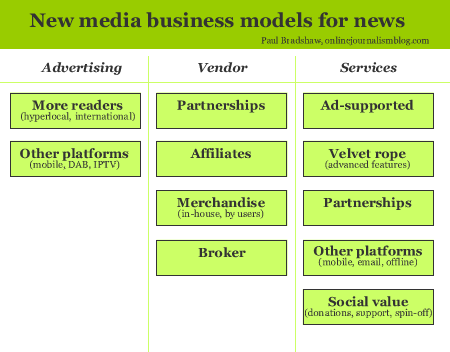
Making money from journalism: new media business models (A model for the 21st century newsroom pt5)

In the final part of the Model for the 21st Century Newsroom I look at how new media has compounded problems in news organisations’ core business models – and the new business models which it could begin to explore.

Let’s start by looking at the traditional newspaper business model. This has rested on selling, in a broad simplification, three things:

  • Advertising. Put more explicitly: selling readers to advertisers.
  • Selling content to readers, and, twinned with that:
  • Selling the delivery platform to readers – i.e. the paper

Developments in the past few decades have eaten into each of those areas as follows: Continue reading

Geotagging: the experiences of Archant’s Web Editor

Could 2008 be the year geotagging breaks through? Archant are the ones to watch in the UK with (delayedplans to geotag all their stories. I asked Suffolk’s Web Editor James Goffin to write a piece for the OJB on his experience with the process – and the opportunities it’s opening up. 

Journalists have always asked the question “Where?”. People are interested in news from where they live, and it’s a sad fact that tragedies abroad have more resonance when there’s a British passport holder involved.

As communities have become more mobile, those associations have become more complex – people reminisce about their home town, where they used to work; they are interested in where they live now, where their brothers and sisters have moved to. The world around them has become more complex too, as has the sheer amount of information being pumped out around them. Continue reading

Five W’s and a H that should come *after* every story (A model for the 21st century newsroom: pt3)

So far this model has looked at sourcing stories in the new media age, and reporting a news story in the new media age. In this third part I look at what should happen after a news story has been reported, using a familiar framework: the 5 Ws and a H – who, what, where, why, when and how.

Five W’s and a H that should come *after* every story

A web page – unlike a newspaper, magazine or broadcast – is never finished – or at least, can always be updated. Its permanence is central to its power, and relates directly to its connectivity (and therefore visibility).

Once out there it can be linked to, commented on, discussed, dissected, tagged, bookmarked and sent to a friend. That can take place on the original news site, but it probably doesn’t. The story is no longer yours. So once the news site has added comments, a message board, ’email to a friend’ boxes and ‘bookmark this’ buttons, what more can it do? Continue reading

All quiet on the western front? Not quite.

German regional publisher WAZ just launched its new flagship website, Der Westen. New features include geotagging, blogs and keyword filtering, monitored from a futuristic-looking newsroom. Martin Stabe has the details.

The concept, writes Der Spiegel, is to let users choose the centre of their world, their perspective on news. Der Westen then provides content around it.

The FAZ today has an interview of blogger-turned-editor-in-chief Katharina Borchert. Numerous online ventures have been playing on regional papers’ turf, from local advertisers flocking to AdSense to local radios breaking news more rapidly, she says. To compete, paper brands must regain their offline roles as community leaders by enhancing the news hole with social features, Facebook-style. Continue reading

Citizen journalism: some conclusions from the European Bloggers Unconference

Consider this my first attempt at a photoblog entry. For those who prefer video or text you can see both at http://www.ejc.net/seminars/picnic_2007_3

What is citizen journalism

Continue reading