Tag Archives: twitter

What I expect at news:rewired — and what I hope will happen

Screen shot 2010-01-06 at 11.23.20Next Thursday is the news:rewired event at City University London, which is being put on by the good people at journalism.co.uk. I’ll be on hand as a delegate.

All of the bases will be covered, it seems: Multimedia, social media, hyperlocal, crowdsourcing, datamashups, and news business models.

Continue reading

National newspaper Twitter account growth gets ever slower …

UK national newspaper Twitter accounts are continuing to grow – but the rate is getting slower and slower, according to the latest figures for the 129 accounts I’m tracking:

The detail

These accounts had 1,801,044 followers on November 2nd (ignoring one FT account that has been shut). On December 2nd they had 1,919,770 followers in total.

Of the 118,726 increase, 76,812 or 65% was for the @guardiantech account (which benefits from being on Twitter’s suggested user list).

As ever, you can see the figures for each account here. (And yes, sorry about no Scottish ones. I’ll redo the list soon, honest).

Did Web 1.0 begin dying in September 2008?

Nicholas Moerman has put together an impressive collection of graphs showing a general decline over the past year in visits to mainstream websites across a raft of categories, from content and commerce to portals and porn. The only sites that buck the trend? I’ll let you guess.

He doesn’t know why this is (or even if he’s seeing things), which is rather refreshing, but offers some ideas, and it’s certainly food for thought. Here it is:

Twit-Fit of the Week: It’s Monday, so let’s Wibble about Twitter…

Articles in newspapers complaining about bloggers and twitter users seem to come along like bills from the taxman – at a rate of about 5 a week.

We have had the remarkable exhibit of Janet Street-Porter (or “Janet Self-Publicist”) complaining about “publicity seeking bloggers“, and more recently Rachel Sylvester starting a pop-psychology consultancy practice for sad and lonely individuals possessed by the Twitter demon.

Last Monday, Nicholas Lezard, the usually literate writer for the Guardian and the Independent, had what I would call a “Twit-Fit”, wibbling furiously for an entire 700 words against Twitter – here.

This is my commentary cum translation. A little light relief for a Sunday, and I hope that Paul Bradshaw doesn’t give me an ASBO.

So you’re eating lunch? Fascinating

(I only read boring Twitter accounts)

Stephen Fry … Twitter

(faux introductory wibble … let’s set up the target)

I have nothing against Stephen Fry

(lots of my friends use Twitter, so I am not prejudiced … I have the right to quibble wibble)

but I CERTAINLY have something against Twitter

(pop-polemical wibble)

The name tells us straightaway

(pop-etymological wibble)

it’s inconsequential, background noise, a waste of time and space

(unintentionally self-revelatory wibble)

Actually, the name does a disservice to the sounds birds make, which are, for the birds, significant, and, for the humans, soothing and, if you’re Messiaen, inspirational

(arty-farty-Primrose-Hill-party wibble)

But Twitter? Inspirational?

(well, it isn’t when you can’t hear for your own ranting)

The online phenonemon is about humanity disappearing up it’s own fundament, or the air leaking out of the whole Enlightenment project

(I just managed to look over Nigel Molesworth‘s shoulder, and I cribbed a bit from his 2nd year philosophy test, Hem-Hem)

It makes blogging look like literature

(I have a whole quiverful of cookie-cutter stereotypes, and boy am I going to use them)

It’s anti-literature, the new opium of the masses

(Clickety-click! I taught Blue Peter how to prepare things earlier, and this one is from 1843)

It’s unreflective instantaneousness encourages neurotic behaviour in both the Tweeter and the Twatters

(Dear Damien Hirst, can I be your Press Officer ? )

Seriously, the Americans have proposed that “twatted” should be the past participle of “tweet”

(Obviously there are 300 million identical cardboard-cut-out idiots across the pond. Perhaps “stereotroped” should be the past participle of “stereotype”)

It encourages us in the delusion that our random thoughts, our banal experiences, are significant

(I want to be Alain de Botton when I grow up, Blankety-Blank)

It is masturbatory and infantile, and the amazing thing is that people can’t get enough of it – possibly because it IS masturbatory and infantile

(or ############, Yankety-Yank)

(redacted to avoid being sued by a certain award-winning journalist)

Oh God, that it should have come to this. Centuries of human thought and experience drowned out in a maelstrom of inconsequential rubbish.

(Does Andrew Keen or David Aaronovitch need a ghost-writer for when they are on holiday? )

Don’t tell me about Trafigura – one good deed is not enough

( don’t tell me about the hundreds of other achievements either; the last thing I need is facts – or reality – interfering with my opinions)

(My Rachel Sylvester piece includes a list of about 10 examples of how Twitter can be used positively that I compiled last March).

and an ordinary online campaign would have done the trick just as well

(bollocks …. no other online forum has anything like the permeability or reaction speed of Twitter)

It is like some horrible science-fiction prediction come to pass: it is not just that Twitter signals the end of nuanced, reflective, authoritative thought – it’s that no one seems to mind

(pleeeeeeeease … SOMEBODY … I’ll even write leaders for the Daily Mail)

And I suspect that it’s psychologically dangerous

( Was it Twitter that did for Gordon Brown?)

We have evolved over millions of years to learn not to bore other people with constant updates about what we’re doing,

(I didn’t consult my partner before writing this column)

and we’re throwing it all away

(which is what would have happened if I had consulted my partner)

Twitter encourages monstrous egomania, and the very fact that Fry used Twitter to announce that he was leaving Twitter shows his dependence on it.

(Unlike being an opinionated columnist, of course, Hem Hem)

He was never going to give it up. He’s addicted to it.

(And – finally – did I tell you that I am a self-qualified Doctor able to diagnose from afar)

(Hem-Hem)

Wrapping Up

I really have trouble understanding why some people just do not seem to appreciate the positive side of Twitter, although many of them seem to be general commentators inside the London media bubble.

I suspect that it could be that the main benefits of Twitter (and blogging) have made to make politics and media more permeable, and have made it possible for a far wider group of people to engage in the political debate without going through the media filter.

The point is that if you are inside the bubble and already get politicians reply to your emails in person because you work for an organisation they have heard of, then all of these seem to be unwelcome threats, rather than benefits or opportunities.

Bye-bye media bubble, I hope.

Growth of Newspaper Twitter accounts running out of steam

English national newspaper Twitter accounts continue to grow – but at an ever slower rate, according to the latest figures for the 130 accounts I’m tracking:

The detail

These 130 accounts had 1,801,811 followers on November 2nd, up by 137,568 from 1,664,243 on October 1. Of that increase, 95,007 (or 69%) was for the @guardiantech account (which benefits from being on Twitter’s suggested user list).

(NB the Telegraph has renamed its @TelegraphScienc account, so this month I’ve restated October’s figures to be for 130 accounts – I thought it had deleted it when I downloaded the latest figures.).

The biggest mover was @MirrorFootball, up 11 places to 81st (from 455 to 809 followers), suggesting the Mirror is finally making some use of Twitter (most of its other accounts are near the bottom – and only appear to have moved up a place due to the demise of the Telegraph’s Science account).

The full spreadsheet is here or you can see the iframe below.

Twitter insights: Blaine Cooke @ teacamp

This is the video I shot (with hand-held Flash camera, someone tweeted about how I managed to keep my hand up for an hour) of one of Twitter’s creators, Blaine Cooke, visiting Teacamp, a gathering of Whitehall webbies and hangers on.

Cooke kindly spent a hour answering questions about Twitter – where it came from, is now and where it’s heading to. In other words, lots of insider knowledge

2009 Technorati State of the Blogosphere Report – key findings.

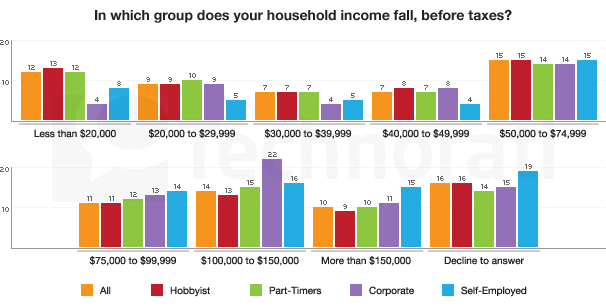
Bloggers are generally more affluent than the average person

Bloggers are generally more affluent than the average person

5 things journalists should know about the report:

  • The blogosphere continues to be dominated by male, affluent and educated bloggers
  • Bloggers use Twitter far more than the average person and microblogging is changing blogging habits
  • Blogging is becoming more mainstream and influential, but not replacing traditional media
  • More bloggers are making money, but most don’t make any
  • Most bloggers are “hobbyists” and are driven by personal fulfilment rather than financial gain.

Last week over five days, Technorati released the annual 2009 State of the Blogosphere Report with a strong theme of gaining strength. A record number of 2,828 bloggers submitted extensive surveys about their blogging activities from the past year from 50 countries, with half from the US (48%), 26% from the EU, 10% from the APAC (Asia Pacific) and 16% from elsewhere.
Results were combined with interviews with professional and well-known bloggers and statistics and findings from Lijit and Blogcritics. Bloggers were separated into four distinct groups; hobbyists, part-timers, self-employeds and professionals.

While blogging is gaining in popularity and credibility, the blogging demographic doesn’t appear to be widening. The average blogger continues to be male (two thirds), affluent (a majority have household incomes of an average of $75,000) and educated.

While most bloggers are blogging more regularly and have at least three blogs, the majority consider their output a hobby (72%).

The vast majority of bloggers seek to share their personal experience for emotional and personal fulfilment rather than monetary gain. Most bloggers feel their blog has acted positively on their personal and professional lives. Generally, respondents said they blog for one of three distinct reasons: speaking one’s mind; sharing expertise and experiences with family and friends (old and new); and making money or doing business.

70% of all respondents say that personal satisfaction is a way they measure the success of their blog, but for Pros, the leading measure of success is the number of unique visitors.

The survey found that contrary to popular belief, many bloggers have had professional media experience, with 35% of all respondents having worked in traditional media as a writer, reporter, producer, or on-air personality, and 27% continue to do so.

Interestingly, the report found that while bloggers read other blogs they do not consider them a substitute for other news sources and the majority do not consider online media more important than traditional media. However, 31% don’t think newspapers will survive the next ten years.

The report highlighted the instrumental role the blogosphere has played in recent global issues; namely the protests during the recent Iranian elections and debate surrounding last year’s US presidential elections. Even though only a relatively small number of bloggers commented on these events, bloggers believe their influence on global affairs is growing. 51% believe it will be a more effective tool to voice dissent in the future and 39% believe blogs made the Iranian protests earlier this year more effective.

Bloggers are getting savvier and more influential. Most bloggers know how their blog is created and use an average of five activities to draw an audience to their site. Bloggers with greater audiences and with Technorati authority ratings blog more regularly, posting more than 300 times more than lower ranked bloggers. One in five bloggers report updating on a daily basis, but the majority update their blog two to three times per week. The survey results and interviews with influential bloggers clearly show the number of page views depends on how prolific a blog is.

More bloggers are earning some revenue from their blog, but they are not in the majority and most income streams are indirect. For 83% of people that make money from their blog, it is not their primary income. Interviewees agreed the key to a successful blog is passion. In each case they describe how professional and lucrative blogging stemmed from their original passion and drive.

The growth of Twitter is having a big impact on the blogosphere. A large proportion of bloggers (73%) report using Twitter, largely for promotion and interaction with readers, compared with just 14% of the general population. Furthermore, according to Lijit, blogs with greater than 100 page views a day received on average 83% of their page views from Twitter referrals. Twitter was also by far the fastest growing content source to be included by bloggers.

Bloggers are avid Twitter users

Bloggers are avid Twitter users

How “organised” was the Jan Moir campaign?

Was the campaign against Jan Moir that crashed the PCC website “heavily orchestrated”? Jan Moir herself thinks so. Was it “organised”? The deputy editor of the Telegraph said it was.

If this was the case, who was organising this? “The big gay who runs the internet“? Stephen Fry?

And what do they mean by organised?

Let’s start with 3 definitions:

  1. Functioning within a formal structure, as in the coordination and direction of activities.
  2. Affiliated in an organization, especially a union.
  3. Efficient and methodical.

Of the 3 descriptions, the only one that might apply in this case is the third, and here’s the rub. Imagine the Jan Moir fuss in a world without Twitter: here’s how it unfolded:

  1. Some people read the Jan Moir article and are offended; they forward it to their friends to express disgust.
  2. People complain to the PCC. They also complain to advertisers.
  3. After a while the expressions of disgust reach a celebrity, and a columnist.
  4. The celebrity mentions the article during a public appearance; the columnist writes a column about it. The columnist mentions the parts of the Press Complaints Commission code that the article breaks. Politicians pick it up too.
  5. More people complain. They also complain to advertisers.
  6. The ‘offence’ over the article now becomes a story in itself; the celebrity angle is key to selling the story.
  7. More people complain. They also complain to advertisers.

In a world without Twitter the above might unfold over a series of days. The difference in a world with Twitter is that the above process is accelerated beyond the ability of many people to see, and they think Step 4 is where it begins.

But why does it matter if it’s organised?

But of course this isn’t about definitions, but about the discourse of what ‘organised’ means in this context. It means ‘not spontaneous’; it means ‘not genuine’; it means ‘not valid’.

Although different people may have different (oppositional, negotiated) readings I would argue this is the dominant one, where the discourse of ‘organised’ is being used to marginalise the protests. I will make a bet here that the PCC use that discourse in how they deal with the record numbers of complaints.

Stef Lewandowski hit the nail on the head when he said that it sounded “like the argument from design applied to social media”.

Help me investigate this

But what would be really interesting here is to test the hypotheses against some evidence: I want to see just how organised the ‘campaign’ was. How important were the celebrities and the formal organisations?

I’m using Help Me Investigate to see if we can work out what level of organisation there was in the campaign. So far, thanks to Kevin Sablan we have a key part of the evidence: all the #janmoir tweets since October 14. And some suggestions on how to analyse that from Ethan Zuckerman (who’s been here before): “grab all #janmoir tweets, do word freq. analysis esp on RTs, look to see if it’s grassroots or one instigator, amplified…”

If you need an invite, let me know.

And if you have any ideas how you can measure the organisation of a campaign like this, I’d welcome them.

Notes on #janmoir – don’t ‘blame’ Fry

I’ve seen a few media reports now on yesterday’s unprecedented new media revolt against the Daily Mail.

Of all of them the Huffington Post’s takes the biscuit for ‘worst take’. They reckon it’s about a fight between the Daily Mail and The Guardian. Seriously. I suspect a showbizzy intern selected their quote heavy, googled contribution.

A meme in practically all the reports is the role of Stephen Fry. This has now culminated in a Telegraph piece titled ‘Don’t laugh – Stephen Fry is giving the orders now.’

Those, like Fry, who are “deeply dippy about all things digital”, argue that the internet is the ultimate tool of democracy. But it could just be that historians – if they are so permitted – might look back on this period as the moment when the techno-savvy few seized control of the minds of the many.

The blogger Guido Fawkes seems effectively to run British politics. Ashton Kutcher – actor and tweeter with over three million followers: “life isn’t tied with a bow, but it’s still a gift” – is our spiritual leader. And Fry? Well, he’s bigger than both of them.

Where to start? Iain Dale has a lot more blog traffic than Guido. Not sure what Kutcher’s in there for save to keep the ‘celeb’s rule’ idea going (and his Twitter following like that of other Hollywood celebs doesn’t seem to translate to followers automatically watching their shows). And as for Fry?

I was actually dipping in-and-out of the #janmoir Twitter stream yesterday and very, very few of the tweets were Fry Retweets. Sure, his numbers are huge but the ‘Twitosphere’ is far, far, far huger. Presumably far too huge for most journalist’s to get their minds around.

By 2010, 26 Million (1 in 7) U.S. Adults Will Use Twitter Monthly.

Edited to add: Thanks to to commentator Ian Hopkinson for pointing to some evidence.

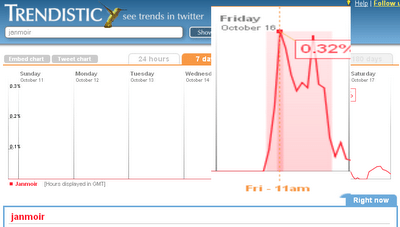
Here’s the trendastic tracking of #janmoir

Showing it peaking at 11am – @stephenfry first tweet on #janmoir was at 12:27pm.

What the ubiquitous Fry mentions in their reports are about is a journalistic laziness and the ever-present need for a celeb mention. A real piece of good work would be to actually track #janmoir all the way from where the first rock was thrown out to the furthest reach of the ripples.

Such as the excellent American analyst Evgeny Morozov‘s tweet:

notes on the new public sphere: Twitter has shrunk the Atlantic and purely local UK scandals are now global news

That’s why HuffPost bothered putting Gately on the front page – #janmoir was number one or two trending topic when they woke up, and it had that celeb angle they love. 

It’s notable that they’ve ignored what it by far the most game-changing event on Twitter this week, #trafigura – something which Gill Hornby in the Telegraph thinks is also down to Mr Fry.

From his palm-top device .. he struck a major blow for press freedom – when the Dutch company Trafigura won an order preventing the press from discussing the impact of its pollutants on the African coast, Fry tweeted the details to his vast audience and the gag was lifted.

Sigh.

How to spot a hoax Twitter account – a case study

Fake Jan Moir tweets on Twitter

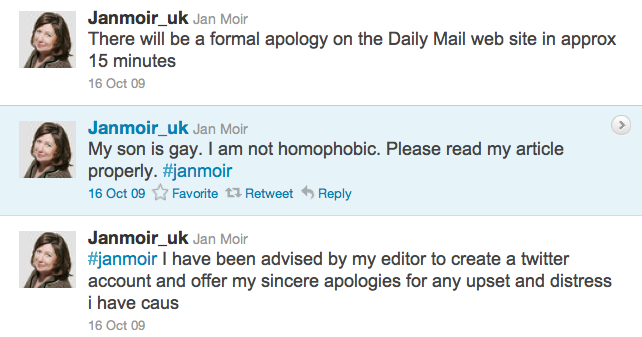
The fake Jan Moir lays some too-good-to-be-true bait on Twitter

If you were following the Jan Moir-Stephen Gateley story that was all over Twitter today you may have come across a Twitter account claiming to be Jan Moir herself – @janmoir_uk. It wasn’t her – but it was a convincing attempt, and I thought it might be worth picking out how I and other Twitter users tried to work out the account’s legitimacy.

The too-good-to-be-true test

The first test in these cases is the too-good-to-be-true test, and this works on a number of levels. Jan Moir tweeting in itself was a great story – but not completely unbelievable. Her second tweet said “I have been advised by my editor to create a twitter account and offer my sincere apologies for any upset and distress i have caus” [sic] – a superficially plausible story. Would you buy it?

But there were some other too-good-to-be-true claims in her tweets. One said “My son is gay. I am not homophobic. Please read my article properly.” Does Jan Moir have a son? Is he gay? Would she announce it on Twitter? Continue reading