Tag Archives: video

Double counting: how to spot it and how to avoid it

Double counting — counting something more than once in data — can present particular risks for journalists, leading to an incorrect total or proportion. Here’s how to spot it — and what to do about it.

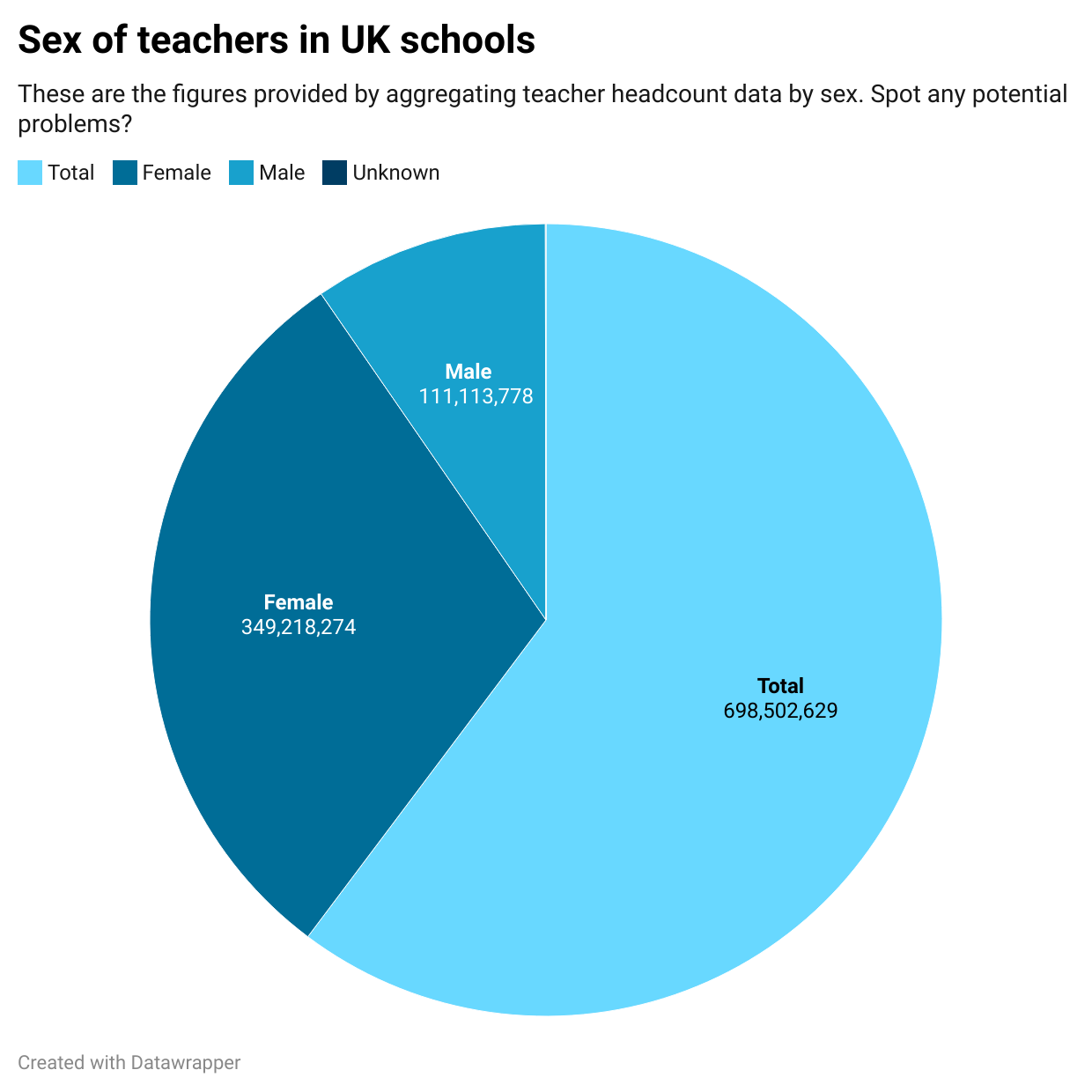
Look at the following chart showing the gender of teachers in UK schools, based on data on teacher headcounts. Notice anything wrong? (There are at least two problems)
Pie chart: Sex of teachers in UK schools
There are three visible slices: male, female and 'total', which takes up more than half of the pie.

The most obvious problem is that the chart appears to be ‘comparing apples with oranges’ (things that aren’t comparable). Specifically: “male”, “female”, and “unknown” are similar categories which can fairly be compared with each other, but “total” is a wider category that contains the other three.

I’ve used a pie chart here to make it easier to spot: we expect a pie chart to show parts of a whole, not the whole as well as its parts.

But the same problem should be obvious from the same data in a table before visualising it:
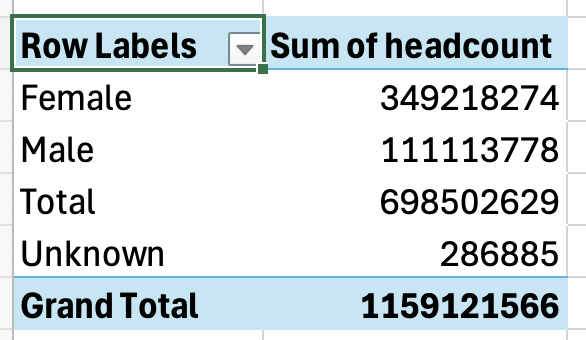
Table showing headcount of teachers in the categories: female, male, unknown, total, plus a grand total of all four at the bottom

The table shows us that we have both a “Total” and a “Grand Total”. This is a red flag. There can only be one total, so if there’s more than one that’s a strong sign of double counting.

Why is this happening? We need to take a look at the data.

Continue reading
VIDEO: Developing ideas for factual storytelling

Strong factual storytelling relies on good idea development. In this video, part of a series of video posts made for students on the MA in Data Journalism at Birmingham City University, I explain how to generate good ideas by avoiding common mistakes, applying professional techniques and considering your audience.

The links mentioned in the video include:

Related post: Here’s how we teach creativity in journalism (and why it’s the 5th habit of successful journalists)

VIDEO: AI in journalism: machine learning and natural language processing

Machine learning and Natural Language Processing (NLP) are two forms of artificial intelligence that have been used for years within journalism. In this video, part of a series of video posts made for students on the MA in Data Journalism at Birmingham City University, I explain how both technologies have been used in journalism, the challenges that journalists face in using them, and the various concepts and jargon you will come across in the field.

PS: The MA courses at BCU have an open day this month: you can register here.

The examples mentioned in the video include:

VIDEO: How can virtual reality, 360 degree video and augmented reality be used for journalism — and what are the challenges?

Virtual reality and augmented reality have opened up a range of new opportunities for journalists and publishers — as well as new challenges.

In this video, made for students on the MA in Data Journalism and the MA in Media Production at Birmingham City University, I explain what types of stories and projects suit these technologies, what to consider when using them, and some useful techniques from those who have worked in the field.

The MA courses at BCU have an open day in June: you can register here.

You can find links to all of the examples used in the video on the YouTube page.

This video is shared as part of a series of video posts.

VIDEO: How to plan an investigation or large editorial project

Planning an investigation, or any larger editorial project, raises its own particular challenges — but if you know where to look, you can find resources that are especially useful in anticipating and tackling those.

This video, made for students on the MA in Data Journalism at Birmingham City University, introduces and explores two such resources: Mark Lee Hunter‘s story-based inquiry method; and breaking down an investigation into five roles; . It also touches on issues to consider in undercover reporting or the use of subterfuge.

Further video clips of Mark Lee Hunter and Luuk Sengers are embedded below:

Continue reading

VIDEO: How automation played a central role in data journalism — and is now playing it again

Automation was key to the work of data journalism pioneers such as Adrian Holovaty — and it’s becoming increasingly central once again. This video, made for students on the MA in Data Journalism at Birmingham City University, explores the variety of roles that automation plays in data journalism; new concepts such as robot journalism, natural language generation (NLG) and structured journalism; and how data journalists’ editorial role becomes “delegated to the future” through the creation of algorithms.

You can find the video about Poligraft, and the FT on robot journalism at those links.

This video is shared as part of a series of video posts.

VIDEO PLAYLIST: An introduction to Python for data journalism and scraping

Python is an extremely powerful language for journalists who want to scrape information from online sources. This series of videos, made for students on the MA in Data Journalism at Birmingham City University, explains some core concepts to get started in Python, how to use Colab notebooks within Google Drive, and introduces some code to get started with scraping.

Continue reading

VIDEO: An introduction to SQL for data journalists

The database query language SQL pops up in all sorts of places when you’re working with data — especially big data — and can be a very useful way to query data in spreadsheets, APIs and coding. This video, made for students on the MA in Data Journalism at Birmingham City University, explains what SQL is, the different places you will come across it, and how to get started with SQL queries.

You’ll find related resources and tutorials in the repo here.

UPDATE: Thanks to Tony Hirst in the comments for pointing me to his post about browser-based SQL tools.

This video is shared as part of a series of video posts.

VIDEO: Big data, open data, linked data and other big ideas that data journalists need to know about

Three key terms you might hear used in data journalism circles are “open data“, “linked data” and “big data“. This video, made for students on the MA in Data Journalism at Birmingham City University, explores definitions of the three terms, explains some of the jargon used in relation to them, and the critical and ethical issues to consider in relation to open and big data in particular.

Three other video clips are mentioned in the video, and these are embedded below. First of all, Tim Berners-Lee‘s 2009 call for “raw data now”, where he outlined the potential of open and linked data…

Continue reading

VIDEO: Transmedia journalism

Transmedia storytelling is the process of telling a story across multiple platforms. Henry Jenkins coined the term when he noticed how different stories from a single ‘story world’ were being distributed between films, animated shorts, comic books and games. But the same principle has been applied to news reporting where different information about a news event might be reported on Twitter, Facebook Live, radio broadcasts and a dedicated news website. 

In this video, made for students on the MA in Data Journalism and the MA in Multiplatform and Mobile Journalism at Birmingham City University, I explain how transmedia is different to simple multiplatform or multimedia publishing; the news situations where a transmedia approach might be appropriate for journalists; and tips in planning a transmedia news project.

This video is shared as part of a series of video posts.