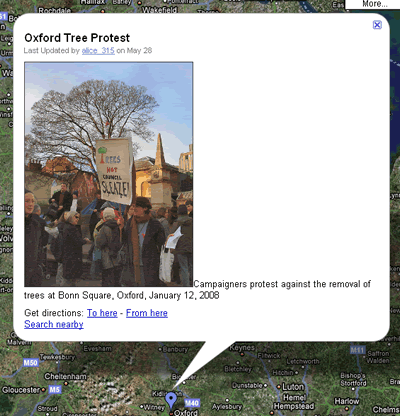
Charlotte Dunckley is a final year journalism degree students who has already launched a fanzine and is in the process of turning it into a commercially viable magazine - Things.
She recently popped in for an ad hoc tutorial and I asked her about her web strategy.
As you have probably worked out, this year’s Online Journalism students have been building up towards launching an environmental news website. This week the site went public, and I thought I’d take the opportunity to reflect on the lessons learned so far…
The Background
The site is the final year project of two final year journalism degree students - Azeem Ahmad and Rachael Wilson. The decision was made to launch an environmental site because of the increase of investment in this area from a number of news organisations, and also because of a local connection - more of which later.
Azeem is responsible for the more technical side of the site, which he has built from scratch using the open source content management software Joomla.
Rachael has the responsibility for editorial, which means writing for the site herself, but more importantly managing 14 second year students on the Online Journalism module as they try to build a news site on a subject most have never written about. She’s also been blogging her experiences.
Week One: Choosing a name, assigning beats, making connections
After some cheesy brainstorming, the very literal name ‘Environmental News Online‘ was chosen for the site for the simple reasons of search engine optimisation and domain name availability. The abbreviation ‘ENO’ lent it more character. (more…)
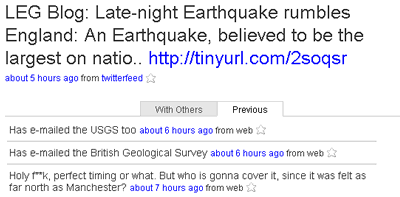
Kudos to two of my student journalists who had the nous to report on last night’s earthquake as soon as it happened, using Twitter, blogs and the website, and sourcing from forums, Twitter, blogs, and Flickr.
Once he’d gathered some facts, he blogged it. In addition to the official sources and other news outlets, Mitch had also gathered some original material from blogs and blog comments.
(And the Flickr-sourced image of a bleary-eyed housemate in dressing gown watching the news was an unusual one, but in the absence of the old lump-of-debris snap it kinda works for me as a representation of what was happening across the country - and he gets credit for thinking visually).
Cleverly, he’s obviously set up Twitterfeed to post blog updates to his Twitter account too.
It’s been a pretty good first week of blogging from my online journalism students. After those impressive first ideas they’ve demonstrated that they understand the form in practice as well as theory.
First-time bloggers are often disappointed that the world isn’t listening as soon as they open their mouth, and I was expecting to have to advise all students that it would take time to build any sort of audience.
But when I asked them to call up their stats after just seven days I was surprised to find some were already gathering a readership: two students had had over 130 visits; another had had around 60; and a further two had around 40. (more…)
I thought the following two Twitter posts from journalism student Tuuli Platner neatly demonstrate how the platform can be used to involve readers in the drama of newsgathering and build anticipation (read from the bottom up):
Now, don’t you want to read the story that came out of it?
In week two of my Online Journalism module I introduced students to the principles of blogging. After the lecture I asked the students to brainstorm ideas for blogs on an environmental issue theme, based on what they’d just heard.
To inject some extra ideas I brought in star Birmingham blogger Pete Ashton.
The results were some of the best blog ideas I’ve heard from journalism students - and certainly more imaginative than most newspaper thinking around the blog platform.
Emma wanted to look at supermarket waste - Pete suggested getting “behind the scenes of what happens at a supermarket”; I added the possibility of a Flickr account/photoblog.
Hayley wanted to do something about energy efficiency - Pete suggested they drill down very specifically to something like a blog purely about issues around energy saving lightbulbs.
Natalie has recently learned to drive - she suggested blogging about her experiences of a ‘return to public transport’
Laura wanted to look at the topical issue of chickens and supermarkets and mentioned the fact that you could access data on declining sales - I suggested a blog monitoring sales of chicken at supermarkets; Pete suggested tapping into the online organic farming community.
Stephanie thought of a challenge-based blog following her as she tries to get an environmental story from every country in sub-Saharan Africa.
Alice was thinking of a blog following attempts to get a whole street to go eco-friendly. I suggested a group blog.
Kat wanted to follow her student house doing something similar with ‘downshifting’. Pete pointed out the dangers of blogging about other people without their knowledge/editorial approval. I advised her to broaden her mind beyond students.
Kasper wanted to pick a community, e.g. fishermen, then look at their perspectives on water pollution country-by-country. I suggested turning it round to pick one country and use the blog to post on different communities’ perspectives and experiences on/of water pollution, e.g. fishermen, people who live by rivers; shipping companies; water suppliers.
Tuuli wanted to pick a name (e.g. “Adam”) and get one person with that name from every state in America to write a post about what they do related to the environment. Pete suggested that there will be spin-offs from those, like follow-ups on what contributors are up to.
They also set up their own blogs during the lesson - more on these in future posts.
subscribe to useful feeds through their RSS reader,
use social recommendation and tags to discover new sources
- and to twitter the whole process.
The results? Frankly, disappointing.
If you think 19- and 20-year-olds are au fait with Twitter, think again. Only one had used it before starting the class. And even afterwards, the journalism students I was teaching hardly hit the ground running. (more…)
In two weeks I begin teaching the 2008 class on Online Journalism. As a way of inviting ideas and being open source and all that, I thought I would post 2007’s classes online. The first lecture is below…
…it’s very much one-word slides with me riffing off them, but hopefully it gives you a sense of what areas I covered. The idea here is to get students thinking about their own motivations before they begin, and for me to get an idea of why they’re doing this. (more…)
I recently had a discussion with a few people who had just graduated from journalism school about the importance of blogging. Most of them acknowledged being told to blog by professors, however, none of them actually blogged. This is contrary to my personal view of things, and was wondering what other professionals in the industry thought.
It’s an experience I share: students blog while they’re told to, but the majority stop once the teaching ends. It’s like someone saying they want to be a musician, but refusing to play any gigs until they sign a record deal. Thanks to Kerim Satirli for the link