Author Archives: Paul Bradshaw

Baroness Buscombe, the Press Complaints Commission and the Internet: Hard Questions

Baroness Buscombe, the Chairman of the Press Complaints Commission, gave a speech this week to the Society of Editors, followed by some comments to Ian Burrell of the Independent about a desire to “regulate the blogosphere “.

The Baroness has taken several steps backwards from her previous statements to Mr Burrell, and has attempted to emphasise that any proposals would be “voluntary”.

I am sceptical as to whether this is a true change of mind, or a simply more nuanced journey aiming for the same destination by a more circuitous, and perhaps better hidden, route. Ian Burrell has pointed out that he had a direct interview with her for 40 minutes, so making that mistake would not be easy. However, that has been addressed elsewhere by perhaps hundreds of people, with a vigorous collective letter from hundreds of bloggers.

For me, in addition to the “will we … won’t we … will we … won’t we … regulate the bloggers” game of Hokey-Cokey, this affair has highlighted a number of problems with both the Press Complaints commission, and perhaps with Baroness Buscombe herself.

Firstly, the Chairman of the Press Complaints Commission is a position which surely depends on political and commercial neutrality. Perhaps it can only be compared to that of Speaker of the House of Commons. How is it possible for a Peer who takes the whip for a political party to be neutral?

Secondly, despite the Chairman of the PCC clearly needing to be a neutral figure, Baroness Buscombe used her speech to the Society of Editors to make party political points.

Thirdly, having read Baroness Buscombe’s speech to the Society of Editors, I think that her, and the PCC’s, level of knowledge and understanding about the Internet is open to question.

And finally, Baroness Buscombe applauds the aggressive media investigations of the House of Commons, and MPs’ Expenses, yet suggests that they need to lay off the House of Lords – where she is a member; this at a time when the finanical skeletons have begun to emerge, creaking, from their Lordships’ cupboards into the light of day. That is a double standard.

Let me illustrate this with a few extracts.

Political Neutrality

Baroness Buscombe opens with a recounting of her experience as a Shadow Minister fighting the current Labour administration, including:

Of course the fact that unfortunately we do have such a dysfunctional democracy – particularly given the House of Commons appears almost entirely to have forgotten what they are there for – means it is vital that the press is free to investigate and probe and tell it like it is.

You can rightly feel proud that, from unraveling the government’s misleading spinning of intelligence in the Iraq War to exposing uncensored details of MPs’ expenses, the British press has filled the democratic deficit in recent years.

Does this partisan accusation, whether true or not, have any place in a speech by the person who is ultimately responsible for determining the accuracy or otherwise of such claims made by newspapers?

And why has she not, at the very least, resigned the Conservative whip?

Understanding the Internet

Baroness Buscombe, on news aggregators and search engines:

Together the press, all commercial broadcasters, film, book publishing and music industries must now work together to find a new business model with the Search Engines. The latter, the aggregators, think it is ok to enjoy the use of all your valuable intellectual property and ad revenues for little or no return.

This statement is simply untrue. Major aggregators do *not* use *all* of the intellectual property of newspapers and media. Google, which is attacked by the Baroness in the following paragraph, runs the Google News service.

Google News takes 1) a headline, and 2) up to around 155 characters of text.

It must be very depressing for journalists who spend a whole week creating a 5000-word article to realise that only the first 2 lines and the subeditor headline are of any value !

Further, Google offers a complete opt-out service, either from having articles included in the site’s cache, or from having a site indexed altogether. I use it myself on the Wardman Wire to prevent caching, since I have taken the trouble to invest in a high-quality server and want the visitors to come to my site rather than read the Google cache.

If services such as Google News are covering content from newspapers and the media, it is simply because those newspapers have made a decision to allow Google to do so.

The issue of aggregators and search engines, and their impact on the revenues of newspapers, has been one of the very highest priorities of the industry for months, and it is worrying that the head of the PCC hasn’t got to grips with the basic concepts involved after 6 months with the organisation (Wikipedia quotes her start date as April 2009).

Leave their Lordships Alone

Baroness Buscombe on the Commons, and the importance of vigorous scrutiny:

I know that this is not a popular message with many of my fellow Parliamentarians, some of whom are bruised by recent coverage, but we must consider the MPs’ expenses furore as a whole, and not focus on individual injustices.

What is the main lesson to be learned?

Surely, it is that the absence of scrutiny in the first place allowed a culture of abuse to flourish. If trust in politics is at a low ebb, it is because there has been too little freedom to shine a light on politicians’ activities, not too much.

However, about 4 paragraphs later the tone of Baroness Buscombe’s speech changes:

Which leads me to the House of Lords. I may be partisan, but is it really in anyone’s interests for the media to be party to the undermining of our Second Chamber – one of the few platforms in this country where people can stand up and say what they believe without fear or favour?

This is astonishing at a time when the light of day is at last shining on abuses of the Expenses system in the Upper Chamber. This is not a good recommendation for a Press Regulator who is trying to declare her support for strong investigation by journalists.

And that letter …

The letter should should still be signed by as wide a range of bloggers as possible, because – even if we take Baroness Buscombe’s new position as being the real one – the PCC and the Baroness clearly need someone to explain to them how the Internet works.

Wrapping Up

You can find the letter and the argument behind it, and sign up, here at Liberal Conspiracy .

Before signing, I’d encourage readers to read the whole speech and judge my comments in their full context.

At present this riposte has been driven largely by bloggers in the political niche; I’d particularly encourage bloggers in the media and journalism areas to offer their support.

But the bloggers who I really want to sign up are those for either the Society of Editors, or the Press Complaints Commission.

Unfortunately, neither of them has a blogger. Perhaps that would be a good first step to find out more about the internet before Baroness Buscombe makes another speech.

They presumably already have an insight into how quickly the online community can react when necessary.

Further Coverage

  1. Mark Pack has a slightly less pointed critique of Baroness Buscombe’s speech.
  2. Roy Greenslade has three articles about the “blog regulation” incident.
  3. The Heresiarch has a different angle entitled “Bloggers Repel Boarders“. Ooh-arr, me hearties.
  4. Liberal Conspiracy has the “Unity letter“.

Young people drying up like puddles on a sunny day: useful tools

There is a tool available to show graphically changes in population over time between 1992 and 2031.

The website provides an interactive map that graphically illustrates the extent to which age profile of the UK will change over the next few years. The mapping tool allows the user to select criteria for studying various age groups from UK level down to every local authority area. So, if you’d like to see what the age profile of your locality will look like in ten years’ time, this site can help. It is especially useful for local news bloggers.

To find out more, visithttp://www.statistics.gov.uk/ageingintheuk/agemap.html

If you set the age range to the 0-15’s, it’s like watching pools of water dry up on a sunny day, as the drought of young people spreads across the country. Or watch the progress of the over-65s (which I join just after the end of the period) as the map gradually darkens.

20090117-uk-young-people-1998

20090117-uk-young-people-2026

20090117-uk-young-people-ceregedion

Hat-tip: St Aidan to Abbey Moor.

Let’s do something interesting with the OJB Facebook Group

The OJB Facebook Group is about to hit 1500 members, and yet we’ve never really done anything interesting with it. I’d like to change that.

I am advertising the position of OJB Facebook Group Manager. It has no pay, of course, but it does have potential for fun, and valuable experience.

For example, could we crowdsource something? Could we broaden the voices on OJB? Use apps and widgets creatively? Engage with the Wall and forums better? Something else? (setting up a Fan page?).

What would you do with a group of 1500 people? Send me a message on Facebook with your ideas and a link to your online presence, and then I’ll set up some online discussion to develop it further.

PS: As an equal opportunities non-employer, I’m particularly interested to hear from people outside of the Anglo-American world.

A glance at the magazine industry

I am speaking to the various digital heads at the major magazines for an overview of the industry as we approach 2010.

Emanuela Pignataro, head of Conde Nast Digital UK, spoke of relaunches and a new focus on social media.

What are you working on now?

We are focusing on the relaunch of CNTraveller.com – version two of this site is due to go live at the beginning of December with exciting new services.  In addition we are looking ahead to early 2010 where we are working towards unveiling an evolution of the successful men’s quality lifestyle site, GQ.com.

What is the biggest challenge you are currently facing?

The ability to keep innovating and investing in spite of the current economic climate. We have shown consistent investment over the past two years – this year alone we have launched a brand new website – wired.co.uk, as well as relaunching CNTraveller next month, and we will be continuing this investment in order to ensure we stay ahead of the competition.

What do you hope to achieve in 2010?

A robust social media platform which can support our editorial content and increase user engagement

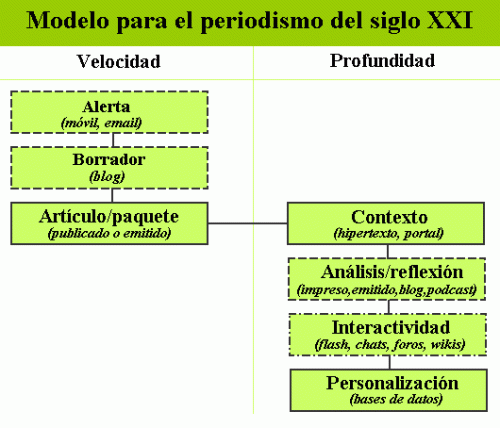
Model for a 21st Century Newsroom – in Spanish

In April Maxim Salomatin translated the Model for a 21st Century Newsroom series into Russian. Now Mauro Accurso has translated it into Spanish. All 6 parts, which make up around 10,000 or so words. It’s an incredible feat, and I’m enormously grateful.

News Diamond in Spanish

So, here they are, part by part:

  1. Part 1: The News Diamond – http://tejiendo-redes.com/2009/09/02/el-diamante-de-noticias-modelo-para-la-redaccion-del-siglo-xx1-1ra-parte/
  2. Part 2: Distributed Journalism – http://tejiendo-redes.com/2009/09/07/periodismo-distribuido-modelo-para-la-redaccion-del-siglo-xxi-2da-parte/
  3. Part 3: 5 Ws and a H that should come after every story – http://tejiendo-redes.com/2009/09/21/6-preguntas-que-deberian-venir-despues-de-cada-noticia-modelo-para-la-redaccion-del-siglo-xxi-3ra-parte/
  4. Part 4: News distribution in a new media age – http://tejiendo-redes.com/2009/10/06/la-distribucion-de-las-noticias-en-un-mundo-de-nuevos-medios-modelo-para-la-redaccion-del-siglo-xxi-%e2%80%93-4ta-parte/
  5. Part 5: Making money from journalism online: new media business models – http://tejiendo-redes.com/2009/11/02/ganando-plata-con-el-periodismo-modelos-de-negocio-de-los-nuevos-medios-modelo-para-la-redaccion-del-siglo-xxi-5ta-parte/
  6. Part 6: New journalists for new information – http://tejiendo-redes.com/2009/11/11/nuevos-periodistas-para-un-nuevo-flujo-de-informacion-modelo-para-la-redaccion-del-siglo-xxi-%e2%80%93-6ta-parte/

(As an aside, The Spanish Press Association approached me last year for permission to translate it too but I’ve never seen it. Perhaps they got bored after part 1… or perhaps they’re just rude. Anyway, if you’ve seen it, let me know.)

Sun misjudges readers’ mood over Gordon Brown letter

The Sun is running a despicable campaign against Gordon Brown. But I’ve analysed the comments on its website – and readers disagree with its stance by a ratio of more than 3 to 2 (on top of which, there are now accusations that the Sun is censoring pro-Brown comments).

The paper has exploited the grief of Jacqui Janes over her son Jamie’s death in Afghanistan to attack the PM – because his handwritten letter of condolence was supposedly disrespectful due to sloppy writing and (disputed) spelling errors.

It’s loathsome journalism that ignores the effect of his disability (the PM is blind in one eye).

And it seems Sun readers are mostly on the Prime Minister’s side.

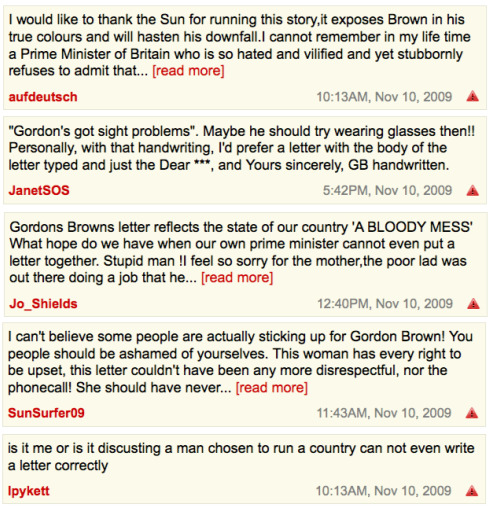
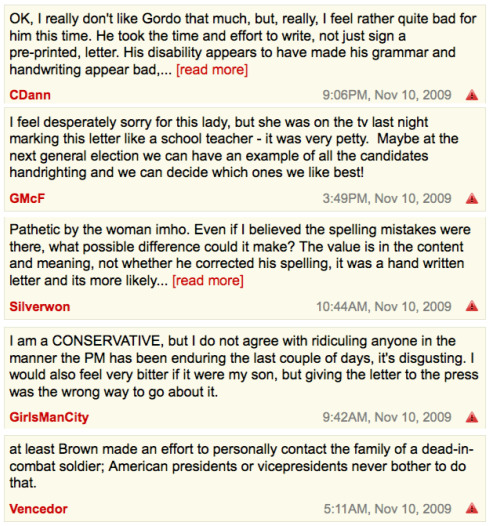
Of the 100+ comments on the story (don’t worry, I’ve nofollowed those links) when I checked, 111 expressed a view for or against Jacqui Janes or Gordon Brown (the rest commented on other issues or corrected people’s spelling errors). Of these:

  • 42 were anti Gordon or pro the Sun’s stance.
  • 69 were pro Gordon or anti the Sun’s stance.

So that’s more than 60% who don’t agree with the Sun, and less than 40% who do.

Sample comments from those who agree with the Sun’s stanceanti-gordon-brown

Some comments from those opposing itpro-gordon-brown

Conclusion

The Sun is channeling this woman’s grief into a personal attack on the Prime Minister.

It’s refusing to make allowances for his disability (maybe we could next attack the war wounded for being workshy benefit scroungers?).

And it’s facilitating her breaking data protection laws by releasing a recording of a private phone call.

The whole thing is sickening – let’s hope that observing its readers’ reactions will lead to an end to this (not that this happened in the Jan Moir case) – and preferably prosecution of the Sun over the data protection offence. What’s more, Daily Mail readers are pro Brown, too. The Sun has got this badly wrong.

Research: news execs still think they have a monopoly

Statistics from the American Press Institute paint a strong picture of the disconnect between news executives and readers that covers

  • how much content is valued by execs and readers,
  • how easy the two camps think it is to find alternative sources of news; and
  • where readers would go if the website was turned off. That last question shows the biggest disconnect,

As reproduced below, an incredible 75% news execs think switching off their websites will drive people to their newspapers. Readers, however, are saying they would go to another local website, with other prominent alternatives including regional and national websites, TV and radio (note that news execs also feel that ‘local media sites’ will benefit but users disagree): Continue reading

Do something now: help change the daft defamation law on online publishing

Forget about turning your Twitter avatar green or adding a Twibbon, here’s something you can do today which can make a genuine difference to both professional journalists and bloggers: write to the Ministry of Justice as part of their consultation on defamation which has just a few weeks left:

“This consultation seeks views on the ‘multiple publication rule’ under which [people can be sued for every time a web article has been  accessed], and its effects in relation to online archives. The paper considers the arguments for and against the rule and the alternatives of a single publication rule.”

This consultation couldn’t have been published in a more user-unfriendly way. The consultation page consists mainly of a link to a PDF and a Word document (which was clearly written for an online form that was never created, even down to HTML coding).

There is no clear address to send your responses to. You’ll find it on the 4th line of the Word document. It’s defamationandtheinternet@justice.gsi.gov.uk. Don’t worry, I’ll repeat that again at the end of the post.

UPDATE: RightToReply.org have published the consultation in their trademark easy-to-respond form here.

Here’s what they’re asking (also hereherehereherehere and here), reproduced in a rather easier-to-navigate format and rephrased for slightly easier reading: Continue reading

“Mapped” writing model takes a layered approach to news

If the inverted pyramid as a writing form is tied to the printed page, what writing form does the web suggest?

That was the question asked by João Canavilhas of Portugal when he proposed the “tumbled pyramid,” a more open story architecture designed to encourage online navigation and personal reading paths. Canavilhas describes a new structure with four levels: base, explanation, and two levels of exploration.

I’ve wrestled with the same question. My solution: the “mapped” writing model (interesting how we reach out to new metaphors to replace old ones). Where my approach differs is its simplicity. The mapped model is really just a specific way to organize information. It assumes little change in how you, as the practitioner, define a story or function as a journalist. I’d like to explain the concept and how it rethinks the inverted pyramid.

HOW IT WORKS:

The mapped model views the news story as a whole and parts. First comes a summary of the main elements. Then the story breaks into an orderly conversation of one element or thread at a time. It’s up to the writer to define the content threads. Each thread starts with a subhead that clearly conveys what comes next, for example: “what happened,” “what witnesses saw,” or “next steps in the process.” The subheads function as a map, telling readers ahead of time where the story will lead, what turns in the road they can expect, and reminding them where they are. This form seems to work best on longer news and feature stories.

Below is a simple example of a mapped story I wrote recently for our community newspaper. I presented the story experimentally in a simple Flash file, to see how it might look on the web. You won’t be wowed by zippy graphics. It’s meant to show how the subheads can become the means of navigation, literally. On the web you could also present this story as a continuous text, with subheads set into the story, acting as signposts.

ORIGIN OF THE CONCEPT:

I developed this model as a news designer a few years ago as I tried to imagine ways to make stories easier to read.

I was troubled by what seemed like information chaos in many news stories dealing with complex topics. With a background in writing, I began to analyze how stories were built. I used color markers to highlight the various categories or threads present in a story, wherever they showed up in the text (I choose the colors at random). For example, “background” might turn up as a block of yellow in the second paragraph, then again in the sixth paragraph, then as a chunk toward the end of the story. Fully deconstructed, the story might contain six or eight threads, showing up as a patchwork of colors. Continue reading

Troubleshooting WordPress: A quick DIY guide

WordPress is being used for thousands of blogs because of how powerful it can be. However, that can often be its downfall and many blog owners come across problems while extending and customising their blog. Being a free platform, there’s no support other than the forums so here’s a quick DIY troubleshooting guide.

Essentially, WordPress is made up of 3 parts;

  1. Core – the bare bones of WordPress, without any plugins or themes.
  2. Themes – the theme controls the look and feel of your blog, the part your readers see.
  3. Plugins – extra functionality or features are provided by these extensions.

When a problem arises the cause will likely be in one of these three areas. Go through these steps to try to find out where the problem lies;

  1. Revert to the default theme that comes with WordPress.
  2. De-activate all your plugins.
  3. If you’ve edited any of the themes or plugins you’re using, revert to the original.
  4. If the problem persists, it may be an issue with the WordPress Core. Try upgrading to the latest version if you’re not up-to-date.
  5. Or, if the problem goes away; start re-activating each of your plugins, checking for the issue after each one. If it’s a plugin issue it’ll be obvious which plugin has the problem, and you can contact that plugin’s author.
  6. If you’ve re-activated all the plugins and the problem hasn’t come back, re-activate the theme you were using. If the problem comes back it could be either;
    1. the theme is clashing with one of your plugins (go back to step 2) or
    2. the theme is trying to use a plugin that you haven’t activated; check the ‘readme’ or ‘install’ file that came with the theme.

Once you’ve done all that, if you still find yourself with the problem, take a screenshot of the problem and search for any error message you get. It might also be worth searching for the error on the WordPress support forums. If you’re still stuck, pray to your chosen deity.

Philip John is a freelance consultant providing WordPress installation, customisation, training and support. He is the technical geek behind The Lichfield Blog and you can find out more on his blog.