Last week I began the new class of Online Journalism. First task: getting students signed up to Twitter. Then, I asked half the class to ‘twitter’ my lecture on, er, what Twitter is. I then asked the other half to twitter me talking about the news diamond. While I gave the lecture I had my Twitter page on screen so that students could see the twitters coming in as I spoke. The result is shown below – start from the bottom and work upwards. Forgive the poor image quality – I reduced it to 8 colours to make the file size reasonable. Continue reading
Author Archives: Paul Bradshaw
The Online Journalism Blog readers’ map – what to do if your entry has been changed
If your entry has been incorrectly amended you can edit it by clicking on your placemark or listing in the left hand column. Continue reading
The Online Journalism Blog readers’ map – normal service is resumed
Thanks to all those who have so far added themselves to the OJB readers’ map – it looks very impressive. I had a couple emails from people who arrived at the map to find it called something else – ‘Mark Weber’ or ‘Félix Bahón’. One of the problems of making it editable, it seems, is people accidentally changing the name of the map itself.
UPDATE: Another is that people can accidentally edit each others’ entries, and so Laura Oliver of Journalism.co.uk in London has suddenly been reassigned to the role of video journalist at Sydney’s Telegraph.
Anyway, the map is now back to its original name with some instructions in the description as well as here.
If your entry has been incorrectly amended you can edit it by clicking on your placemark or listing in the left hand column. Then go to the top of the left hand column and click ‘Edit’. Both the map name and the selected placemark become editable.
It seems Google Maps has some way to go before being intuitive enough for the average reader to contribute to.
Meanwhile, looking forward to seeing more readers popping up, particularly in those hard-to-reach places…
…and after those Google Maps mashups, what better time to start playing with this stuff?
Feb 5, 2008: the day Super Tuesday became the ‘Mashup Election’
If news organisations thought they were starting to ‘get’ this whole internet journalism thing, yesterday may make them think again.
At 8pm GMT yesterday I received a breathless email from Azeem Ahmad, a student from the journalism degree I teach on:
“Tell me you have seen the Google Maps/Twitter mash up of the American Super Tuesday voters.. it’s amazing! The pointer is flying all over the world, from Spain to England, and all through the various parts of America.”
Logging onto Twitter I found a similar buzz from Martin Stabe and Kevin Anderson:
“Enthralled by Twitter and Google Maps super mashup. I could be entertained for hours”
A quick search on Terraminds (image below) showed it wasn’t just us journo nerds: Twitter was alive with chatter about the mashup – one tweet in particular was worth noting: Continue reading
Journalist, map thyself
I’d like you to help me out with a little mapping demonstration. I’ve created a map of Online Journalism Blog readers – here. I’d love if you could add yourself to the map. If you’ve never done this before (and what better way to start?), this is how:
-
make sure you’re signed in to Google,
-
search for your postcode/zip code/street address,

-
click ‘Save to my maps’ on the box that appears – select the OJB readers option from the drop-down and click ‘Save’.

-
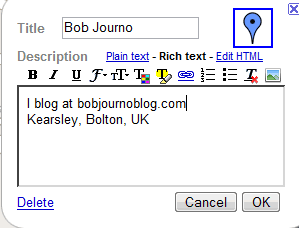
You can then edit the entry – change the title to your name and add any biographical details you want (e.g. link to your blog) in the Description box. Then click OK.

I’m hoping that a) this will allow OJB readers to network with each other more easily; and b) this will provide a platform for experimentation/mashups (perhaps a mashup with WiredJournalists.com?) – if anyone has any ideas, let me know.
But it’s only as powerful as its members, so map away!
Listen to this blog’s posts
So I signed up to automatic podcast generator Odiogo. The result: a podcast feed for all of my posts. Useful for accessibility – and recommended on that basis if nothing else. The automated reading of posts is surprisingly natural. But one big problem: because I use the <more> strip in WordPress to prevent my homepage being dominated by lengthy posts, this also truncates the feed, and so the audio only runs to that point.
UPDATE: Some tips were given below, plus an email from Odiogo themselves as follows:
“some WordPress plugins such as DualFeeds or CopyFeed create a full RSS feed, including the text after the more tag.
“Please note that these plugins have not been tested by Odiogo – we don’t know if they are compatible with WordPress.com and cannot be held responsible if they cause any issue to your blog.“
What (new) skills do you look for in a journalist?
We know basic newsgathering and newswriting skills are essential, but what new skills have you begun to look for in budding journalists? Whether technical, personal, or general…
Journalism enterprise headlines
The team at JournalismEnterprise.com have been busy – here are some of the most recent reviews:
Pownce: a Twitter with bells on.
EveryBlock: Adrian Holovaty’s much-anticipated news mapping service gets a five-star rating.
Newstin: multilingual news search: “Its taxonomy engine goes way beyond the usual keyword and tags approach. For each article, Newstin’s engine is able to tell you what it’s about, who was mentioned, where it happened, etc.”
Gnooze: satirical daily news show for YouTube browsers.
Skewz: “a political Digg that goes both ways. You can submit any news story and the community can vote on how “liberal” or “conservative” the story is.”
As always, the review is only the start of the process: please add your own comments on the sites. And if you want to review sites for JournalismEnterprise.com, what’s stopping you? Send an email to info@journalismenterprise.com to join.
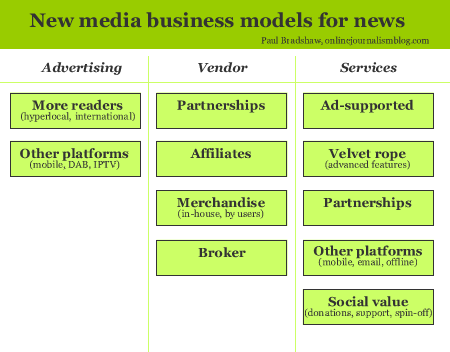
Making money from journalism: new media business models (A model for the 21st century newsroom pt5)
In the final part of the Model for the 21st Century Newsroom I look at how new media has compounded problems in news organisations’ core business models – and the new business models which it could begin to explore.
Let’s start by looking at the traditional newspaper business model. This has rested on selling, in a broad simplification, three things:
-
Advertising. Put more explicitly: selling readers to advertisers.
-
Selling content to readers, and, twinned with that:
-
Selling the delivery platform to readers – i.e. the paper
Developments in the past few decades have eaten into each of those areas as follows: Continue reading
Online Journalism Atlas: Norway
The Online Journalism Atlas continues, with Kristine Lowe looking at online journalism in Norway, where some newspapers make more money online than in print. Got any information about your own country’s online journalism? Add it here.
Norway is one of the most newspaper-reading in countries in the world, a fact also reflected in the country’s online media environment. In contrast to many other countries, Norwegians seem to prefer news-driven sites with journalistic content to all others.
Early starters
Early adoption has put Norwegian online media at a great at advantage, some of the online players even earn good money. Continue reading