Category Archives: blogs

Hyperlocal voices: Alderleyedge.com’s Lisa Reeves

Hyperlocal site alderleyedge.com

Following on from last week’s blog post on the founder of Parwich.org, I interviewed Lisa Reeves, the co-founder of alderleyedge.com, launched in 2009 and already selling out advertising.

Who were the people behind the blog, and what were their backgrounds before setting it up?

I run alderleyedge.com with my husband Martin, we live in the village. Martin built the site, so we own the technology, and I do the rest.

Martin set up his first internet company 13 years ago, and has always worked on internet based businesses of his own. I worked in publishing for 8 years then spent several years running the commercial side of internet businesses before giving up my career to be a stay at home mum.

What made you decide to set up the blog?

I wouldn’t describe alderleyedge.com as a blog, more a community news and information platform. A primary motivation for setting up the site was so that I could have a flexible job that I enjoyed as the children started to spend more time in school. The concept of alderleyedge.com seemed perfect as it allowed us to combine our experience in the Internet sector with our passion for the village in which we live.

We also felt that Alderley Edge was poorly served by its local newspaper, The Wilmslow Express, which seemed very much focused on the adjoining town of Wilmslow, and paid very little attention to Alderley Edge which it also purported to cover – although they seem to be providing a lot more coverage of Alderley Edge since we have become more established. Continue reading

Hyperlocal voices: Mike Atkinson from Parwich.org

Hyperlocal blog Parwich.org

Earlier this year I interviewed blogger Mike Atkinson, who launched Parwich.org in 2008. I wanted to get a feel for how the reality of hyperlocal blogs compared with the perception (there are other interviews to follow). Here are his responses:

Who were the people behind the blog, and what were their backgrounds before setting it up?

Local villagers (current team is six people), differing backgrounds and interests. I’ve been blogging since 2001 (my personal blog was one of the better known UK blogs in the first half of the decade, and was shortlisted for a Bloggie award), but the others had no prior blogging or website management experience. Most had never even read a blog before.

What made you decide to set up the blog?

Official reason: to promote the fund-raising activities for our proposed Memorial Hall rebuild. We needed to provide evidence to potential funders that we were an active self-organised community, and this seemed like an idea vehicle. Also, we could offer promotion for funding bodies in our Sponsors section on the blog sidebar, which might have been an added inducement for them.

But speaking personally, as the person who first suggested the blog, I simply wanted the blog to help foster and maintain a sense of community in a village whose resources at the time felt under threat – and I wanted to give us an effective voice when presenting ourselves and our concerns to the outside world. Continue reading

Online News Survey – suggestions wanted

Global news provider Small World News Service and online research company OnePoll are looking to undertake a large study which will research how the public access and use news online.

After discussing possible angles to take with the survey, it was decided that it would be good to work with the Online Journalism Blog to crowdsource possible avenues to take with the research.

The goal is to produce a number of studies that can help news professionals, journalists and anyone else with an interest understand the attitude and behaviours of online news consumers.

Our method will be to conduct a survey with a large representative sample of UK internet users.

After the study has been completed we will publish both the report and the data on the OnePoll website and make it freely available.

So if you have any suggestions for questions or possible angles then I would be delighted to hear about them.

You can contact me on Twitter @oliconner or email oli2706@gmail dot com

Of online audiences and modes of address

One of the mistakes that people new to blogging often make is to write as if they’re addressing a crowd. “Hey everyone!” they shout. “Can any of you help with this?”

Speak to people who teach radio journalism, and you’ll find similar experiences.

Radio and online journalism have this in common: they are typically consumed alone. We listen to the radio in the car, or while we’re painting. We may listen to it in the workplace – but unless it is something seminal, not crowded around the set. We read online news at our work terminal, or on our mobile phone or laptop. It’s not a group activity. Television news is the only type we consume in groups, socially.

Or at least, that’s what I thought until recently.

Because it occurs to me that there are some examples in online media when we are addressing a crowd.

Social media is the most obvious example: if you ask a question on Twitter, should you say “Do you know the answer to this question?” or “Does anyone know the answer to this question?”

Although each user is sat at their computer or phone individually, they are also occupying a virtual social space, in which they are a group.

But isn’t a blog comments thread a similar virtual social space? No.

The key to the issue is synchronicity: if people are occupying that space at the same time, then they can be addressed as a crowd. If it is asynchronous – people occupy the space at different times, and return to check communications – then that mode of address doesn’t work.

Asynchronous communication is the dominant form of communication online: email, blogs, forums are all asynchronous. Live chat, some IM and some social media like Twitter tend to be more synchronous.

In those contexts then, is it okay to address people as a group? I think it is.

FROM THE COMMENTS: @Dubber’s further insights from radio are worth incorporating:

“Most online writing seems to fall naturally into the same mode as radio writing: personal, direct, individual – and, most importantly, conversational. If I was writing a style guide for online communication (including journalism), I’d pretty much make those four elements the fundamental rules.”

Review: Funding Journalism in the Digital Age

For the past few weeks I’ve been casually enjoying Funding Journalism in the Digital Age, a book that surveys the business models underpinning the industry – and those that are being explored for its future. And it’s rather good.
The book has four broad parts: the initial 3 chapters provide the current context: a history of news publishing as a business; and an overview of current business models and commercial tactics, from paywalls and hyperlocal projects to SEO and dayparting.

The bulk of the book then looks in detail at particular types of business models: micropayments and microfunding; sponsorship and philanthropy; family ownership and trusts; niche content; e-paper, and e-commerce.

Alongside this, a number of chapters look at organisational innovation, from pro-am collaboration to institutional partnerships. And finally, two key chapters look at the principles of microeconomic concepts for the industry, and the importance of innovation.

Rather than sit back and paint a neutral picture of things, the book states quite firmly why now is not the time to stick with old models (the economics of both publishing and advertising have changed), while also not pretending to know the answer to the industry’s problems.

Instead, over the course of the book, readers get a good overview of how media organisations are attempting to adapt to the new environment, as well as a sample of the different models being experimented with by innovative startups – the successes, failures, but mostly the wait-and-sees. The result is a valuable insight into the increasingly varied nature of the industry side of ‘the industry’.

The chapters are littered with examples from both mainstream and lesser-known publishing projects, and it’s refreshingly global in its perspective: the usual US and UK stories are complemented with online and print examples from France, Singapore, Norway, Australia and elsewhere. Sadly, like most journalism textbooks, magazines and, to a lesser extent, broadcast, are a little neglected.

Although this is an entry-level book the subject is broad enough – and the industry itself so varied – for most people to find something new here.

For students, this is a book to join the list of must-reads. Too few books address the current commercial realities that students face upon entering the media. It would be nice to see some more.

Mapping global events in a local way: BBC Dimensions

BBC Dimensions

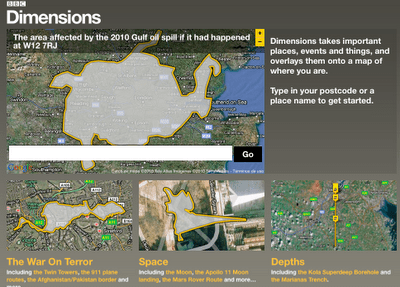
This is one of the best BBC projects I’ve seen in a while: Dimensions maps key events, places and things such as the Pakistan floods, the Gulf oil spill and the Afghanistan-Pakistan border – over your postcode.

It’s a simple idea, but hugely effective.

The prototype comes not from the corporation’s News arm – it was commissioned by History. Commissioning Executive for the Multi-Platform Team Max Gadney writes:

“Our challenge was to make it relevant to audiences.

“This is a common desire. Commissioning editors often want stuff ‘made relevant’ – TV producers might translate this as putting a celebrity in it – one we can relate to (Who Do You Think You Are does this very well). How does digital media make something relevant?”

Currently this is a prototype, so feedback is welcomed. I hope that News will be rubbing their hands at the potential applications and making their own suggestions for improvements on those lines.

For once we may be able to stop comparing things to the size of Wales. Unless, of course, you have a Welsh postcode.

Are Android phones the best option for journalism students?

[youtube:http://www.youtube.com/watch?v=8ADwPLSFeY8%5D

A few months ago I was asked what sort of mobile phone I would recommend for a journalism student. Knowing how tight student budgets are, and that any choice should have as much of an eye on the future as on the present, I recommended getting an Android phone.

The reasoning went like this: iPhones are great at certain things, and currently benefit from a wider range of applications than other mobile phones. But the contracts are expensive, the battery life poor, and Apple’s closed system problematic, for reasons I’ll expand on in a moment. Continue reading

The New Online Journalists #9: Amy McLeod

As part of an ongoing series on recent graduates who have gone into online journalism, Amy McLeod talks about her path from the BBC to setting up a website offering graduate advice.

I had no idea that I wanted to be a journalist when I left university; I graduated with a degree in Politics, Philosophy and Economics from St Edmund Hall, Oxford University in 2008.  I had, however, made a number of short films which served as a useful starting point and got me work experience for the BBC.

Once in the building I talked my way into the current affairs development department and found myself working as a journalist.  I heard about the intriguing future plans for BBC content management and worked alongside Phillip Trippenbach, who was responsible for multimedia development – he made me realise the enormous potential that digital technology provides.   Continue reading

The New Online Journalists #8: Ed Walker

As part of an ongoing series on recent graduates who have gone into online journalism, online communities editor Ed Walker talks about what got him the job, what it involves, and what skills he feels online journalists need today.

I graduated from the University of Central Lancashire School of Journalism in 2007 with a BA (Hons) first-class in Journalism. I specialised in online journalism in my final year and was taught by the digital yoda that is Andy Dickinson.

As part of my degree I was taught how to do HTML/CSS, built websites from scratch, shot video, chopped up audio, used RSS feeds for newsgathering, wrote stories, blogged using WordPress, used content management systems and all that lovely stuff.

During the course it was obvious that you needed real experience – not just Microsoft Word-submitted stories to a lecturer – to get on in the industry. I started writing for my student paper, Pluto, as soon as I arrived – it was then in a monthly magazine format – and was part of the team that turned it into a fortnightly newspaper.

In 2005 we took the paper online for the first time with Pluto Online and I moved up to Assistant Editor before winning the election to become editor for a year.

We had some good splashes, with two stories going national, and we picked up two awards at the Press Gazette Student Journalism Awards 2008: the Scoop of the Year for an undercover investigation into an essay writing company run by a UCLan student; and one of our reporters picked up Student Reporter of the Year. Continue reading