Category Archives: blogs

Magazine editing: social media policies

In the first of three extracts from the 3rd edition of Magazine Editing, published by Routledge, I talk about some basic considerations in drawing up social media policies. If you are aware of any particularly good or bad examples of social media policies in the magazine industry, I’d love to know.

Social media policies

A policy need not be particularly restrictive – the key is that everyone is clear what is acceptable (and in some cases, what is encouraged, or ‘best practice’), as well as what to do in particular situations (such as when they receive abusive or offensive messages).

There are plenty of examples to look at online, including a database of social media policies at socialmediagovernance.com/policies.php – key issues for you as a publication are making all journalists aware of legal risks such as defamation, contempt and copyright (which they might normally otherwise think sub-editors are covering) and professionalism (for example, posting inappropriate images on an account they used for professional purposes).

Also worth considering carefully are the areas of objectivity and impartiality. US publications are a lot more anxious about their journalists being perceived to be anything but completely neutral in all affairs, leading to some policies that would appear draconian to the more opinionated Brits.

Neutrality, however, is different to objectivity (which is rather more complicated but comes down to a process based on facts rather than simply creating an appearance of balance through presenting conflicting beliefs), and well informed opinion is a key feature in most magazines.

You want to allow your writers to play to their strengths and find their natural ‘voice’ on social media platforms (institutional voices do not work well here), while also guarding against ill-considered comments that might be used against the publication.

What other issues should a social media policy cover? And why should a magazine have one?

A style guide for collaborative journalism: what I’ve learned from the first weeks of Help Me Investigate: Networks

Collaborative journalism as relay race?

Collaborative journalism as relay race? Image by Phil Roeder


It’s a few weeks into the Help Me Investigate: Networks project and I’ve been learning a lot about how community management and investigative journalism can support each other.

Some of this is building on experiences on the original Help Me Investigate, but one thing in particular is emerging from this project. It’s about how you should write when your intention is to make it easy for others to get involved – a different approach to traditional newswriting, but not too different to good blogging practice.

It’s a style guide, of sorts. And so far I’ve identified 3 key qualities:

1. Write ‘news that I can use’

Pull out the practical aspects of what you’re writing about. Even if your post is just a link to an article elsewhere, pull out the most useful quote: the facts, the legalities, the implications. If you’re writing about an investigation, tell us about the process; link to the full data; translate relevant documents and reports.

Make it useful, because users can build on that to help you in return.

2. End your posts with a baton that others can pick up

If it’s a work-in-progress, outline what questions you need to answer next. This will also help keep your own planning on track. If you’re linking to something else, highlight the gaps that need filling – what information is missing?

Already on Help Me Investigate Welfare, for example, one investigation has moved from one user’s initial blog post, to my setting up the site, to a third person supplying extra contextual data, and a fourth contributor mapping the results. That wouldn’t have been possible if the first person had waited and waited until they felt that they were ‘finished’. Online, it’s the unfinished article that is easier to help with.

3. Create momentum by posting small things, often, as you move towards your target

Rather than waiting for things to be perfect, publish as you go. This provides multiple opportunities for others to discover your work, and multiple ways in which to enter it (one post may talk about documents that someone has expertise on; another may profile a particular individual, and so on).

It also makes it clear that the investigation is going somewhere, and the user may be more inclined to help it get there as a result.

Interestingly, one of the journalists on National Public Radio in the US talks of a similar approach:

“[Rina Palta] became a leading reporter on the story, not by writing one big investigative piece but by filing frequent, incremental updates, [NPR’s Matt] Thompson said. (Even Stephen Colbert cited her work.) Thompson calls it the quest: The body of work makes a bigger impact than any single post.”

So there are editorial benefits too.

This style guide works in tandem with a wider content strategy which I’ll blog about at some point.

Meanwhile, what other points would you add to a style guide for collaborative journalism? (Better still, why not join the project and find out for yourself)

The rise of local media sales partnerships and 19 other recent hyper-local developments you may have missed

In this guest post Ofcom’s Damian Radcliffe cross-publishes his latest presentation on developments in hyperlocal publishing for September-October, and highlights how partnerships are increasingly important for hyper-local, regional and national media in terms of “making it pay”.

When producing my latest bi-monthly update on hyper-local media, I was struck by the fact that media sales partnerships suddenly seem to be all the rage.

In a challenging economic climate, a number of media providers – both big and small – have recently come together to announce initiatives aimed at maximising economies of scale and potentially reducing overheads.

At a hyperlocal level, the launch on 1st November of the Chicago Independent Advertising Network (CIAN), saw 15 Chicago community news sites coming together to offer a single point of contact for advertisers. These sites “collectively serve more than 1 million page views each month.”

This initiative follows in the footsteps of other small scale advertising alliances including the Seattle Indie Ad Network and Boston Blogs.

These moves – bringing together a range of small scale location based websites – can help address concerns that hyper-local sites are not big enough (on their own) to unlock funding from large advertisers.

CIAN also aims to address a further hyper-local concern: that of sales skills. Rather than having a hyperlocal practitioner add media sales to an ever expanding list of duties, funding from the Chicago Community Trust and the Knight Community Information Challenge allows for a full-time salesperson.

Big Media is also getting in on this act.

In early November Microsoft, Yahoo! and AOL agreed to sell each other’s unsold display ads. The move is a response to Google and Facebook’s increasing clout in this space.

Reuters reported that both Facebook and Google are expected to increase their share of online display advertising in the United States in 2011 by 9.3% and 16.3%.

In contrast, AOL, Microsoft and Yahoo are forecast to lose share, with Facebook expected to surpass Yahoo for the first time.

Similarly in the UK, DMGT’s Northcliffe Media, home to 113 regional newspapers, recently announced it was forging a joint partnership with Trinity Mirror’s regional sales house, AMRA.

This will create a commercial proposition encompassing over 260 titles, including nine of the UK’s 10 biggest regional paid-for titles. Like The Microsoft, Yahoo! and AOL arrangement, this new partnership comes into effect in 2012.

These examples all offer opportunities for economies of scale for media outlets and potentially larger potential reach and impact for advertisers.  Given these benefits, I wouldn’t be surprised if we didn’t see more of these types of partnership in the coming months and years.

Damian Radcliffe is writing in a personal capacity.

Other topics in his current hyperlocal slides  include Sky’s local pilot in NE England and research into the links between tablet useand local news consumption. As ever, feedback and suggestions for future editions are welcome.


Magazine Editing – 3rd edition now out (disclosure: I edited it)

Magazine Editing 3rd edition

UPDATE: Readers of this blog can now get a 20% discount off the book by using the code ME1211 when ordering on the Routledge site.

Magazine Editing is one of those books that I’ve used for years in my teaching. Unlike most books in the field, it has a healthy focus on the less glamorous aspects of running magazines, such as managing teams and budgets, editorial strategy, and the significant proportion of the industry – B2B, contract publishing, controlled-circulation, subscription-based – that you don’t see on supermarket shelves.

For the third edition, publishers Routledge approached me to update the book for a multiplatform age. That work is now done – and the new edition is now out.

Although it now has my name on it, the book remains primarily the work of John Morrish, who wrote the first two editions of the book. Editing his work gave me a fresh appreciation of just what a timeless job he has done in identifying the skills needed by magazine editors – as I write in the introduction:

“It is striking how much of the advice in the book is more important than ever. In a period of enormous change it is key to focus on the core skills of magazine editing: clear leadership, effective management, people skills and creative thinking around what exactly it is that your readers are buying into – whether that’s printed on paper, pixels on a screen, or something intangible like a sense of community and belonging.”

So if you can find one of the older editions cheap, you’ll still find it useful.

So what did I add to the new edition of Magazine Editing? It goes without saying that digital magazines (web-only, apps) are now covered. The diversification of revenue models – the increased importance of events, merchandising, data, mobile and apps – is now explored, as well as how online advertising works, and how it differs from traditional advertising. How to use online resources, including web analytics, to better understand your audience and inform your editorial strategy; and how magazine campaigns are changed by the dynamics of the web.

The chapter on leading and managing now includes sections on managing information overload, social bookmarking and social media policies, and there’s a new section on legal guidance on placements and internships. The budgeting sections now include online considerations, and there’s an exploration of the pros and cons of using free or minimal cost third party services against building tools in-house. A passage from the section on ‘Making money online’ is illustrative of the shifts facing the industry:

“Like so much else on the web, it is becoming difficult to see where content ends and commerce begins. The concept of a ‘magazine’ blurs when, online, it can also be a shop, a game, or a tool. It helps to think of how the business model of magazines has traditionally worked: gathering a community of people in the same place (on your pages) where companies can then advertise their products and services. The same principle applies now, but the barriers to selling products and services yourself have been significantly lowered, just as the barriers to publishing content have been significantly lowered for those companies whose advertising used to fund print publishing. Integrity is no less important in this context: users will desert your website if your content is only concerned with selling them your products, just as they will desert if your events are badly organised, your merchandise poor quality, or your service shoddy. Publishers increasingly talk of a ‘brand experience’ of which the content is just one part. In many ways this makes the reader – as they also become a consumer – more powerful, and the advertiser less so. Your insights into what they are talking and reading about may be of increasing interest to those who are searching for new revenue streams.”

The chapter on writing covers considerations in evaluating online sources of information and the debates in online journalism around objectivity versus transparency, and the values of a ‘web-first’ strategy. I also cover online tools for organising diaries and monitoring social media. There’s an exploration of best practice guidelines in writing for the web, and when multimedia is appropriate or preferable.

The chapter on pictures and design now includes advice on dealing with web designers and developers, multiplatform design and branding, sourcing video for the web, copyright and Creative Commons, infographics, and image considerations for online publication. And ‘Managing Production’ covers search engine optimisation, scheduling online production, and online distribution. The penultimate chapter on legal considerations adds data protection, the role of archives in contempt of court, and website terms and conditions.

I end the book with a list of tools that allows the reader to get publishing right now. And aside from the legal developments, the new considerations, roles and stages in the production cycle, this is perhaps the most important change from previous editions: a student reading this book is no longer waiting for their first job in publishing: they should be creating it.

If you have read the book and want to receive updates on developments in the magazine industry, please Like the book’s Facebook page. I’d also welcome any comments on areas you think are well covered – or need to be covered further.

FAQ: Niche blogs vs mainstream media outlets

Here’s another collection of questions answered here to avoid duplication. This time from a final year student at UCLAN:

Blogs are often based on niche subject areas and created by individuals from a community. Do you think mainstream media outlets are limited by resources to compete? Or are there signs they are adapting?

I think they are more limited by passion, and by commercial imperatives. Niche blogs tend to be driven by passion initially, and sometimes by the commercial imperative to target those niches, whereas mainstream outlets are built on scale and mass audiences – or affluent audiences who still don’t really qualify as a niche.

They are adapting as the commercial drive changes and advertisers look for measurements of engagement, but it’s hard, as your next question fleshes out…

Communities by nature need conversation, and this often visible online in forums, blog comments etc. Can it be argued niche blogs are better at engaging communities and providing a platform for conversation?

…yes, but more because they often build those communities from the ground up, whereas established media platforms are having to start with a mass audience and carve niches out of those. It’s like trying to hold a community meeting in the middle of a busy high street, compared to doing it in a community centre.

… If so, do you think the success of blogs are as a result of people wanting conversation instead of a ‘lecture from journalists?

Not necessarily – I think blogs succeed (and fail) for all sorts of reasons. One of those is that blogs have made it easier to connect with likeminded people across the platform (in comments, for example, without having to fight through hundreds of comments from idiots), another is the ability for users to input into the journalistic process rather than merely consuming a story, and another is the ability to focus on elements of an issue which may not be accessible enough to justify coverage by a mass audience publication – and I’m sure there are as many other reasons as there are blogs.

Finally, with the emergence of Twitter, along with other methods of contact, are journalists now becoming more involved in conversation with communities of interest or is there still a reluctance from journalists to be involved?

Some recent research in the US suggested that Twitter is still being used overwhelmingly as a broadcast platform by journalists and news brands. But there are also an increasing number of journalists who are using it particularly effectively as a way to talk with users. My own research into blogging suggested a similar effect. So yes, there is reluctance (talking to sources is hard work, after all, whether it’s on Twitter, the phone, or face to face – and for many journalists it’s easier to avoid it) but the culture is changing slowly.

Teaching liveblogging

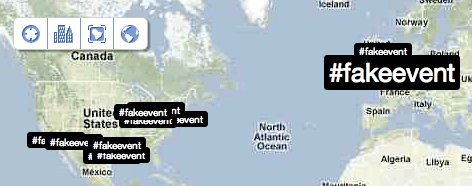
Liveblogging exercise trending on Twitter

Liveblogging exercise trending on Twitter

In the final part of a trilogy of articles on liveblogging I wanted to talk about a recent experiment I conducted in teaching liveblogging, where I decided to abandon most of my planned lecture on the topic and stage a live ‘event’ instead.

I’d also like to this post to provide a space to share your own experiences of teaching liveblogging and mobile journalism.

One of the biggest problems in teaching liveblogging – and of much of online journalism in fact – is getting students to ‘unlearn’ assumptions about journalism production learned in an analogue context. You can talk about the need to operate across a network, to multitask and to look for where the need lies – but there’s nothing like experience to drill that home.

image by @mattclinch81

Casting the panel: image by @mattclinch81

The event

I decided to recreate one of the less interesting events to liveblog: a committee hearing. I could have chosen to recreate a demonstration or a riot, but aside from the obvious potential for things to go horribly wrong, recreating something less ‘eventful’ meant I could communicate some important lessons about those sorts of events – more on which below.

Specifically, I took the transcript from one of the committee hearings into the MPs’ expenses scandal in the UK. Specifically, I chose the evidence of a husband and wife, providing as it did a little extra colour.

Image by @andrewstuart

Image by @andrewstuart

Precautions

Because the event was going to be tweeted live and in public, I had to make sure that there was no chance of libel. And so the names of all participants were changed to quite obviously false ones: the MP was Alan Fiction (Fiction, Al – see what I did there?) and the various committee members had names that made them sound like Mr Men characters (“Dr Fashionabletrousers”).

Normally hashtags emerge organically but I decided to specify a hashtag up front to make the nature of the event explicit, and so #FAKEevent was born.

With those precautions in place I needed to give the event some dynamics that would show the students the issues they would have to deal with in a live situation. Specifically: multiple sources of information; unexpected events; and incomplete information.

Image by @iamdjcarlo

Image by @iamdjcarlo

The roles

The room (over 200 students) was split into 4 main groups: over half made up a group playing the role of journalists. These were asked to move so that they were all sat in the central column of seats. To further mix things up, I gave them different editorial contexts: one quarter was working for a left-leaning broadsheet; another for a right-leaning one; a third quarter was working for a public broadcaster; and a final one for a commercial broadcaster.

20 more students each made up a pro-MP group, and an anti-MP group, who occupied the left and right columns of seats respectively. A final group of 10 or so students were ‘bystanders‘, occupying the back row.

In addition, a group of 10 or so took the roles of the committee itself, the MP and his ‘wife’.

These groups were now given the following materials:

  • The committee/MP/wife: an edited transcript of the hearing which they were to use as a script. Also: instructions for particular actions that individuals should do at specific times (more below)
  • The journalists: briefing notes: the members of the panel; background on the MP
  • Pro-MP group: instructions that they should try to steer coverage in a positive direction, and details of the website that they could use to do so.
  • Anti-MP group: instructions that they should try to steer coverage in a negative direction, and details of the website that they could use to do so.
  • The bystanders: instructions on who they were, and the roles they would play (more below).

I had also approached 3 students beforehand to play specific roles within those groups: one student each as the ‘editor’ of the pro- and anti-MP websites, who had already been assigned admin access to their particular blog and so could give other students publishing rights; and a third student who would act as the major ‘disruption’ to the event.

And I had told all students ahead of the event to bring either a laptop or mobile phone from which they could publish to the web.

A series of unfortunate events

The transcript formed the backdrop to a number of other events which I wanted to use as a device for demonstrating the skills they would need as livebloggers:

  • One member of the panel would begin to fall asleep after a minute. This was to test how many were only paying attention to the testimony.
  • Another member would shout ‘Snake!’ after 2 minutes, waking the first person up. Again, who would be paying attention? Would they have made a note of who he was?
  • A third member would stare intently at the wife throughout – a small detail; who would notice?
  • After 5 minutes or so, my ‘plant’ would storm into the back of the room and shout a loud accusation at the MP, then be calmly escorted out. Most journalists would not have seen what happened (because it was behind them), and so would have to reconstruct events from the bystanders in the back row, some of whom had their own agendas and some of whom had recorded it.

In all, the exercise took some time to organise (here are my notes): around 20-25 minutes to get everyone into their groups and around 7 minutes for the event itself (actually longer as my interruption held back for some time, waiting for a nod). A livestream of tweets (using Twitterfall) was put up on the projector – if you had a phone set up with Qik or Bambuser you could also stream the video.

image by @nicky_henderson

image of sleeping panel member by @nicky_henderson

The lessons

Choosing a staged event like a committee hearing that wasn’t particularly eventful meant that the students had to do a number of things over and above reacting to events.

Firstly, they had to concentrate on what was taking place because it was easy to lose concentration when nothing interesting was happening.

Secondly, they had to make things interesting. Many resorted to opinion and wit – entertaining, but not particularly informative, although that was excusable given that the event and the actors were fictional, and there was no background knowledge (other than that in the briefing notes) to draw on.

Still, the point wasn’t what they did but rather what they learned, and the frustrations of needing that background were a useful teaching tool in themselves.

Finally, they had to be proactive: seek out information, find out what had happened.

At the end of the exercise I asked them what they had learned, and pointed out some things I’d noticed myself about how they’d dealt with the challenge:

  • Some noted the difficulties of taking in information from both the event itself and on Twitter. This is a skill that comes from practice – or if you have the resources, partnering up with another journalist.
  • Not a single student got up from their seat and moved – either to hear the proceedings more clearly (at least one tweeted that they couldn’t hear what was being said) or to speak to the bystanders
  • Only one found out the name of the protestor. None picked up on his hashtagged tweets. None traced his blog where his accusations were fleshed out.
  • Most journalists did not follow what was being said about the event, and put it into context
  • Few took images or other multimedia

Once again: the point wasn’t that they do things right; in many ways they were set up to fail, and the discussion at the end was about reflecting on those rather than playing a blame game.

‘Failure’ was used as a teaching tool: instead of telling them what they should do, expecting them to remember, and giving them an exercise to do that, I wanted to give them an exercise up front, to experience and internalise that desire to do better, and use that as the context for the lessons, so they could connect it to their own experience of liveblogging rather than experiences of, for example, live broadcast or print reporting. (It seemed to work – a couple of students took the time to express their thanks for the nature of the lesson.)

So although that left me much less time to pass on a lesson, it did, I hope, leave the students learning more and with a higher motivation to continue learning (the full presentation, by the way, was available for those who wanted to go through it).

On the motivation side, the hashtag for the event also trended not only in the UK but in the US too, which I think the students rather enjoyed.

10 liveblogging ideas (and 31 liveblogging tips)

Liveblogging image by Dustin Diaz on Flickr

Liveblogging image by Dustin Diaz on Flickr

Following my previous post about the rise of liveblogging, I wanted to provide a simple list of ideas for student journalists wanting to get some liveblogging experience. Some people assume that you need to wait for a big news event to start a liveblog, but the format has proved particularly flexible in serving a whole range of editorial demands. Here are just a few:

1. A protest or demonstration

Let’s start with the obvious one. Protests and demonstrations are normally planned and announced in advance, so use a tool like Google Alerts to receive emails when the terms are mentioned, as well as following local campaigning groups and local branches of national campaigns. Issues to consider:

  • There will be conflicting versions of events so seek to verify as much as possible – from both demonstrators and police, and any other parties, such as counter-demonstrations.
  • Know as many key facts ahead of time as possible to be able to contextualise any claims from any side. Have links to hand – Delicious is particularly useful as a way of organising these.
  • Make contacts ahead of the event to find out who will be recording it and how those records will be published (e.g. livestream, YouTube, Flickr, Google Maps etc). Make sure you have mobile phone numbers in your contacts book and are following those people on the relevant social network. Try to anticipate where you will be needed most – where will the gaps in coverage be?
  • Don’t just cover the event on the day – build up to it and plan for the aftermath. Walk round the route to plan for the event – and post a photoblog while you’re at it. Interview key participants for profiles while you make contact. Join online forums and Facebook groups and engage with discussions on key issues.
  • Summarise regularly to help those just joining find their feet (thanks to Ed Walker in the comments for this one – more tips in his blog post on liveblogging)

2. An industry conference

Whether you’re reporting on a particular location or a shared interest there will be industries that play a key role in that. And industries have conferences. Use a quick Google search or some of the specialist events listing and organisation services like Exhibitions.co.uk to find them.

Issues to consider:

  • Industries have jargon. Try to familiarise yourself with that ahead of time (follow the specialist press and key figures on social media) or you’ll mis-hear key words and phrases.
  • There are often different events happening at the same time. Plan your schedule so you know where your priorities are.
  • Don’t follow the crowd. Often you will add more value by missing a session in order to conduct an interview or post some deeper analysis. This will also require preparation: organise to meet key individuals ahead of time; read up on the key issues.
  • As above, you’ll also need to know what’s going to be covered well and who’s going to be publishing online at the event. Build-ups will also be useful.

3. A meeting

Council or board meetings, hearings, committees and other public and semi-public meetings often have significant implications for local communities, sections of society or particular industries. They are also often poorly covered. This provides a real opportunity for enterprising individuals to add value to their readership.

In addition, there are more informal meetings of small groups which you can find on sites such as Upcoming and Eventbrite.

Issues to consider:

  • These meetings can easily pass under the radar so make sure you know when they’re taking place. For council meetings, Openly Local’s listings are particularly useful.
  • Many meetings have to publish their minutes – keep up to date with these (ask for them if you have to – use the Freedom of Information Act if you cannot get them any other way) so you know the background.
  • Know who’s who – and make sure you know which is which. Write down their names and where they’re sitting so you can attribute quotes correctly.
  • Prepare for nothing much to happen, most of the time. Concentration is key: newsworthy nuggets will be hidden in dull proceedings – and they won’t be clearly signposted. One advantage of liveblogging is that others can bring your attention to issues you might miss in the flow of reporting.

4. The build up to an event

Anticipation of an event can be an event in itself. The Birmingham Mail’s Friday afternoon liveblogs previewing the weekend’s football fixture are a particularly successful example of this. Really, this is a live chat, with the liveblog format providing the editorial urgency to give it a news twist.

Issues to consider:

  • Have prompts ready to get things started and inject new momentum when conversation dries up – prepare as you would for an interview, only with 100 possible interviewees.
  • Anticipate the main questions and have key facts and links to hand.
  • Get the tone right: can you have a bit of banter? It might be worth preparing a joke or two, or looking for opportunities to make them.

5. Breaking news

While you cannot plan for the exact timing of breaking news, you can prepare for some news events. At the most basic level, you should know how to quickly launch a liveblog once you know you need to do so. Other issues to consider:

6. Your own journey

You don’t need someone else to organise something for you to start a liveblog: you can do something yourself, and liveblog your progress. Considerations:

  • Ideally it should be something with a beginning, a middle and an end over a limited period of time: running a marathon, for example (if you can hold the mobile phone), or collecting 1,000 signatures for a campaign.
  • It should also involve others: the liveblog format lends itself to outside contributions.
  • You’ll have to work harder to make it interesting, so don’t update unless something has changed, and prepare material so you have interesting things to fill the gaps with.

7. A press conference

A familiar sight on 24 hour news channels, press conferences are an obvious candidate for liveblog treatment. You can also add to this similar political events such as the Budget, debates, or Prime Minister’s Questions. The main consideration is that you will be covering the conference alongside other journalists, so your coverage needs to be distinctive. Here are some things to consider:

  • Controlled as they are, press conferences don’t often generate a constant supply of newsworthy quotes, so when a spokesperson is trotting out platitudes or steering questions back to the particular angle she wants to sell, tell us about other things going on in the room: how is the journalist reacting? What is the PR rep doing?
  • If the situation is likely to be tightly controlled, you have a better chance of predicting what will be said, and to prepare for that. In particular, if a person is going to try to ‘spin’ facts in a particular direction, have the facts and evidence ready to ‘unspin’ them – as always, including links.
  • If you want to use one of your question opportunities to give your audience a voice, do so.
  • Likewise, tap into the wit and intelligence of users to liveblog their reactions outside the room to the questions and answers being exchanged inside.

8. A staged event

A liveblog is an obvious choice for a live event, and there are plenty of sporting and cultural events to cover. The obvious candidates – football matches, popular Olympic events – should be avoided, as existing and live coverage will be more than sufficient, so look to less well-covered sports, concerts, performances, fashion shows, exhibitions and other events. Think about:

  • Be aware of rights deals and other restrictions. Live coverages of certain popular sports, such as Premiership football, may be limited. There may be restrictions on taking photographs of cultural events, or recording audio or video at a music event.
  • As with meetings (above) it’s crucial to know who’s who and have a crib sheet of related facts.
  • Be descriptive and engage the senses. Tell us about the atmosphere, smells, sounds, and other elements that make people feel like they’re there.

9. A launch or opening

Product launches and store opening can be very dull affairs, but occasionally generate significant interest – particularly among technology and fashion fans. The interest doesn’t generally make for a sustained news event, so your liveblog is likely to be use that interest as the basis for some broader editorial angles. The tips on a ‘build up to an event’ above, apply again here, as that is essentially what this is, with the following differences:

  • Launches and openings are social gatherings, so try focusing on the people there: interview them, paint a picture of how diverse or similar they are. Tap into their expertise or enthusiasm; work with them.
  • Think about what people might want to know after the launch/opening: tips and tricks on using new technology? The items that are flying off the shelves? Have experts and inside sources on call.

10. Add your own here

Like blogging generally, liveblogs are just a platform, with the flexibility to adapt to a range of circumstances. If Popjustice can liveblog “Things we can learn from Greg James’ interview with Lady Gaga” then you can liveblog anything. If you’ve used them for a purpose not listed here, please let me know and I’ll add it to the list.

Likewise, if you have any tips to add from your own experiences of covering events, please add them in the comments.

UPDATE (November 2014): The Birmingham Mail used liveblogging to commemorate an anniversary:

“From the morning of Friday November 21, the Mail will be live blogging and live tweeting in ‘real time’ the events of the day, from the stories of those preparing for a night out on the town, to the moment the bomb warning was phoned through to the Post and Mail, to the reaction of the emergency services.”

The strikes and the rise of the liveblog

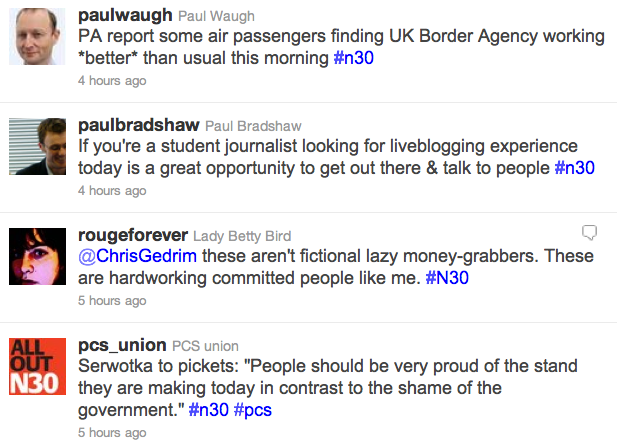
Liveblogging the strikes: Twitter's #n30 stream

Liveblogging the strikes: Twitter's #n30 stream

Today sees the UK’s biggest strike in decades as public sector workers protest against pension reforms. Most news organisations are covering the day’s events through liveblogs: that web-native format which has so quickly become the automatic choice for covering rolling news.

To illustrate just how dominant the liveblog has become take a look at the BBCChannel 4 News, The Guardian’s ‘Strikesblog‘ or The TelegraphThe Independent’s coverage is hosted on their own live.independent.co.uk subdomain while Sky have embedded their liveblog in other articles. There’s even a separate Storify liveblog for The Guardian’s Local Government section, and on Radio 5 Live you can find an example of radio reporters liveblogging.

Regional newspapers such as the Chronicle in the north east and the Essex County Standard are liveblogging the local angle; while the Huffington Post liveblog the political face-off at Prime Minister’s Question Time and the PoliticsHome blog liveblogs both. Leeds Student are liveblogging too. And it’s not just news organisations: campaigning organisation UK Uncut have their own liveblog, as do the public sector workers union UNISON and Pensions Justice (on Tumblr).

So dominant so quickly

The format has become so dominant so quickly because it satisfies both editorial and commercial demands: liveblogs are sticky – people stick around on them much longer than on traditional articles, in the same way that they tend to leave the streams of information from Twitter or Facebook on in the background of their phone, tablet or PC – or indeed, the way that they leave on 24 hour television when there are big events.

It also allows print outlets to compete in the 24-hour environment of rolling news. The updates of the liveblog are equivalent to the ‘time-filling’ of 24-hour television, with this key difference: that updates no longer come from a handful of strategically-placed reporters, but rather (when done well) hundreds of eyewitnesses, stakeholders, experts, campaigners, reporters from other news outlets, and other participants.

The results (when done badly) can be more noise than signal – incoherent, disconnected, fragmented. When done well, however, a good liveblog can draw clarity out of confusion, chase rumours down to facts, and draw multiple threads into something resembling a canvas.

At this early stage liveblogging is still a form finding its feet. More static than broadcast, it does not require the same cycle of repetition; more dynamic than print, it does, however, demand regular summarising.

Most importantly, it takes place within a network. The audience are not sat on their couches watching a single piece of coverage; they may be clicking between a dozen different sources; they may be present at the event itself; they may have friends or family there, sending them updates from their phone. If they are hearing about something important that you’re not addressing, you have a problem.

The list of liveblogs above demonstrates this particularly well, and it doesn’t include the biggest liveblog of all: the #n30 thread on Twitter (and as Facebook users we might also be consuming a liveblog of sorts of our friends’ updates).

More than documenting

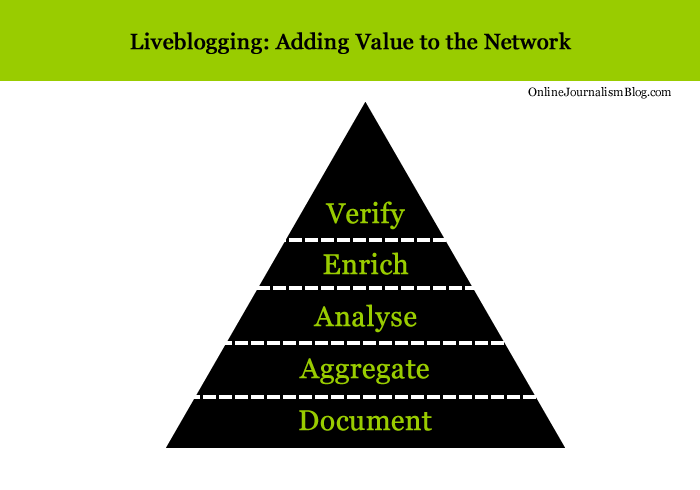
In this situation the journalist is needed less to document what is taking place, and more to build on the documentation that is already being done: by witnesses, and by other journalists. That might mean aggregating the most important updates, or providing analysis of what they mean. It might mean enriching content by adding audio, video, maps or photography. Most importantly, it may mean verifying accounts that hold particular significance.

Liveblogging: adding value to the network

Liveblogging: adding value to the network

These were the lessons that I sought to teach my class last week when I reconstructed an event in the class and asked them to liveblog it (more in a future blog post). Without any briefing, they made predictable (and planned) mistakes: they thought they were there purely to document the event.

But now, more than ever, journalists are not there solely to document.

On a day like today you do not need to be journalist to take part in the ‘liveblog’ of #n20. If you are passionate about current events, if you are curious about news, you can be out there getting experience in dealing with those events – not just reporting them, but speaking to the people involved, recording images and audio to enrich what is in front of you, creating maps and galleries and Storify threads to aggregate the most illuminating accounts. Seeking reaction and verification to the most challenging ones.

The story is already being told by hundreds of people, some better than others. It’s a chance to create good journalism, and be better at it. I hope every aspiring journalist takes it, and the next chance, and the next one.

How to deal with a PR man who emails like a lawyer

There’s a fascinating case study going on across some skeptics blogs on dealing with legal threats from another country.

The Quackometer and Rhys Morgan have – among others – received emails from Marc Stephens, who claims to “represent” the Burzynski Clinic in Houston, Texas, and threatens them with legal action for libel, among other things.

What is notable is how both have researched both Stephens and the law, and composed their responses accordingly. From Rhys Morgan:

“I have carried out some internet research, and I have not been able to establish whether or not Mr. Stephens is a lawyer; certainly he does not appear to be a member of the California Bar nor the Texas Bar in the light of my visit to the California Bar Association’s and the State Bar of Texas’s websites.”

From Quackometer:

“This foam-flecked angry rant did not look like the work of a lawyer to me. And indeed it is not. Marc Stephens appears to work for Burzynski in the form of PR, marketing and sponsorship.”

There’s plenty more in each post, including reference to case law and the pre-action defamation protocol, which provide plenty of material if you’re ever in a similar situation – or hosting a classroom discussion on libel law.

via Neurobonkers

Crowdsourcing investigative journalism: a case study (part 3)

Continuing the serialisation of the research underpinning a new Help Me Investigate project, in this third part I describe how the focus of the site was shaped by the interests of its users and staff, and how site functionality was changed to react to user needs. I also identify some areas where the site could have been further developed and improved. (Part 1 is available here; Part 2 is here)

Reflections on the proof of concept phase

By the end of the 12 week proof of concept phase the site had also completed a number of investigations that were not ‘headline-makers’ but fulfilled the objective of informing users: in particular ‘Why is a new bus company allowed on an existing route with same number, but higher prices?’; ‘What is the tracking process for petitions handed in to Birmingham City Council?’ and ‘The DVLA and misrepresented number plates’

The site had also unearthed some promising information that could provide the basis for more stories, such as Birmingham City Council receiving over £160,000 in payments for vehicle removals; and ‘Which councils in the UK (that use Civil Enforcement) make the most from parking tickets?’ (as a byproduct, this also unearthed how well different councils responded to Freedom of Information requests#)

A number of news organisations expressed an interest in working with the site, but practical contributions to the site took place largely at an individual rather than organisational level. Journalist Tom Scotney, who was involved in one of the investigations, commented: “Get it right and you’re becoming part of an investigative team that’s bigger, more diverse and more skilled than any newsroom could ever be” (Scotney, 2009, n.p.) – but it was becoming clear that most journalists were not culturally prepared – or had the time – to engage with the site unless there was a story ‘ready made’ for them to use. Once there were stories to be had, however, they contributed a valuable role in writing those stories up, obtaining official reactions, and spreading visibility.

After 12 weeks the site had around 275 users (whose backgrounds ranged from journalism and web development to locally active citizens) and 71 investigations, exceeding project targets. It is difficult to measure ‘success’ or ‘failure’ but at least eight investigations had resulted in coherent stories, representing a success rate of at least 11%: the target figure before launch had been 1-5%. That figure rose to around 21% if other promising investigations were included, and the sample included recently initiated investigations which were yet to get off the ground.

‘Success’ was an interesting metric which deserves further elaboration. In his reflection on The Guardian’s crowdsourcing experiment, for example, developer Martin Belam (2011a, n.p.) noted a tendency to evaluate success “not purely editorially, but with a technology mindset in terms of the ‘100% – Achievement unlocked!’ games mechanic.”. In other words, success might be measured in terms of degrees of ‘completion’ rather than results.

In contrast, the newspaper’s journalist Paul Lewis saw success in terms of something other than pure percentages: getting 27,000 people to look at expense claims was, he felt, a successful outcome, regardless of the percentage of claims that those represented. And BBC Special Reports Editor Bella Hurrell – who oversaw a similar but less ambitious crowdsourcing project on the same subject on the broadcaster’s website, felt that they had also succeeded in genuine ‘public service journalism’ in the process (personal interview).

A third measure of success is noted by Belam – that of implementation and iteration (being able to improve the service based on how it is used):

“It demonstrated that as a team our tech guys could, in the space of around a week, get an application deployed into the cloud but appear integrated into our site, using a technology stack that was not our regular infrastructure.

“Secondly, it showed that as a business we could bring people together from editorial, design, technology and QA to deliver a rapid turnaround project in a multi-disciplinary way, based on a topical news story.

“And thirdly, we learned from and improved upon it.“ (Belam, 2010, n.p.)

A percentage ‘success’ rate of Help Me Investigate, then, represents a similar, ‘game-oriented’ perspective on the site, and it is important to draw on other frameworks to measure its success.

For example, it was clear that the site did very well in producing raw material for ‘journalism’, but it was less successful in generating more general civic information such as how to find out who owned a piece of land. Returning to the ideas of Actor-Network Theory outlined above, the behaviour of two principal actors – and one investigation – had a particular influence on this, and how the site more generally developed over time. Site user Neil Houston was an early adopter of the site and one of its heaviest contributors. His interest in interrogating data helped shape the path of many of the site’s most active investigations, which in turn set the editorial ‘tone’ of the site. This attracted users with similar interests to Neil, but may have discouraged others who did not – further research would be needed to establish this.

Likewise, while Birmingham City Council staff contributed to the site in its earliest days, when the council became the subject of an investigation staff’s involvement was actively discouraged (personal interview with contributor). This left the site short of particular expertise in answering civic questions.

At least one user commented that the site was very ‘FOI [Freedom Of Information request]-heavy’ and risked excluding users interested in different types of investigations, or who saw Freedom of Information requests as too difficult for them. This could be traced directly to the appointment of Heather Brooke as the site’s support journalist. Heather is a leading Freedom of Information activist and user of FOI requests: this was an enormous strength in supporting relevant investigations but it should also be recognised how that served to set the editorial tone of the site.

This narrowing of tone was addressed by bringing in a second support journalist with a consumer background: Colin Meek. There was also a strategic shift in community management which involved actively involving users with other investigations. As more users came onto the site these broadened into consumer, property and legal areas.

However, a further ‘actor’ then came into play: the legal and insurance systems. Due to the end of proof of concept funding and the associated legal insurance the team had to close investigations unrelated to the public sector as they left the site most vulnerable legally.

A final example of Actor-Network Theory in action was a difference between the intentions of the site designers and its users. The founders wanted Help Me Investigate to be a place for consensus, not discussion, but it was quickly apparent users did not want to have to go elsewhere to have their discussions. Users needed to – and did – have conversations around the updates that they posted.

The initial challenge-and-result model (breaking investigations down into challenges with entry fields for the subsequent results, which were required to include a link to the source of their information) was therefore changed very early on to challenge-and-update: people could now update without a link, simply to make a point about a previous result, or to explain their efforts in failing to obtain a result.

One of the challenges least likely to be accepted by users was to ‘Write the story up’. It seemed that those who knew the investigation had no need to write it up: the story existed in their heads. Instead it was either site staff or professional journalists who would normally write up the results. Similarly, when an investigation was complete, it required site staff to update the investigation description to include a link to any write-up. There was no evidence of a desire from users to ‘be a journalist’. Indeed, the overriding objective appeared rather to ‘be a citizen’.

In contrast, a challenge to write ‘the story so far’ seemed more appealing in investigations that had gathered data but no resolution as yet. The site founders underestimated the need for narrative in designing a site that allowed users to join investigations while they were in progress.

As was to be expected with a ‘proof of concept’ site (one testing whether an idea could work), there were a number of areas of frustration in the limitations of the site – and identification of areas of opportunity. When looking to crowdfund small amounts for an investigation, for example, there were no third party tools available that would allow this without going through a nonprofit organisation. And when an investigation involved a large crowdsourcing operation the connection to activity conducted on other platforms needed to be stronger so users could more easily see what needed doing (e.g. a live feed of changes to a Google spreadsheet, or documents bookmarked using Delicious).

Finally investigations often evolved into new questions but had to stay with an old title or risk losing the team and resources that had been built up. The option to ‘export’ an investigation team and resources into a fresh question/investigation was one possible future solution.

‘Failure for free’ was part of the design of the site in order to allow investigations to succeed on the efforts of its members rather than as a result of any top-down editorial agenda – although naturally journalist users would concentrate their efforts on the most newsworthy investigations. In practice it was hard to ‘let failure happen’, especially when almost all investigations had some public interest value.

Although the failure itself was not an issue (and indeed the failure rate lower than expected), a ‘safety net’ was needed that would more proactively suggest ways investigators could make their investigation a success, including features such as investigation ‘mentors’ who could pass on their experience; ‘expiry dates’ on challenges with reminders; improved ability to find other investigators with relevant skills or experience; a ‘sandbox’ investigation for new users to find their feet; and developing a metric to identify successful and failing investigations.

Communication was central to successful investigations and two areas required more attention: staff time in pursuing communication with users; and technical infrastructure to automate and facilitate communication (such as alerts to new updates or the ability to mail all investigation members)

The much-feared legal issues threatened by the site did not particularly materialise. Out of over 70 investigations in the first 12 weeks, only four needed rephrasing to avoid being potentially libellous. Two involved minor tweaks; the other two were more significant, partly because of a related need for clarity in the question.

Individual updates within investigations, which were post-moderated, presented even less of a legal problem. Only two updates were referred for legal advice, and only one of those rephrased. One was flagged and removed because it was ‘flamey’ and did not contribute to the investigation.

There was a lack of involvement by users across investigations. Users tended to stick to their own investigation and the idea of ‘helping another so they help you’ did not take root. Further research is needed to see if there was a power law distribution at work here – often seen on the internet – of a few people being involved in lots of investigations, most being involved in one, and a steep upward curve between.

In the next part I look at one particular investigation in an attempt to identify the qualities that made it successful.

If you want to get involved in the latest Help Me Investigate project, get in touch on paul@helpmeinvestigate.com