Category Archives: online journalism

Over 1000 journalists are now exploring scraping techniques. Incredible.

Scraping for Journalists book coverLast week the number of people who have bought my ebook Scraping for Journalists passed the 1,000 mark. That is, to me, incredible. A thousand journalists interested enough in scraping to buy a book? What happened?

When I first began writing the book I imagined there might be perhaps 100 people in the world who would be interested in buying it. It was such a niche subject I didn’t even consider pitching it to my normal publishers.

Now it’s so mainstream that the 1000th ‘book’ was actually 12: purchased by a university which wanted multiple copies for its students to borrow – one of a number of such institutions to approach me to do so.  Continue reading

Making digital journalism pay: doable. Making a living: difficult

SA Mathieson, who has previously written for OJB about crowdfunding journalism, was one of three speakers at an NUJ Oxford event on how to make digital journalism pay. In a guest post for OJB he sums up the key points.

It is perfectly realistic for journalists to make money out of digital journalism, but the problem comes from making a decent living.

That was the theme to emerge from the NUJ Oxford event on making digital journalism pay. 

Speaking first, Tim Dawson, vice-president of the National Union of Journalists and a long-time writer and editor for The Sunday Times, has literally written the book on this area: Help Yourself – new ways to make money from writing. (It’s also available free for NUJ members – details here.)

He outlined some of the methods for raising money, which can be divided into three types: advertising-funded, marketing for other business and reader-funded. (More on his New Model Journalism site here.)

Continue reading

Staffordshire Council just made a very persuasive case for the value of Freedom of Information

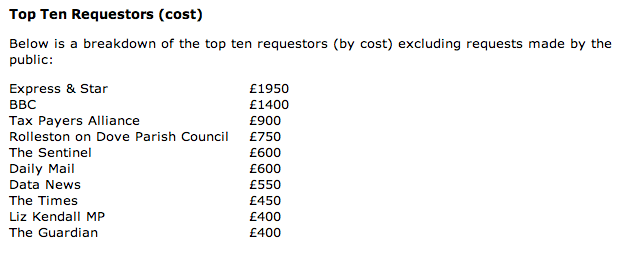
Yesterday Staffordshire County Council controversially published details of “The cost of “Freedom of Information” to local people. The titling of that page gives some clue to its intent: FOI is a ‘cost’, and it’s you, local people, who pay.

But I think the list – despite its obvious agenda and related weaknesses – is actually rather brilliant.

Why? Because it shows just how flexible a tool FOI is, how widely it is used, and perhaps raises questions to be answered about why it has to be used in the first place.

staffordshire FOI requesters

Staffordshire’s top 10 list of FOI requesters includes a parish council, elected MP and local and national media

The top ten requesters, for example, throws up not just news organisations but a politician, a parish council, and the right wing campaign group TaxPayers’ Alliance. Continue reading

Curation vs aggregation, and why news organisations can’t be ‘the next LinkedIn’

“We are not a magazine company,” he exclaims, unprompted. “We are a media company with a portfolio.”  “We want to build the next LinkedIn, the next Gilt [a US commerce site], the next Facebook,”

M Scott Havens, senior vice president of digital, Time Inc

What does it mean to be a platform? Time Inc’s M Scott Havens is the latest to express a desire to move into the platform industry, telling The Guardian:

“We want to build the next LinkedIn, the next Gilt [a US commerce site], the next Facebook,”

Platforms came up at the BBC ‘Revival of Local Journalism‘ event last week too. Why weren’t regional newspaper publishers doing more to become ‘platforms’ for their local communities? Continue reading

‘We need blogging, video, audio, or social media’ – and that’s just for an internship

Spectator intern image

Image from The Spectator – next time will it be an animated GIF?

The Spectator is advertising for interns, and the message is loud and clear on digital skills:

“Just do some of the following:-

  1. Produce a two minute video with either our audio or your own explaining a topic you’ve read about on the Spectator’s website.

  2. Prepare a sample 200-300 word blog offering something new on a topic of your choice for publishing on the Spectator’s Coffee House blog.

  3. Choose a magazine article, and work out the best way to promote it on the website, Twitter, Facebook and beyond.

  4. Suggest three ideas for potential stories.

  5. Suggest two ways in which we could improve how the Spectator’s articles are promoted digitally.”

There is one option (number 4) for those who think they can avoid digital skills – but that is the exception to the rule. It’s also the exception to the preceding instruction that “All that matters in journalism is whether you can do it.”

What the list makes clear is: even to get a foot in the door, you must be able to do it digitally.

A fairy tale: ‘Giving your content away for free’ is not the problem – giving your audience away for free is

handful of sweets

A grocer doesn’t give away content – they sell packages of content. Image by Agel Alcantara

Are publishers ‘giving away the grocery’? That’s the argument Richard Coulter, publisher of the hyperlocal paper and website Filton Voice, made In the lead up to yesterday’s BBC event on ‘The Revival of Local Journalism‘. His analogy, published on the BBC’s Academy site, described a grocer’s which opened a second shop ‘at the bottom of the hill’: Continue reading

Panini sticker albums – a great way to learn programming and statistics

1970 sticker album - image by John Cooper

1970 sticker album – image by John Cooper

When should you stop buying football stickers? I don’t mean how old should you be – but rather, at what point does the law of diminishing returns mean that it no longer makes sense to buy yet another packet of five stickers?

This was the question that struck me after seeing James Offer‘s ‘How much could it cost to fill a World Cup Sticker Album?Continue reading

How to: combine multiple rows in a dataset where text is split across them (Open Refine)

When you’ve converted data from a PDF to a spreadsheet it’s not uncommon for text to end up being split across multiple rows, like this: text split across rows In this post I’ll explain how you can use Open Refine to quickly clean the data up so that the text is put back together and you have a single row for each entry. Continue reading

This simple piece of visualisation will have you rethinking what you know about impact and mobile

deadworkers

It’s not often I encounter a piece of data journalism which solves a common problem in the field – and it’s even rarer to find a piece of work which tackles two.

But that’s just what lean data journalism Ampp3d did last week when it published a piece of visualisation on the deaths of construction workers in Qatar.

The two problems? Creating impact on mobile – and making big numbers meaningful. Continue reading

Useful sources of health data – on Help Me Investigate

Last month I spoke to some health reporters from a national broadcaster about my favourite sources of health data. As part of that I wrote a post on Help Me Investigate. I’m cross-posting it here this month as I talk about sources of data on the Data Journalism MOOC:
Continue reading