
Over on the Help Me Investigate blog I’ve published a guide to extracting data from council budget reports. Very timely, you see. Let me know what you do with it.

Over on the Help Me Investigate blog I’ve published a guide to extracting data from council budget reports. Very timely, you see. Let me know what you do with it.
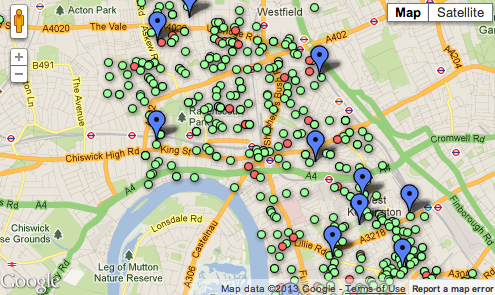
Sid Ryan’s planning applications map
Sid Ryan wanted to see if planning applications near planning committee members were more or less likely to be accepted. In two guest posts on Help Me Investigate he shows how to research people online (in this case the councillors), and how to map planning applications to identify potential relationships.
The posts take in a range of techniques including:
If you find it useful, please let me know – and if you can add anything… please do.
Motion graphics has become an increasingly popular way to present data in a compelling visual form. In a series of videos guest contributor Sihlangu Tshuma outlines his workflow process for managing a motion graphics video project, the results of which are shown at the end. All 13 videos are also available in this playlist.

I’ve been working recently with the Birmingham Mail to launch Behind The Numbers, a new datablog project with Birmingham City University supported by Help Me Investigate. I’m told that it is probably the UK’s first regional newspaper datablog, although whether that’s a meaningful claim is debatable*.
The first story generated by the project – what is the worst time to be seen at A&E – was published in the newspaper a week ago. But it’s what happens next that’s going to be interesting. Continue reading

image from xkcd
With news last week of the New York Times and Washington Post being hacked recently, The Muckraker‘s Lyra McKee looks at internet security.
“They were able to hack into the computer and remotely access my Facebook account, printing out a transcript of a private conversation. Then they told me who I’d been talking to over the past week and who was on my contacts list. They’d hacked into my phone. When they first told me they could hack into computers and phones, I didn’t believe them. So they showed me.”
I was sitting at the kitchen table of one of Northern Ireland’s few investigative journalists. He was shaken.
In thirty years of reporting, Colin (not his real name) has seen things that would leave the average person traumatized. A confidante of IRA terrorists, he has shaken hands with assassins and invited them into his home for a chat over a cup of tea – as he had done with me that night.
A few weeks previous, during one visit from a source, the subject of hacking had come up. Continue reading
Yesterday my review of drag-and-drop data analysis tool QueryTree App kicked off a surprising amount of reaction across Twitter, including some interesting insights into the role of spreadsheets in newsrooms. I’ve collected them together below.
http://storify.com/paulbradshaw/spreadsheet-killer-the-fallout-from-my-querytree-a

Sometimes the most impressive tools solve a problem you never knew you had. In the case of QueryTree, a new data analysis tool, that problem is something most people never question: spreadsheets.
For all the shiny-shiny copy-and-paste-click-and-drag-ness in new journalism tools, most data digging comes back to at least some simple spreadsheet work, and that represents a significant hurdle for many journalists used to working with simpler tools.
While interface design has undergone generations of improvement on the web, spreadsheet software interfaces have remained largely unchanged for decades.
So why did no one think to do this before?


Most writing on law is like a gas: it expands to fill the space given to it. But a new ebook by journalism trainer Cleland Thom bucks the trend, and it’s all the better for it.
Internet Law for Journalists, Bloggers, Students, Social Media Users … is as impressively succinct as its title is long. The book provides a tour through the expanding range of laws you need to consider when you publish online, illustrated with copious and simple examples, along with guidance for what you should do to avoid being added to the list. Continue reading
Do you have students or classes who want to do something investigative but lack support or ideas?
Next week students in Birmingham, Portsmouth and Strathclyde will be starting new investigations focused on education and the arts. Their focus will be local, but by exchanging notes the investigations should be quicker, easier, and potentially bigger.
They’ll be supported by new editors at Help Me Investigate Education who have put together the list of potential investigations, along with mentors from the media industry.
If that sounds like something useful – or you have an investigation you’d like them to help you with – contact me at paul@helpmeinvestigate.com
PS: Further supporting this is a free resource on teaching collaborative journalism, and an accompanying pack for students.
In a world where an extraordinary amount of people own smartphones, it’s easier than ever to connect instantaneously with those affected by significant news events wherever you happen to be based. But what tools can help reporters find those affected?
Simple searches on Twitter or Facebook may present too many ‘junk leads’ to wade through. Tools like TweetDeck are better, but what if you were able to find social media users more quickly through geolocation? Surely that would be a much more efficient method?
There are numerous websites out there that offer this functionality.
 Online Journalism Blog