Tag Archives: citizen journalism

Combating the digital divide in the developing world with mobile phones

Last week, the Guardian reported on a few promising citizen journalism projects in Africa that use mobile phone technology effectively to not only communicate with people but to also allow the audience to contribute to newsgathering. As opposed to the excessive – and even frivolous – growth of smart phone applications in the Western world, mobile phones in developing countries, which are nowhere near as sophisticated as ones in America and Europe, are being used as a reliable proxy for high-speed Internet access to perform basic functions, such as paying grocery bills and delivering medicines. Cell phone companies have bought into this as well, developing cheap, reliable phones with ease of use and practical functionality.

The Ushahidi crowdsourcing project that the Guardian article elaborates, is perhaps one of the best known and most successful mobile journalism exercises in Kenya. Ushahidi–which means “testimony” in Swahili–attempts to gather as much information from the public as possible and then verify this collected data with the help of computer and human confirmation. Launched during the post-election violence in Kenya in 2008, Ushahidi has since been implemented worldwide — from monitoring unrest in the Congo, tracking violence in Ghaza, to reporting on the Indian elections earlier this year.

The project allows people to contribute in the form of simple text messages, photos and video delivered through smartphones, or reports submitted online; this is posted in real time to an interactive map, accessible directly through smart phone technology. This information can also be converted to formats that are readable in various communities by news organizations in developing countries. The technology itself is open source, so anyone can help enhance and develop it. In order to verify the accuracy of information obtained in the case of breaking news events, Ushahidi has also launched the Swift River Project, which helps voluntary participants worldwide to separate good information from ‘noise,’ or in the team’s own words, in “crowdsourcing the filter.”

Basically, the way it works is that once the aggregated data comes in through multiple streams, be it Flickr, Twitter, or Ushahidi, people can go in and rate the data – the information is thus verified by the sheer power of numbers, as in any crowdsourcing project. In addition, the information is filtered through machine-based algorithms to confirm accuracy. Ushahidi used a similar method to track the Indian elections earlier this year through VoteReport.in. In India, “moblogging” or microblogging, made possible through the explosive popularity of cell phones, has been growing for the past few years. Sites like smsgupshup.com and Vakow.com – Indian versions of Twitter – allow people to disseminate 160-character messages to groups, enabling amateurs to deliver personalized, customized news through sms messages. This makes up for the relative lack of interactivity from mainstream Indian news organizations.

Cell phones as tools for information dissemination are particularly valuable in countries like Zimbabwe where radio transmission is often blocked. Text messages can allow an uninterrupted flow of information in such cases. The Guardian‘s Activate 09 project sends out headlines to tens of thousands of citizens in the Southern African country through sms messaging. In addition, the paper has been crowdsourcing ideas from its global audience on the different methods available to reach thousands of people during breaking news events.

The Grameen Foundation, a global nonprofit, has partnered with Google and a Uganda-based telecommunications provider MTN, to answer important queries sent in by residents via text messages; questions range from clarifications about deadly diseases to agricultural problems. In Kenya, RSS feeds from the Internet are fed into mobile phones to educate and inform people, and text-to-speech tools that convert sms messages into audio files are helping the visually impaired. Some Western companies are encouraging Kenyans to take part in crowdsourcing projects in return for micropayments. Citizens perform small tasks such as transcribing audio and tagging photos for small sums of money. The BBC is now providing English language learning capabilities in Bangladesh through cheap audio and SMS lessons through a partnership with mobile service providers.

Despite the availability of hi-speed Internet access in Western countries, the versatility of the cell phone as a vehicle for citizen journalism is very special indeed. The ability of a phone to provide real-time, on-the-ground coverage is undisputed, whether you see an unusual occurrence on the street on your way to a mall in Los Angeles or witness a riot in a displaced community in Darfur.

Taking cues from Citizen Science

One rap against citizen journalism is that there is always a possibility that it isn’t accurate or credible. Unmonitored, unmoderated blogs can get it wrong. Well, so can traditional journalists, but with blogs, it’s harder to hold someone accountable, and erroneous information is that much trickier to retract.

Would it help then, to look for ideas in a field where inaccuracy is barely tolerated, if at all? The media should be able to tap into crowd wisdom for credible content if, as Dan Schultz notes, “members of the scientific community, a professional group that arguably maintains higher standards for verification than journalism, are trying to harness the crowd in the same way that we are.”

Citizen science has been effectively used in one main way – collection of data, which is then used by scientists for contextualization, analysis and consolidation with experiments and previous scientific literature.

Be it recording the dates of Spring’s first lilac blossoms, or counting the number of eggs in bird nests, citizens are contributing in meaningful ways, so scientists can then then use this for more specialized tasks, like assessing the information thus obtained to study the impact of global warming or the influence of human activity on wildlife.

Perhaps, the closest counterpart to this use in journalism is something akin to WNYC’s crowdsourced project to track price gouging in New York City or the Shropshire Star’s map of fuel prices. In both these exercises, citizens were not expected to do much more than report their daily observations.

Since scientific research usually requires a high level of education and training, the tasks get divided neatly between professionals and dabblers. As Schultz points out, in the case of science, “professionals have bigger and better things to do; it doesn’t make sense for a PhD to use a million-dollar telescope to look at something that a hobbyist could view using a thousand-dollar one, especially when there is so much of the universe left to unlock.”

This is not to say that such a clear definition would not work for journalism. In fact, citizen journalism pioneer Jay Rosen has often said that division of labor is essential for crowdsourced journalism projects. In WNYC’s case, citizens were responsible for collecting information that was put together in a story. In more complex investigative projects, the public is given the task of perusing documents, as is happening with The Guardian’s investigation of the MP’s expenses scandal.

Another idea would be to outsource so-called “fluff” journalism to the public (self plug warning). Many sites are already implementing this, by allowing citizens to post blogs and articles on lifestyle and recreational topics. Schulz suggests hyperlocal content as one such department where citizens can often do a good, if not better, job than reporters.

One of the main problems is that unlike scientists, journalists–irrationally or not–are in constant fear of being replaced by amateurs. Hence, they seem more hesitant to solicit citizen help. The fact that journalists are losing jobs, however, has more to do with the lack of revenue-generating mechanisms on the Internet than it has to do with bloggers posting content online. In fact, by recruiting audiences to act as eyes and ears for news organizations, the latter would actually save costs and be able to divert resources toward more specialized reporting.

Secondly, in the case of scientific crowdsourcing or citizen science, there is a distinct classification of contributors and their scope of contribution–as identified by what professionals, amateurs and citizens can do. This leads to a clear division of labor, which is not quite possible in journalism, at least in the way it is being practiced right now. While there is no doubt that journalism needs a special set of skills and training, it’s not rocket science, quite literally.

Amateurs contribute toward citizen science in significant ways by performing unspecialized tasks. In the case of bloggers, on the other hand, short of traveling to a war zone (with some exceptions) they are pretty much doing–or attempting to do–what professional journalists routinely do.

The solution is not to curb bloggers and independent journalists, however. It is to produce the sort of in-depth, high-quality journalism that makes newsroom journalism “special.” In order to have clear-cut division of labor, professionals merely have to offer a product that makes use of the creativity and resources that are available to them. And in the process, they can implement projects that involve the lay public so the latter can do what they do best.

The Revenge of Lilliput: Former-SPCK Bookshop Campaign blog passes 150k visitors

20090824-spckssg-news-blog-past-150k-pageviews-screenshotThis morning the SPCK SSG News, Notes and Information campaign blog passed a total of 150,000 page views since it was established in June-July 2008.

This is a story which is an excellent example of both investigation by a network of people, and campaigning blogging. It shows how a coalition of individuals can make a significant difference. You can read a brief outline on the blog’s introductory page.

The blog is about the mismanagement and destruction of a chain of 25 Anglican bookshops, which have been around since the first half of the 20th Century, by two brothers based in the USA, J Mark – who is a lawyer – and Philip Brewer. They took over control of the Bookshops from the SPCK charity with the promise of maintaining and improving the business back in 2006. They used a charity called the “Society of Saint Stephen the Great” (SSG) as their vehicle.

Since then there has been a saga of “shenanigans”, including sackings by email, bullying of staff, “Cease and Desist” attempts to suppress straight reporting, creation of half-a-dozen business entities to confuse everyone, a fake attempt in the US at putting the core charity into bankruptcy (declaring only liabilities not assets) where the court has no jurisdiction anyway, and much much more, which I will be describing in some detail in a series of podcasts.

I (along with many others) helped promote the new campaign site in summer 2008 when Dave Walker the blogger doing the existing reporting (75 posts in about 18 months was one of several threatened legally by Mark Brewer; here is an example of the style of letter used – this one was published by Sam Norton. An instant archive of these deleted posts was of course established within days on the blog Open Debates not Libel Threats .

20080827-philip-brewer-of-spck-aircraft-for-sale-1-small1There have also been some lighter moments, such as the lawyer running a chain of religious bookshops being instructed by the Court to take remedial education in bankruptcy law and legal ethics, and the discovery that his brother possesses a private “hobby” aircraft painted in “Trotter Trading” yellow, which was maintained at charitable expense . However, the core objective is to make sure that the mismanagement of the chain is scrutinised, and the miscreants brought to book.
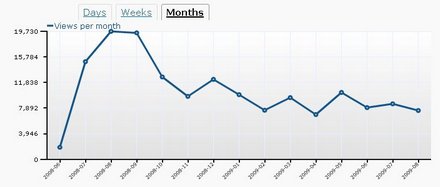
The campaign blog now has nearly 250 articles, and has received 2500 comments. Here are the visitor statistics from the WordPress stats module. You can see the initial surge, and how interest has been maintained at around 10k page views each month.

20090824-spckssg-news-blog-past-150k-pageviews

Though very respectable, this is not a huge amount of traffic, but a successful niche campaign does not need a huge amount of traffic – and it could even be a distraction to receive many more comments than we do already.

Continue reading

Newspapers: turn off your RSS feeds

Update, 2 days later: Paul lets me guest post here (ie I wrote this, not him). It was going fairly well until I wrote this post … You can read my climbdown here

The latest subscriber figures (see table below, and first published in my blog’s newspapers category) show that, apart from a couple of exceptions, it’s time for newspapers to turn off their RSS feeds – and hand over the server space, technical support and webpage real estate to an alternative, such as their Twitter accounts.

(You can read some of the defences of RSS here and here)

The table below shows that only 3 of the 9 national newspapers have an RSS feed with more than 10,000 subscribers in Google Reader.

And most newspaper RSS feeds have readerships in the 00s, if that.

melanie-phillips-rssDaily Mail columnist Melanie Phillips has just 11 subscribers to her RSS feed (maybe there’s hope for the UK population yet …).

Despite having virtually no users, the Mail churns out 160 RSS feeds and the Mirror 280. All so a couple of thousand people can look at them in total.

The other papers are just as bad. And while the Guardian has a couple of RSS readers with decent numbers (partly because Google recommends it in its news bundle), it has more feeds than there are people in the UK … Continue reading

The Guardian’s tool to crowdsource MPs’ expenses data: time to play

So here’s The Guardian’s crowdsourcing tool for MPs’ expenses. If you’ve not already, you should have a play: it’s a dream. There are over 77,000 documents to get through – and in less than 24 hours users have gone through over 50,000 of those. You wonder how long it took The Telegraph to get that far.

Meanwhile, that process is doing much more than just finding ‘stories’. It’s generating data: the date, the amount, the type of expense, the type of document. When this stage is finished, The Guardian will have a database that will allow people to filter, mix and combine the expenses data in different ways.

It’s also about telling a ‘story’ in a different way. There’s an element of game mechanics in the site – that progress bar (shown above) compels you to bring the site to completion (it strangely reminds me of the Twitter game Spymaster). This makes it more engaging than a made-for-print exclusive – as I wrote about Help Me Investigate, this isn’t ‘citizen journalism’: it’s micro-volunteering. And when you volunteer, you tend to engage.

And when you treat news as a platform rather than a destination, then people tend to spend more time on your site, so there’s an advertising win there.

Finally, we may see more stories, we may see interesting mashups, and this will give The Guardian an edge over the newspaper that bought the unredacted data – The Telegraph. When – or if – they release their data online, you can only hope the two sets of data will be easy to merge. 

What’s been happening with Help Me Investigate

It’s finally been announced that my project Help Me Investigate is being funded by 4iP and Screen West Midlands.

Help Me Investigate (HMI) is a platform for crowdsourcing investigative journalism. It allows anyone to submit a question they want to investigate – “How much does my hospital make from parking charges?” “What happened to the money that was allocated to my local area?” “Why was that supermarket allowed to be built opposite another supermarket?” …

But more importantly, it then enables users to mobilise support behind that question; and to pursue it.

HMI attempts to address the biggest issue facing journalism: how do we save the good stuff? The persistent slow-brewed journalism that was previously subsidised (if you were lucky) by more commercially friendly instant journalism, but which stands to lose most as commercial content becomes disaggregated and reaggregated, and audiences and their activity measurable.

How do you support Slow Journalism?

Help Me Investigate is an attempt to use the qualities of the web to pursue investigative journalism. There are various aspects to this (which I’ll be exploring, along with others, in the Help Me Investigate blog), but fundamentally it comes down to this:

  • The web allows you to ‘atomise’ processes – break them down into their constituent parts. The site breaks apart investigative – often campaigning – journalism allowing users to contribute in specific and different ways. This is not citizen journalism – it is micro-volunteering.
  • Investigative journalism is about more than just ‘telling a story’; it is about enlightening, empowering and making a positive difference. And the web offers enormous potential here – but users must be involved in the process and have ownership of the agenda.
  • The web is more tool than destination – successful business models rest on creating a platform
  • Likewise, the web is more of a communication medium than a storytelling one; therefore, we are focusing on communication and community rather than stories; process, rather than product.
  • We are also focused on making the process itself rewarding, not just the end result. Journalism is a by-product.
  • Online, failure is cheap; unlike a traditional news organisation, HMI doesn’t need the majority of investigations to ‘succeed’; in fact, failure is built into the design as a necessary ingredient of the site’s overall success. If you want to budget for it, put it under ‘training’ and ‘R&D’.
  • Do what you do best and link to the rest: the site is networked – we’re not trying to be or host all things but will be pointing elsewhere more often than not

I could go on, and I will in the blog. But I think those points are core. I don’t expect this project will have all the answers, but I think we are asking the right questions, at the right time.

Now, it’s worth pointing out that the idea of ‘investigative journalism’ covered here is a broad one – indeed, we have no idea of predicting what questions will be pursued: the agenda will be determined almost entirely by users (including journalists) and topics could range from the very personal, hyperlocal to more national questions. That alternative to a mainstream editorial agenda will be interesting in itself: how many questions will we get that newspapers would find unappealing?

So what’s happening now?

We’re building a very rough and ready frame within which users can play. How that develops depends in large part on what the users need to do – we’ll be doing much of the development as it is being used.

Already a handful of people have used the site in its closed test form, and in the following weeks quite a few more will start to go through it. Then the site will be opened in a semi-closed beta.

To begin with we’re focusing our personal efforts on Birmingham, although people elsewhere will be able to use the site.

The site is being built by Webby Award-winning developer Stef Lewandowski, while the community side of things is headed up by Nick Booth. Both have been crucial contributors to the development of HMI. Joining us behind the site are community support Paul Henderson and investigative journalist Heather Brooke, author of the wonderful guide to FOI Your Right To Know. They will be suggesting and supporting activities to users who submit or join investigations on the site.

It’s taken 18 months to get to this point, and the hard work starts now. If you want to be involved in any capacity let me know.

Citizen journalism and investigative reporting: from journalism schools to retirement communities

The myriad numbers of citizen journalism sites that pop up everyday seem to suggest that the media can fulfill the purposes of democracy by merely offering their audiences a forum to express themselves.

However, to tap into its full potential, participatory journalism should try to do something in addition to what mainstream reporting already does – such as expanding source diversity, shifting focus to neglected sections of the population, or pursuing different angles and perspectives on a story. If not, it is not doing much more than using its readers as a form of cheap labor, and perhaps laying off journalists while it’s at it.

Citizen journalism is hardly beneficial when it merely propagates the flaws of traditional reporting. Huffington Post’s Off the Bus produced many stories on the US Presidential campaign last year – but the one we remember most vividly is Mayhill Fowler’s reporting of Barack Obama’s “bitter” comment – the story that put gotcha journalism from mainstream reporters to shame.

The paucity of good investigative reporting through citizen journalism is not surprising, considering the amount of effort such stories require from news organizations in terms of coordination and oversight. Perhaps, most importantly, they require a huge time investment from the audience. While people might be easily persuaded to relay food-item prices from their grocery bills, they are less likely to pursue public officials or make trips to government offices to retrieve information.

Which is why magazines like The Nation are allowing their audiences simpler methods to contribute to significant news stories. With its “Ask the President” feature, the weekly is encouraging readers to pose questions for the Obama administration’s upcoming press conferences. Queries that receive the most votes will get asked by Nation journalists, pending agreement from the White House. This is perhaps the digital equivalent of newspapers inviting their readers to town hall meetings to question public officials.

News organizations are also trying to encourage investigative journalism “from the desk.” With the amount of interactive tools available online, it is perhaps easiest to get readers to contribute through their computers since they already spend several hours in front of them. National news stories especially lend themselves well to this form of reporting.

The nonprofit investigative journalism site Propublica hopes to analyze Barack Obama’s stimulus package by encouraging audience contributions. Data and documents will be available on the site, and readers will be encouraged to offer ideas for stories and topics of newsworthy content. Details of how distributed reporting will be implemented have not been worked out yet, but as Senior Editor Eric Umansky reasons, the breadth of the stimulus projects and their potential effects are so huge that there simply are not enough traditional journalists to cover the subject. But with the help of citizen reporters all around the country, Propublica can do a better job of reporting on all angles of the story. When you recall that the same idea allowed Talking Points Memo to break the news about the Bush administration’s firing of eight US attorneys in late 2007, it is easy to be optimistic about Propublica’s venture.

Another idea that is gaining popularity is the coupling of journalism school projects to citizen reporting. In this fast-changing media world where every citizen is a reporter, students of journalism should be specifically trained to tap into the vast talent available in the community, writes Elizabeth Zwerling. That is exactly what the Annenberg School for Communication in Los Angeles is attempting to do with its hyperlocal news site, Intersections.

The project is shining the spotlight on the less privileged classes that mainstream media has long ignored with its profit-centered interest in affluent communities. Online journalism often reproduces this censorship of omission because of the inherent digital divide. Students at the Annenberg School, however, are being trained to report on hyperlocal issues affecting urban LA communities. Local residents, many of whom include working class immigrants, work with students to transmit their photos, videos and stories through cell phones.

Sites such as Texas Watchdog, on the other hand, are implementing programs to train civilians to become watchdogs of the government; the program teaches citizens to access and review public documents, among other things.

Another potential goldmine for citizen journalism at the hyperlocal level appears to be populations of retired individuals, who have both the time and inclination to perform watchdogging functions for their communities, as Jack Driscoll found with Rye Reflections, a user-generated site run by retirees in a small community in New Hampshire. The drastic reduction in local news reporting by newspapers that have cut down their resources and budgets has meant that citizens are willing to take up the slack. This sort of community reporting offers people intellectual and social stimulation while fulfilling civic needs, according to Driscoll.

In addition, retired professionals can often lend their specific expertise to investigative news stories, as former engineers and lawyers in the community of Fort Myers, Florida proved during the News-Press’ investigation of a local utility company. However, Driscoll does not succumb to the rosy-eyed view that this sort of reporting can replace hardcore investigative journalism at the national or international level, or in specialized fields like science and medicine.

It’s little surprise then that the much talked-about Huffington Post Investigative Fund hopes to tap into the expertise of seasoned journalists to kick-start its investigative reporting exercise. Down the road, it will harness the power of its citizen volunteers. As Jay Rosen, who will serve as a senior advisor on the project, writes, “the best approach is to have no orthodoxy and to support very traditional investigative reporting by paid pros who are good at it, as well as teams of pros and amateurs, students working with masters of the craft, crowdsourced investigations, and perhaps other methods.”

A tall order to be sure. But news organizations need to quickly find ways to compensate for the dearth of resources and personnel in order to continue to perform in-depth investigative reporting, lest journalism may become completely irrelevant.

Do blogs make reporting restrictions pointless?

The leaked DNA test on 13-year-old alleged dad Alfie Patten has revealed a big problem with court-ordered reporting restrictions in the internet age. (NB This is a cut down version of a much longer original post on blogging and reporting restrictions that was featured on the Guardian).

Court orders forbidding publication of certain facts apply only to people or companies who have been sent them. But this means there is nothing to stop bloggers publishing material that mainstream news organisations would risk fines and prison for publishing.

Even if a blogger knows that there is an order, and so could be considered bound by it, an absurd catch 22 means they can’t found out the details of the order – and so they risk contempt of court and prison.

Despite the obvious problem the Ministry of Justice have told me they have no plans to address the issue. Continue reading

Use a crowd, gain an expert

Karthika Muthukumaraswamy on how crowdsourcing experiments in journalism need to learn from their commercial counterparts – and how the end results could bring financial rewards for everyone.

The crowd has done a great deal for journalism: it has counted the number of SUVs on the streets of New York City, determined Bill Clinton’s financial impact on Hillary Clinton’s campaign, and offered valuable suggestions to transform an impoverished Ugandan village.

Ever since journalism jumped on the crowdsourcing bandwagon following innovative business models in T-shirt designing and problem solving, it has been baffled by the intensity of crowd response. Consequently, the media’s implementation of it has lacked the selection process that is essential to use crowdsourcing to its fullest potential.

There are only so many T-shirts that Threadless can make and sell; there are only so many solutions to Innocentive’s complex problems; and there are only so many photographs that iStockphoto consumers will purchase. Continue reading

User generated content and citizen journalism (Online Journalism lesson #4)

Lesson 4 in this series of Online Journalism classes looks at User Generated Content (UGC) and Citizen Journalism. Now the students have to think creatively of ways to engage communities in the issues they’re covering (and vice versa):