Tag Archives: gender

Google Sheets has a new AI function — how does it perform on classification tasks?

A new AI function is being added to Google Sheets that could make most other functions redundant. But is it any good? And what can it be used for? Here’s what I’ve learned in the first week…

AI has been built into Google Sheets for some time now in the Clippy-like form of Gemini in Sheets. But Google Sheets’s AI function is different.

Available to a limited number of users for now, it allows you to incorporate AI prompts directly into a formula rather than having to rely on Gemini to suggest a formula using existing functions. 

At the most basic level that means the AI function can be used instead of functions like SUM, AVERAGE or COUNT by simply including a prompt like “Add the numbers in these cells” (or “calculate an average for” or “count”). But more interesting applications come in areas such as classification, translation, analysis and extraction, especially where a task requires a little more ‘intelligence’ than a more literally-minded function can offer.

I put the AI function through its paces with a series of classification challenges to see how it performed. Here’s what happened — and some ways in which the risks of generative AI need to be identified and addressed.
Continue reading

If we are using AI in journalism we need better guidelines on reporting uncertainty

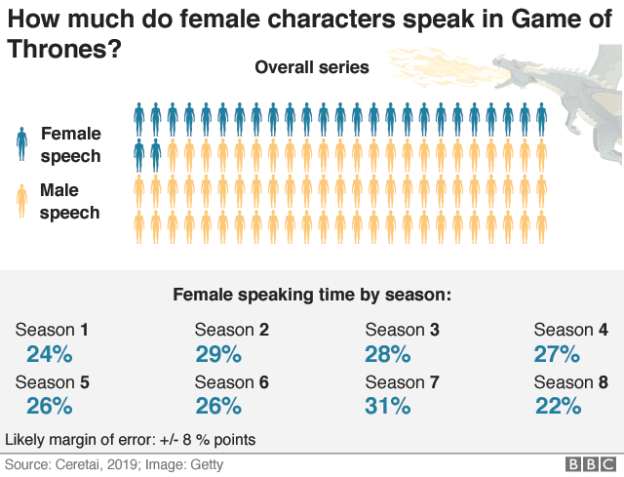
Chart: women speak 27% of the time in Game of Thrones

The BBC’s chart mentions a margin of error

There’s a story out this week on the BBC website about dialogue and gender in Game of Thrones. It uses data generated by artificial intelligence (AI) — specifically, machine learning —  and it’s a good example of some of the challenges that journalists are increasingly going to face as they come to deal with more and more algorithmically-generated data.

Information and decisions generated by AI are qualitatively different from the sort of data you might find in an official report, but journalists may fall back on treating data as inherently factual.

Here, then, are some of the ways the article dealt with that — and what else we can do as journalists to adapt.

Margins of error: journalism doesn’t like vagueness

The story draws on data from an external organisation, Ceretai, which “uses machine learning to analyse diversity in popular culture.” The organisation claims to have created an algorithm which “has learned to identify the difference between male and female voices in video and provides the speaking time lengths in seconds and percentages per gender.”

Crucially, the piece notes that:

“Like most automatic systems, it doesn’t make the right decision every time. The accuracy of this algorithm is about 85%, so figures could be slightly higher or lower than reported.”

And this is the first problem. Continue reading

On International Women’s Day here are 7 data journalism projects about women’s issues

Photo: Pixabay

Women represent 49.5% of the world’s population, but they do not have a corresponding public, political and social influence. In recent years, more and more women have raised their voices, making society aware of their challenges — data journalists included. To commemorate International Women’s Day, Carla Pedret presents a list of data journalism projects that detail the sacrifices, injustices and prejudices that women still have to face in the 21st century.

Continue reading

Want your reporting to better reflect the diversity of your audience? There’s a free ebook for that

Two of my colleagues at Birmingham City University have produced a rather wonderful free guide to help journalists and journalism educators make reporting more inclusive and diverse. As they explain in the introduction: Continue reading