
The Telegraph is starting to make a habit of combining Flash and databases to impressive effect. Their latest project brings in mapping too, to produce a political map of the UK which has real depth behind its Flashy appearance.

The Telegraph is starting to make a habit of combining Flash and databases to impressive effect. Their latest project brings in mapping too, to produce a political map of the UK which has real depth behind its Flashy appearance.
Eric Ulken has taken “all the online job descriptions on JournalismJobs.com from this year, omitted the non-technical words (like “editor”, “seeks” and “self-starter”) and built a tagcloud out of the rest”. This is the result:
Eric Ulken | Technical skills in journalism jobs
Blogged with Flock
De Volkskrant’s Harry Potter multimedia interactive isn’t quite what I meant when I talked about the ‘Daily Prophet’ approach to video journalism, but it’s a nice twist on the idea…
So far this model has looked at sourcing stories in the new media age, and reporting a news story in the new media age. In this third part I look at what should happen after a news story has been reported, using a familiar framework: the 5 Ws and a H – who, what, where, why, when and how.

A web page – unlike a newspaper, magazine or broadcast – is never finished – or at least, can always be updated. Its permanence is central to its power, and relates directly to its connectivity (and therefore visibility).
Once out there it can be linked to, commented on, discussed, dissected, tagged, bookmarked and sent to a friend. That can take place on the original news site, but it probably doesn’t. The story is no longer yours. So once the news site has added comments, a message board, ’email to a friend’ boxes and ‘bookmark this’ buttons, what more can it do? Continue reading
Part four of this draft book chapter looks at how blogs have changed the publishing of journalism through its possibilities for transparency, potential permanence over time, limitless space, and digital distribution systems (part one is here; part two here; part three here) . I would welcome any corrections, extra information or comments.
Traditionally, news has always been subject to the pressures of time and space. Today’s news is tomorrow’s proverbial ‘fish and chip paper’ – news is required to be ‘new’; stories “have a 24 hour audition on the news stage, and if they don’t catch fire in that 24 hours, there’s no second chance” (Rosen, 2004). At the same time, part of the craft of journalism in the 20th century has been the ability to distil a complex story into a particular word count or time slot, while a talent of editors is their judgement in allocating space based on the pressures of the day’s competing stories.
In the 21st century, however, new media technologies have begun to challenge the limitations of time and space that defined the news media in the 20th. Continue reading
If you have ten minutes today, click along to Katine: it starts with a village. With this project The Guardian is doing something very special indeed with crowdsourcing, interactive storytelling, and journalism itself.
Launched over the weekend, Katine appears to be a new approach to “the annual appeal to focus attention on worthwhile causes during the pre-Christmas giving season”. Editor Alan Rusbridger explains: Continue reading
Consider this my first attempt at a photoblog entry. For those who prefer video or text you can see both at http://www.ejc.net/seminars/picnic_2007_3

I’ve agreed to pass on the following call from Gregory Povey of MELD. Sounds a very worthy attempt to match new media and journalistic expertise:
MELD is a world first project: bringing together the best northern (UK) journalists and new media practitioners to explore what happens when the two worlds collide
Selected talent will be paid to attend a five-day residential lab where they will develop products and pitch them to industry partners. This is a fantastic opportunity to extend industry networks, develop new products and explore new routes to market Continue reading
A month ago, I used the Online Journalism Facebook Group to ask readers to suggest what areas they wanted covering, in an experiment with bottom-up editing (the forum for suggestions is still open by the way). Megan T suggested “Rethinking the production of newspapers”.
After researching, conceptualising and scribbling, I’ve come up with a number of models around the news process, newsgathering, interactivity and business models.
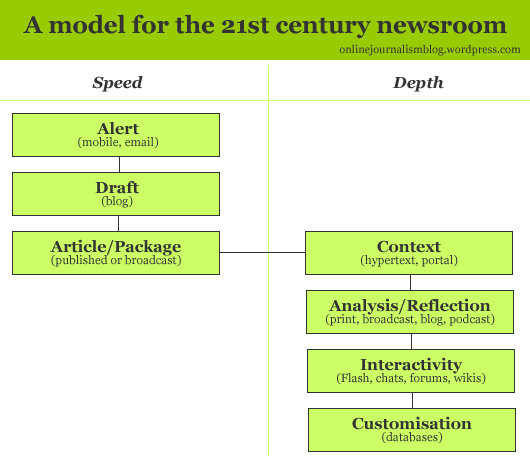
The following, then, is the first in a series of proposals for a ‘model for the 21st century newsroom’ (part two is now here). This is a converged newsroom which may produce material for print or broadcast or both, but definitely includes an online element. Here’s the diagram. The model is explained further below it
On Thursday I’ll be presenting my paper on wiki journalism at the Future of Newspapers conference in Cardiff. As previously reported, the full paper is available as a wiki online for anyone to add to or edit. You can also download a PDF of the ‘official’ version.
Based on a review of a number of case studies, and some literature on wikis, the paper proposes a taxonomy of wiki journalism, and outlines the opportunities and weaknesses of the form. The following is the edited highlights: Continue reading

 Online Journalism Blog