Tag Archives: review

4 ways you can ‘role play’ with AI

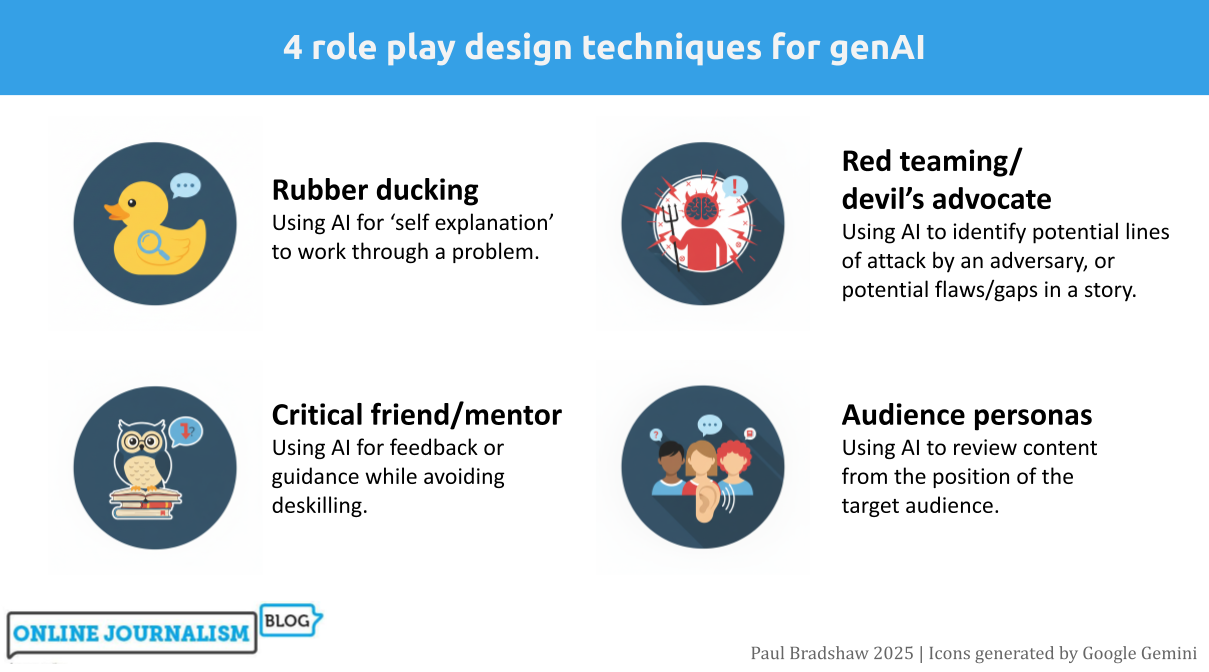
4 roleplay design techniques for genAI
Rubber ducking
Using AI for ‘self explanation’ to work through a problem.
Critical friend/mentor
Using AI for feedback or guidance while avoiding deskilling.
Red teaming/
devil’s advocate
Using AI to identify potential lines of attack by an adversary, or potential flaws/gaps in a story.
Audience personas
Using AI to review content from the position of the target audience.

One of the most productive ways of using generative AI tools is role playing: asking Copilot or ChatGPT etc. to adopt a persona in order to work through a scenario or problem. In this post I work through four of the most useful role playing techniques for journalists: “rubber ducking”, mentoring, “red teaming” and audience personas, and identify key techniques for each.

Role playing sits in a particularly good position when it comes to AI’s strengths and weaknesses. It plays to the strengths of AI around counter-balancing human cognitive biases and ‘holding up a mirror’ to workflows and content — and scores low on most measures of risk in using AI, being neither audience-facing nor requiring high accuracy.

Continue reading


The most-read posts on Online Journalism Blog — and on Medium — in 2016

2016

Rounding up the best posts of the year is a good habit to get into, but one that I’ve failed to acquire. In 2014 – the ten year anniversary of this site – I rounded up the year’s best performing posts, which does give you a flavour of what was happening that year — but I forgot to repeat it for 2015.

Here, then, are some reflections on the 10 pieces which did best in 2016 (there were 100 posts across the year), plus the older posts which keep on giving, and a comparison of some pieces which did far better on Medium than on OJB. Continue reading

2015 in review: you’re so retro

Snapchat's breaking news coverage

Snapchat’s breaking news coverage was one of the most significant developments of 2015

It’s that time again: Nic Newman‘s email has dropped asking various people to do some highly suspect future-gazing (at least I got WhatsApp and the election right last time). Here are my answers to his questions, delivered with suitable scepticism…

What surprised me most in 2015?

What surprised me most in 2015 is the enormous surge in ‘civic tech‘ around the election compared to 2010: coders collaborating to make apps and websites to help people make an informed decision on their vote. Continue reading

The 10 most-read posts (and one page) on the Online Journalism Blog in 2014

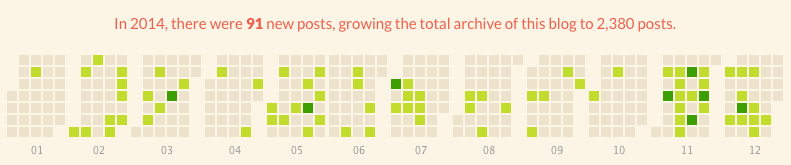
ojb post frequency 2014

The last 2 months of 2014 saw a return to regular blogging after some quiet periods earlier in the year

2014 was the 10th anniversary of the Online Journalism Blog, so I thought I’d better begin keeping track of what each year’s most-read posts were.

In 2014 the overriding themes for this blog were programming for journalists, web security, and social media optimisation. Here are the most-read posts of the year, plus one surprisingly popular new page with some background and updates. Continue reading

A review of Help Me Investigate in 2013 – and learning from it in 2014

Help Me Investigate logo

Over on the Help Me Investigate Blog there’s a review of the project’s activities over the past year across its four sites: Health, Olympics, Education and Welfare.

Four site editors landed jobs in the media during the year, which was particularly nice to see, but also meant we lost a certain amount of continuity. Learning from that, this year I’ll be focusing the project’s efforts particularly on welfare issues such as child poverty, housing, food poverty, and the one year anniversary of the bedroom tax.

If you want to get involved, please contact carol@helpmeinvestigate.com or tweet us for a follow on Twitter @carolmiers and @paulbradshaw.

Web security for journalists – takeaway tips and review

Web security for journalists - book cover

Early in Alan Pearce‘s book on web security, Deep Web for Journalists, a series of statistics appears that tell a striking story about the spread of surveillance in just one country.

199 is the first: the number of data mining programs in the US in 2004 when 16 Federal agencies were “on the look-out for suspicious activity”.

Just six years later there were 1,200 government agencies working on domestic intelligence programs, and 1,900 private companies working on domestic intelligence programs in the same year.

As a result of this spread there are, notes Pearce, 4.8m people with security clearance “that allows them to access all kinds of personal information”. 1.4m have Top Secret clearance.

But the most sobering figure comes at the end: 1,600 – the number of names added to the FBI’s terrorism watchlist each day.

Predictive policing

This is the world of predictive policing that a modern journalist must operate in: where browsing protesters’ websites, making particular searches, or mentioning certain keywords in your emails or tweets can put you on a watchlist, or even a no-fly list. An environment where it is increasingly difficult to protect your sources – or indeed for sources to trust you.

Alan Pearce’s book attempts to map this world – and outline the myriad techniques to avoid compromising your sources. Continue reading

Three book reviews: leaks, FOI, and surveillance

Secret Manoeuvres in the Dark book cover
This Machine Kills Secrets book cover

If you’re interested in leaks, surveillance or FOI, three book reviews I wrote over the last two months on the Help Me Investigate blog recently might interest you:

Livesheets creator wants to “make all kids into rocket scientists”

Abacus image by Anssi Koskinen

Abacus image by Anssi Koskinen on Flickr

“Imagine if you could search for any calculations and then just use them directly without ever having to work it out yourself from scratch.”

This is the vision of developer Daniel Maxwell, the creator of livesheets.com, whose dream it is for no one in the world to perform the same calculation twice again. Continue reading

7 books that journalists working online should read?

Image by B_Zedan

While it’s one thing to understand interactive storytelling, community management, or the history of online journalism, the changes that are affecting journalism are wider than the industry itself. So although I’ve written previously on essential books about online journalism, I wanted to also compile a list of books which I think are essential for those wanting to gain an understanding of wider dynamics affecting the media industries and, by extension, journalism.

These are books that provide historical context to the hysteria surrounding technologies; that give an insight into the cultural movements changing society; that explore key philosophical issues such as privacy; or that explore the commercial dynamics driving change.

But they’re just my choices – please add your own.

Continue reading