Tag Archives: twitter

BCU’s ‘Trinity Mirror Student Online Journalist of the Year 2008’ – Azeem Ahmad

Before the year ends please allow me to publicly congratulate Azeem Ahmad on winning the Birmingham City University ‘Student Online Journalist of the Year’ award, sponsored by Trinity Mirror.

Azeem graduated this year from the journalism degree. For his final year project he worked as the Web Editor for ENO (Environmental News Online), along with Editor Rachael Wilson.

Azeem built the site from scratch using open source content management system Joomla, a raft of plugins, and even survived a hacker attack. But more importantly, he has probably grasped the workings of a networked environment better than any other student, using Twitter particularly effectively, building RSS mashups, learning about search engine optimisation, and exploring the vagaries of online communities. With Rachael he managed a team of second year journalism students as they learned online journalism on the job – the first time I’d tried such a model, which seemed to work very well.

I thoroughly enjoyed reading Azeem’s blog entries and seeing the problems he faced in building and maintaining the site both technically and editorially. But, unsurprisingly in the current environment, Azeem has not yet landed a permanent journalism job and so is not blogging as often these days. I’m hoping that changes in ’09. Good luck, Azeem.
Twitter/mobile bookmarking with Tagthis (Something for the Weekend #13)

It’s been a while since I did a Something for the Weekend tool review, but Twitter bookmarking service TagThis is such a great tool it needed covering.

TagThis allows you to bookmark any URL you see on Twitter to your own account on Delicious or Magnolia. This is particularly useful if, like me, you use Twitter on a mobile phone or iPod, and often see useful links on Twitter that you’d like to come back to later or ‘file’ for reference. Continue reading

War, assassination, and Strictly Come Dancing: What news did you first hear on Twitter?

This is just a bit of curious fun. I can think of a few stories I heard first on Twitter. They are:

  • The assassination of Benazir Bhutto (via @martinstabe)
  • The Chinese earthquake (via @scobleizer)
  • The deaths of Bo Diddley and Ted Rogers
  • The resignation of Roy Keane as manager of Sunderland
  • Bank of England lowering interest rate to 2%
  • Russian tanks moving into South Ossetia
  • And, er, the Strictly Come Dancing voting scandal-that-then-became-a-fiasco (via @aarons)

It’s a curious mix of the general and the very specific. And I’m sure there are others I’ve since forgotten.

I asked the Twittersphere what events they first heard there, and the recent events in Mumbai featured highly, along with some of the above. Others included Michael Grimes hearing about the arrest of MP Damian Green via Twittering Labour MP @Tom_Watson before it hit the BBC, Dilyan Damyanov hearing about the death of Michael Crichton, and medeamaterial hearing about Ingrid Betancourt’s liberation from the FARC: “full five minutes after reading it tweeted by several people it was on TV”.

Conrad Quilty-Harper mentioned the OJ Simpson guilty verdict “and countless others first via @BreakingNewsOn“. Dana_Willhoit said “It’s amazing. I was a newspaper reporter – now I turn to Twitter for my news.”

What news stories can you remember hearing first on Twitter? Are there certain types that seem to spread better than others?

Is networked journalism more passive?

Last week I spoke at the BBC College of Journalism’s Future of Journalism conference about the future newsroom, and the News Diamond specifically. Chair Louise Minchin asked the following question: did these new production processes mean journalists would become more passive?

It is a great question. On the surface that’s what would appear to be happening: in posting alerts and blog drafts you are inviting the input of the audience and therefore being more reactive. Continue reading

Are these the biggest moments in journalism-blogging history?

Here’s another one for that book I’m working on – I’m trying to think: what have been the most significant events in the history of journalism blogging?

Here’s what I have so far (thanks Mark Jones and Nigel Barlow):

What have I missed? This is a horribly Anglo-American list, too, so I’d particularly welcome similar moments from other countries.

Elections08: Storytelling with public databases

Written by Wilbert Baan

Today is the day of the US elections. I don’t think we ever had a live event on the web that will get so much live coverage. This means incredible amounts of information will be published over all kind of services and social networks. Websites like Facebook, Twitter, Flickr, WordPress, Blogger and many more.

Most popular web services have programmable interfaces. These interfaces allow developers to extract information out of the system. This creates a whole new genre of storytelling: storytelling with public databases. You can aggregate the information you need and sort it the way you want.

To prove the concept I made three small mock-ups. They all use search.twitter.com to see how people voted.

When I made the first the first animation Erik Borra replied by developing the idea into something that stores the data retrieved from Twitter in a database. I made a new interface that shows a graph based on what people say they voted on Twitter. And the result is a Twitter Poll.

These three examples are not representative data, it is extracted from Twitter. But it shows you how much personal and valuable information is in the public database. All you have to do is ask yourself what you want to tell to your readers and if this information is available.

I voted

This animation gets the latest twitter message where someone says they voted on McCain or Obama. It automatically refreshes. Continue reading

Blogging journalists pt 5: Post-publication: “You’ve got to be ready for that conversation”

The 5th part of the results of my survey of blogging journalists looks at how blogging has affected what happens after news is ‘published/broadcast’.

In the post-publication or post-broadcast phase of journalism, blogging has introduced a more iterative and ongoing format. Some phrase this in terms of old media paradigms – the items have “more legs” – while others identify how the previous process of “moving on” to the next big story and forgetting about the old one no longer applies so strongly: Continue reading

Blogging journalists: pt.2: Blogs and news ideas: “The canary in the mine”

The second part of the results of my survey of blogging journalists looks at how blogs have affected how journalists generate story ideas and leads.

Blogs and news ideas: “The canary in the mine”

Blogging's effect on story ideas by industry

For blogging journalists, blogs have disrupted the traditional processes of journalism in a number of ways.

Respondents spoke of a clearer perception of audience needs and interests as a result of comments and visitor statistics, which in turn fed into the choice of topics and angles to cover. Continue reading

Maps, mashups and multimedia: online journalism students tackle interactivity

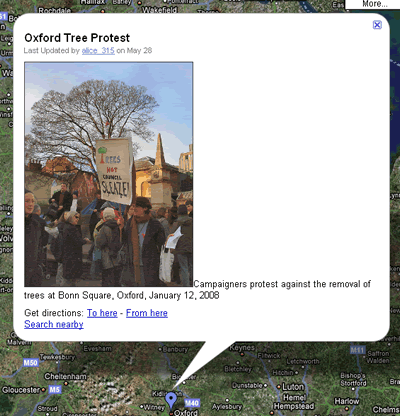
Alice Fanning's map of UK eco stories

Alice Fanning's map of UK eco stories

As a new semester begins it seems a good time to finally post about how my second year journalism degree students approached the ‘interactive’ element of their portfolio way back in May (yes, everything they do is interactive, but bear with me).

For the first time I gave them an open brief in terms of what they did interactively (in previous years I asked them to produce Flash interactives). Having been taught how to create everything from audio slideshows and image maps to multimedia interactives, Google Maps and Yahoo! Pipes mashups, I was curious to see what they would pick. Would they all plump for the same option? Continue reading

They’re not “geeks” – they’re early adopters

Last week I was at a magazine publishers talking about social media platforms, when it was put to me that the platform I was talking about was “mainly used by Valley types”, and why should journalists invest time in a platform when the majority of readers of more conservative titles don’t use it?

It’s a recurring question – so much so that I have decided to present my answer here. I’d welcome any additions. Continue reading