Tag Archives: twitter

Famous Twitter users: who gets the most click-throughs – and why?

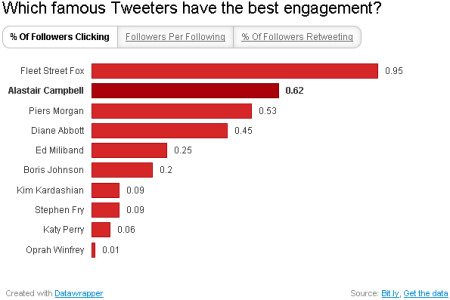
Famous Tweeters - percentage of followers clicking through

Famous Tweeters – percentage of followers clicking through

In the third and final post of this series Patrick Scott had a look at the click-through rate (CTR) of some famous individual Twitter users and found that those who do best tend to be political.

Follow @Patrick_E_Scott

In the first post of this series we saw that regional newspapers that tend to do well on Twitter follow a larger proportion of people relative to the number of people following them.

Conversely, in the second post of the series we saw that this ratio of followers to followed is less significant for magazines. The successful magazine accounts tended to be more personable than personal and gave their followers a clear engagement pathway to go down.

In this post we will see that, like the regional newspapers, famous individuals with a higher CTR tend to have a better followers to followed ratio, although there are a couple of notable exceptions to this. Continue reading

The regional press on Twitter: interview with Johnston Press’s Mark Woodward

In a previous post, we saw that some regional newspapers do a lot better than others in terms of their Twitter click-through rate. Johnston Press titles, The Northampton Chronicle and Echo, The Scotsman and The Lancashire Evening Post tended to perform the best out of the 10 newspapers that we looked at in this regard.

The Online Journalism Blog talked to Mark Woodward, head of websites at Johnston Press, about the findings and about how Johnston Press sees Twitter as a whole.

Johnston Press Logo

Image: Johnston Press

How Johnston Press adapted to Twitter

The need to adapt to the evolving digital landscape is very important for regional newspapers as they attempt to reduce the well documented decline in readership.

A large part of this adaptation is concerned with the growth of social media and the ways that this can be used to drive traffic to a news site.

Out of all the papers analysed in the original post, the Johnston Press titles seemed to be doing this best.

Continue reading

Test your online journalism law: 2 – the celebrity visit without pictures

Every day this week I am publishing an example of a legal dilemma that a journalism student might face (why? Read my previous post on students being publishers, and the responsibilities that come with that). I can’t promise a ‘right answer’ at the end of the week – but I hope you can comment on what a student publisher might do – and why.

Case 2: Celebrity visit – and you don’t have pictures

This is a true story. A fire drill has just ended, and as you’re walking back to the classroom you think you see a famous rugby player in the crowd. Your friend says “Nah, it’s not him”.

Like a good journalist, you don’t accept that, so you go to the university reception to ask if Famous Rugby Player is indeed around today. Yes, they say, he is.

Apparently he’s promoting a healthy eating scheme – and also looking at a new piece of kit designed by the health faculty.

You get the details of what he’s doing there, and where he will be when, make a quick call to your editor, and then chase off to find him.

Once there, you interview him, a marketing rep from the company paying him, and a representative from the health faculty.

But your phone runs out of battery – so you have no photos.

As you get back to the newsroom, Famous Rugby Star’s visit is already all over Twitter.

You want to get this story up on your blog before the local newspaper – but a celebrity story is nothing without images.

Thankfully, a few of those tweeting about the visit have taken snaps. Also, one has uploaded some brief video footage to YouTube, and embedding is enabled.

Meanwhile, you have emailed the marketing rep and the health faculty rep for images – both have been promised, but you have no idea how long it will take.

The questions

  1. What are the legal issues here – and what tests need to be met for them to be an issue (or not)?
  2. What defence could you mount?
  3. How likely is it that legal action would result?
  4. Would you publish – and why?

‘Answers’ and discussion in the comments

Welcome to journalism. Now delete your history.

Yesterday an 18-year-old journalism student told me he’d deleted his entire Twitter history using TweetDelete. The same day I noticed that another had changed his Twitter username to remove a reference to Newcastle United.

I was not an innocent bystander – I have to admit: I’d sort of advised them to do this…

Full circle in five years

Some history: I’ve been training journalists and student journalists to use Twitter for almost five years now, and have seen an enormous shift in that time.

In those early classes – between 2008 and 2010 – the difficulty was getting people to write more informally: almost no one had a Twitter account, so they approached it as a professional tool, with professionalism very much in mind.

By the third year, however, things were starting to change. By then around half would typically have pre-existing Twitter accounts, and many were using them in a personal capacity. The problem was not using Twitter in the first place, but how to combine the professional with the personal. “Should I have a different account for personal use?” Yes, I used to say.

Now I don’t.

There’s no such thing as a personal Twitter account

I no longer suggest having separate professional and personal accounts because, aside from the difficulty of running two accounts, frankly there is no such thing as a truly personal, even private, account if you are a journalist.

Some manage the balance: Joanna Geary, who maintains @guardianJoanna and @joannaGeary, springs to mind. But Joanna is able to do that because her ‘personal’ account is barely distinguishable from her ‘work’ account: she acts professionally; she talks about things that interest many of the same people who follow her ‘professionally’.

Joanna, in other words, is the exception.

In the movement from one audience (close friends) to another (strangers who may be judging our credibility as reporters) the harsh truth is that we will be judged unfairly against a standard we never anticipated.

And so I ended up showing TweetDelete to a class of 18-year-olds.

And I only had to mention SnapChat, and sexting for them to get it.

Welcome to the world of permanence. Please keep an eye on your past. For the sake of convenience, you may want to delete it (at least TweetDelete will give you an archived copy).

Note: Ross Hawkes has a fascinating exercise on the same subject: he will find tweets by members of the class and present them back to the class with the name removed. What would they think? “But it’s out of context!” Exactly.

Related: Why you might not ever get a job again… if you swear a lot on the internet

Daily Mail users think it’s less unbiased than Twitter/Facebook

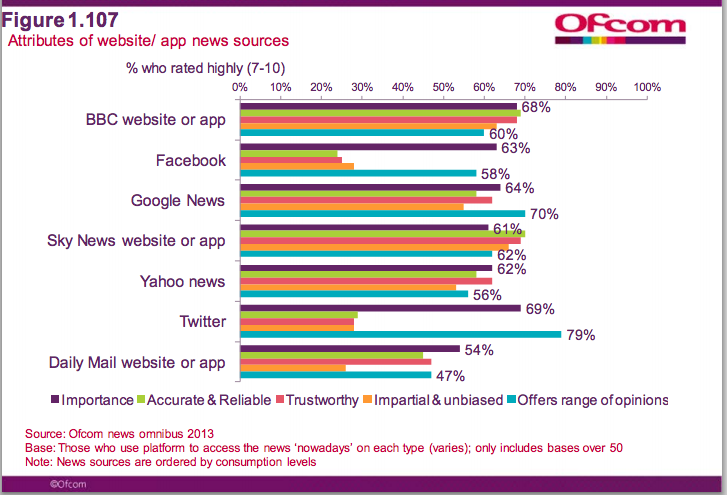
Daily Mail impartiality compared against BBC, Twitter, Facebook and others

Is the Daily Mail less impartial than social media? That’s the takeaway from one of the charts  (shown above) in Ofcom’s latest Communications Market Report.

The report asked website and app users to rate 7 news websites against 5 criteria. The Daily Mail comes out with the lowest proportion of respondents rating it highly for ‘impartiality and unbiased‘, ‘Offers range of opinions‘, and ‘Importance‘.

This is particularly surprising given that two of the other websites are social networks. 28% rated Facebook and Twitter highly on impartiality, compared to 26% for the Daily Mail. Continue reading

A case study in following a field online: setting up feeds on CCGs

Over at Help Me Investigate Health I’ve just published a bunch of 20 places to keep up to date with clinical commissioning. It’s an example of something I’ve written about previously – setting up an online network infrastructure as a journalist. And below, I explain the process behind it:

Following CCGs across local newspapers and blogs

If you’re going to start scrutinising a field, it’s very useful to be kept up to date with developments in that field:

  • Concerns raised in one local newspaper may be checked elsewhere;
  • Specialist magazines may provide guides to jargon or processes that helps save you a lot of time;
  • Politicians might raise concerns and get answers;
  • And expert bloggers can provide leads and questions that you might want to follow up.

Rather than checking a list of websites on the off chance that one has been updated, a much more efficient way to keep up to date on what’s happening is to use a free RSS readerContinue reading

Leveson: the Internet Pops In

The following post was originally published by Gary Herman on the NUJ New Media blog. It’s reproduced here with permission.

Here at Newmedia Towers we are being swamped by events which at long last are demonstrating that the internet is really rather relevant to the whole debate about media ethics and privacy. So this is by way of a short and somewhat belated survey of the news tsunami – Google, Leveson, Twitter, ACTA, the EU and more.

When Camilla Wright, founder of celebrity gossip site Popbitch (which some years ago broke the news of Victoria Beckham’s pregnancy possibly before she even knew about it), testified before Leveson last week (26 January 2012) [Guardian liveblog; Wright’s official written statement (PDF)] the world found out (if it could be bothered) how Popbitch is used by newspaper hacks to plant stories so that they can then be said to have appeared on the internet. Anyone remember the Drudge report, over a decade ago?

Wright, of course, made a somewhat lame excuse that Popbitch is a counterweight to gossip magazines which are full of stories placed by the PR industry.

But most interesting is the fact that Wright claimed that Popbitch is self-regulated and that it works.

Leveson pronounced that he is not sure there is ‘so much of a difference’ between what Popbitch does and what newspapers do – which is somehow off the point. Popbitch – like other websites – has a global reach by definition and Wright told the Inquiry that Popbitch tries to comply with local laws wherever it was available – claims also made more publicly by Google and Yahoo! when they have in the past given in to Chinese pressure to release data that actually or potentially incriminated users and, more recently, by Twitter when it announced its intention to regulate tweets on a country-by-country basis.

Trivia – like the stuff Popbitch trades – aside, the problem is real. A global medium will cross many jurisdictions and be accessible within many different cultures. What one country welcomes, another may ban. And who should judge the merits of each?

Confusing the internet with its applications

The Arab Spring showed us that social media – like mobile phones, CB radios, fly-posted silkscreen prints, cheap offset litho leaflets and political ballads before them – have the power to mobilise and focus dissent. Twitter’s announcement should have been expected – after all, tweeting was never intended to be part of the revolutionaries’ tool-kit.

There are already alternatives to Twitter – Vibe, Futubra, Plurk, Easy Chirp and Blackberry Messenger, of course – and the technology itself will not be restrained by the need to expand into new markets. People confuse the internet with its applications – a mistake often made by those authorities who seek to impose a duty to police content on those who convey it.

Missing the point again, Leveson asked whether it would be useful to have an external ombudsman to advise Popbitch on stories and observed that a common set of standards across newspapers and websites might also help.

While not dismissing the idea, Wright made the point that the internet made it easy for publications to bypass UK regulators.

This takes us right into the territory of Google, Facebook and the various attempts by US and international authorities to introduce regulation and impose duties on websites themselves to police them.

ACTA, SOPA and PIPA

The latest example is the Anti-Counterfeit Trade Agreement (ACTA) – a shadowy international treaty which, according to Google’s legal director, Daphne Keller, speaking over a year ago, has ‘metastasized’ from a proposal on border security and counterfeit goods to an international legal framework covering copyright and the internet.

According to a draft of ACTA, released for public scrutiny after pressure from the European Union, internet providers who disable access to pirated material and adopt a policy to counter unauthorized ‘transmission of materials protected by copyright’ will be protected against legal action.

Fair use rights would not be guaranteed under the terms of the agreement.

Many civil liberty groups have protested the process by which ACTA has been drafted as anti-democratic and ACTA’s provisions as draconian.

Google’s Keller described ACTA as looking ‘a lot like cultural imperialism’.

Google later became active in the successful fight against the US Stop Online Piracy Act (SOPA) and the related Protect Intellectual Proerty Act (PIPA), which contained similar provisions to ACTA.

Google has been remarkably quite on the Megaupload case, however. This saw the US take extraterritorial action against a Hong Kong-based company operating a number of websites accused of copyright infringement.

The arrest of all Megaupload’s executives and the closure of its sites may have the effect of erasing perfectly legitimate and legal data held on the company’s servers – something which would on the face of it be an infringement of the rights of Megaupload users who own the data.

Privacy

Meanwhile, Google – in its growing battle with Facebook – has announced its intention to introduce a single privacy regime for 60 or so of its websites and services which will allow the company to aggregate all the data on individual users the better to serve ads.

Facebook already does something similar, although the scope of its services is much, much narrower than Google’s.

Privacy is at the heart of the current action against Google by Max Mosley, who wants the company to take down all links to external websites from its search results if those sites cover the events at the heart of his successful libel suit against News International.

Mosley is suing Google in the UK, France and Germany, and Daphne Keller popped up at the Leveson Inquiry, together with David-John Collins, head of corporate communications and public affairs for Google UK, to answer questions about the company’s policies on regulation and privacy.

Once again, the argument regarding different jurisdictions and the difficulty of implementing a global policy was raised by Keller and Collins.

Asked about an on-the-record comment by former Google chief executive, Eric Schmidt, that ‘only miscreants worry about net privacy’, Collins responded that the comment was not representative of Google’s policy on privacy, which it takes ‘extremely seriously’.

There is, of course, an interesting disjuncture between Google’s theoretical view of privacy and its treatment of its users. When it comes to examples like Max Mosley, Google pointed out – quite properly – that it can’t police the internet, that it does operate across jurisdictions and that it does ensure that there are comprehensive if somewhat esoteric mechanisms for removing private data and links from the Google listings and caches.

Yet it argues that, if individuals choose to use Google, whatever data they volunteer to the company is fair game for Google – even where that data involves third persons who may not have assented to their details being known or when, as happened during the process of building Google’s StreetView application, the company collected private data from domestic wi-fi routers without the consent or knowledge of the householders.

Keller and Collins brought their double-act to the UK parliament a few days later when they appeared before the joint committee on privacy and injunctions, chaired by John Whittingdale MP.

When asked why Google did not simply ‘find and destroy’ all instances of the images and video that Max Mosley objected to, they repeated their common mantras – Google is not the internet, and neither can nor should control the websites its search results list.

Accused by committee member Lord MacWhinney of ‘ducking and diving’ and of former culture minister, Ben Bradshaw of being ‘totally unconvincing’, Keller noted that Google could in theory police the sites it indexed, but that ‘doing so is a bad idea’.

No apparatus disinterested and qualified enough

That seems indisputable – regulating the internet should not be the job of providers like Google, Facebook or Twitter. On the contrary, the providers are the ones to be regulated, and this should be the job of legislatures equipped (unlike the Whittingdale committee) with the appropriate level of understanding and coordinated at a global level.

The internet requires global oversight – but we have no apparatus that is disinterested and qualified enough to do the job.

A new front has been opened in this battle by the latest draft rules on data protection issued by Viviane Reding’s Justice Directorate at the European Commission on 25 January.

Reding is no friend of Google or the big social networks and is keen to draw them into a framework of legislation that will – should the rules pass into national legislation – be coordinated at EU level.

Reding’s big ideas include a ‘right to be forgotten’ which will apply to online data only and an extension of the scope of personal data to cover a user’s IP address. Confidentiality should be built-in to online systems according to the new rules – an idea called ‘privacy by design’.

These ideas are already drawing flak from corporates like Google who point out that the ‘right to be forgotten’ is something that the company already upholds as far as the data it holds is concerned.

Reding’s draft rules includes an obligation by so-called ‘data controllers’ such as Google to notify third parties when someone wishes their data to be removed, so that links and copies can also be removed.

Not surprisingly, Google objects to this requirement which, if not exactly a demand to police the internet, is at least a demand to ‘help the police with their enquiries’.

The problem will not go away: how do you make sure that a global medium protects privacy, removes defamation and respects copyright while preserving its potential to empower the oppressed and support freedom of speech everywhere?

Answers on a postcard, please.

Twitter’s ‘censorship’ is nothing new – but it is different

Over the weekend thousands of Twitter users boycotted the service in protest at the announcement that the service will begin withholding tweets based on the demands of local governments and law enforcement.

Protesting against censorship is laudable, but it is worth pointing out that most online services already do the same, whether it’s Google’s Orkut; Apple removing apps from its store; or Facebook disabling protest groups.

Evgeny Morozov’s book The Net Delusion provides a good indicative list of examples:

“In the run-up to the Olympic torch relay passing through Hong Kong in 2008, [Facebook] shut down several groups, while many pro-Tibetan activists had their accounts deactivated for “persistent misuse of the site … Twitter has been accused of silencing online tribute to the 2008 Gaza War. Apple has been bashed for blocking Dalai Lama–related iPhone apps from its App Store for China … Google, which owns Orkut, a social network that is surprisingly popular in India, has been accused of being too zealous in removing potentially controversial content that may be interpreted as calling for religious and ethnic violence against both Hindus and Muslims.”

What’s notable about the Twitter announcement is that it suggests that censorship will be local rather than global, and transparent rather than secret. Techdirt have noted this, and Mireille Raad explains the distinction particularly well:

  • “Censorship is not silent and will not go un-noticed like most other censoring systems
  • The official twitter help center article includes the way to bypass it – simply – all you have to do is change your location to another country and overwrite the IP detection.
    Yes, that is all, and it is included in the help center
  • Quantity – can you imagine a govt trying to censor on a tweet by tweet basis a trending topic like Occupy or Egypt or Revolution – the amount of tweets can bring up the fail whale despite the genius twitter architecture , so imagine what is gonna happen to a paper work based system.
  • Speed – twitter, probably one of the fastest updating systems online –  and legislative bodies move at glaringly different speeds – It is impossible for a govt to be able to issue enough approval for a trending topic or anything with enough tweets/interest on.
  • Curiosity kills the cat  and with such an one-click-bypass process, most people will become interested in checking out that “blocked” content. People are willing to sit through endless hours of tech training and use shady services to access blocked content – so this is like doing them a service.”

I’m also reminded of Ethan Zuckerman’s ‘Cute Cats Theory’ of censorship and revolution, as explained by Cory Doctorow:

“When YouTube is taken off your nation’s internet, everyone notices, not just dissidents. So if a state shuts down a site dedicated to exposing official brutality, only the people who care about that sort of thing already are likely to notice.

“But when YouTube goes dark, all the people who want to look at cute cats discover that their favourite site is gone, and they start to ask their neighbours why, and they come to learn that there exists video evidence of official brutality so heinous and awful that the government has shut out all of YouTube in case the people see it.”

What Twitter have announced (and since clarified) perhaps makes this all-or-nothing censorship less likely, but it also adds to the ‘Don’t look at that!’ effect. The very act of censorship, online, can create a signal that is counter-productive. As journalists we should be more attuned to spotting those signals.

Magazine editing: managing information overload

In the second of three extracts from the 3rd edition of Magazine Editingpublished by Routledge, I talk about dealing with the large amount of information that magazine editors receive. 

Managing information overload

A magazine editor now has little problem finding information on a range of topics. It is likely that you will have subscribed to email newsletters, RSS feeds, Facebook groups and pages, YouTube channels and various other sources of news and information both in your field and on journalistic or management topics.

There tend to be two fears driving journalists’ information consumption: the fear that you will miss out on something because you’re not following the right sources; and the fear that you’ll miss out on something because you’re following too many sources. This leads to two broad approaches: people who follow everything of any interest (‘follow, then filter’); and people who are very strict about the number of sources of information they follow (‘filter, then follow’).

A good analogy to use here is of streams versus ponds. A pond is manageable, but predictable. A stream is different every time you step in it, but you can miss things.

As an editor you are in the business of variety: you need to be exposed to a range of different pieces of information, and cannot afford to be caught out. A good strategy for managing your information feeds then, is to follow a wide variety of sources, but to add filters to ensure you don’t miss all the best stuff.

If you are using an RSS reader one way to do this is to have specific folders for your ‘must-read’ feeds. Andrew Dubber, a music industries academic and author of the New Music Strategies blog, recommends choosing 10 subjects in your area, and choosing five ‘must-read’ feeds for each, for example.

For email newsletters and other email updates you can adopt a similar strategy: must-reads go into your Inbox; others are filtered into subfolders to be read if you have time.

To create a folder in Google Reader, add a new feed (or select an existing one) and under the heading click on Feed Settings… – then scroll to the bottom and click on New Folder… – this will also add the feed to that folder.

If you are following hundreds or thousands of people on Twitter, use Twitter lists to split them into manageable channels: ‘People I know’; ‘journalism’; ‘industry’; and so on. To add someone to a list on Twitter, visit their profile page and click on the list button, which will be around the same area as the ‘Follow’ button.

You can also use websites such as Paper.li to send you a daily email ‘newspaper’ of the most popular links shared by a particular list of friends every day, so you don’t miss out on the most interesting stories.

Social bookmarking: creating an archive and publishing at the same time

Social bookmarking tools like Delicious, Digg and Diigo can also be useful in managing web-based resources that you don’t have time to read or think might come in useful later. Bookmarking them essentially ‘files’ each webpage so you can access them quickly when you need them (you do this by giving each page a series of relevant tags, e.g. ‘dieting’, ‘research’, ‘UK’, ‘Jane Jones’).

They also include a raft of other useful features, such as RSS feeds (allowing you to automatically publish selected items to a website, blog, or Twitter or Facebook account), and the ability to see who else has bookmarked the same pages (and what else they have bookmarked, which is likely to be relevant to your interests).

Check the site’s Help or FAQ pages to find out how to use them effectively. Typically this will involve adding a button to your browser’s Links bar (under the web address box) by dragging a link (called ‘Bookmark on Delicious’ or similar) from the relevant page of the site (look for ‘bookmarklets’).

Then, whenever you come across a page you want to bookmark, click on that button. A new window will appear with the name and address of the webpage, and space for you to add comments (a typical tactic is to paste a key quote from the page here), and tags.

Useful things to add as tags include anything that will help you find this later, such as any organisations, locations or people that are mentioned, the author or publisher, and what sort of information is included, such as ‘report’, ‘statistics’, ‘research’, ‘casestudy’ and so on.

If installing a button on your browser is too complicated or impractical many of these services also allow you to bookmark a page by sending the URL to a specific email address. Alternatively, you can just copy the URL and log on to the bookmarking site to bookmark it.

Some bookmarking services double up as blogging sites: Tumblr and Stumbleupon are just two. The process is the same as described above, but these services are more intuitively connected with other services such as Twitter and Facebook, so that bookmarked pages are also automatically published on those services too. With one click your research not only forms a useful archive but also becomes an act of publishing and distribution.

Every so often you might want to have a clear out: try diverting mailings and feeds to a folder for a week without looking at them. After seven days, ask which ones, if any, you have missed. You might benefit from unsubscribing and cutting down some information clutter. In general, it may be useful to have background information, but it all occupies your time. Treat such things as you would anything sent to you on paper. If you need it, and it is likely to be difficult to find again, file it or bookmark it. If not, bin it. After a while, you’ll find it gets easier.

Do you have any other techniques for dealing with information overload?


Paul Lewis: How “citizen journalism” aided two major Guardian scoops (guest post)

In a guest post for the Online Journalism Blog, Paul Lewis shows how Twitter helped the Guardian in its investigations into the deaths of news vendor Ian Tomlinson at the London G20 protests and Jimmy Mubenga, the Angolan detainee, while he was being deported from Heathrow.

This originally appeared in the book Investigative Journalism: Dead or Alive?, which also includes another chapter previously published on the blog: Has investigative journalism found its feet online?.

Investigative journalists traditionally work in the shadows, quietly squirrelling away information until they have gathered enough to stand-up their story. That silence reassures sources, guarantees targets do not discover they are being scrutinised and, perhaps most importantly, prevents competitors from pinching the scoop.

But an alternative modus operandi is insurgent. It is counter-intuitive to traditionalist mind-set, but far more consistent with the prevailing way readers are beginning to engage with news.

Investigating in the open means telling the people what you are looking for and asking them to help search. It means telling them what you have found, too, as you find it. It works because the ease with which information can be shared via the internet, where social-media is enabling collaborative enterprise between paid journalists and citizens who are experts in their realm.

Journalism has historically been about the hunt for sources, but this open method reverses that process, creating exchanges of information through which sources can seek out journalists. There are drawbacks, of course. This approach can mean forfeiting the short-term scoop. At times, the journalist must lose control of what is being investigated, how and by whom, and watch from a distance as others make advances on their story.

They have to drop the fallacy that their job title bestows upon them a superior insight to others. But all these are all worthwhile sacrifices in the context of what can be gained.

This is illustrated by Guardian investigations into the deaths of Ian Tomlinson, the newspaper seller who died at the London G20 protests in 2009, and Jimmy Mubenga, the Angolan detainee who died while being deported from Heathrow on 12 October 2010. In both cases, eliciting cooperation through the internet – particularly Twitter – allowed us to successfully challenge the official accounts of the deaths.

In the second part Lewis explains how he used Twitter and Flickr to pursue his investigation into the death of Ian Tomlinson.

UPDATE: The stories described in these posts can also be seen in this video of Paul speaking at the TEDx conference in Thessaloniki: