Tag Archives: twitter

News sites based on social media content in Latin America

I have to admit I didn’t see this one coming… traditional media corporations in Latin America are launching news sites based exclusively on content originated in social media.

First of all, we have 140 – news of Twitter, a new web site lunched by Perfil in Argentina, intended as a site for “people who don’t have a Twitter account but want to find out what’s happening” in the microblogging world.

Twitter has had a tremendous growth in the country in 2010, thanks mainly to TV shows that sudenly began using Twitter as a live interactive tool with the audience.

Then local celebrities and world-cup football players joined the conversation, finishing the job of popularizing the social network, and now even politicians replace their traditional press releases with fleeting 140 character messages that sometimes end up in front pages.

140 was created by Darío Gallo, executive editor of Perfil.com and former Director of Noticias (the most popular political magazine of the country), one of the early adopters of Twitter in Argentina. He assured me the new project is receiving good reactions and traffic. Continue reading

How to filter out Foursquare tweets

Sue Llewellyn asks if there’s a way to filter out Foursquare tweets. There is.

The first thing to do is work out something that all the tweets share. Well, every Foursquare tweet includes a link that begins http://4sq.com – so that’s it.

If you’re using Tweetdeck this is how you do it. At the bottom of every column in Tweetdeck are 6 buttons. The second one in – a downward-pointing arrow – is the ‘Filter this column’ button. Click this. A new row appears where you can filter the tweets. Select ‘Text’ then ‘-‘ and type ‘http://4sq.com’ in the third box. You should see tweets automatically filtered accordingly.

Seesmic desktop has a similar filtering function.

And on iPhone a few Twitter clients have filtering options, including Twittelator.

Let me know if you know of any others.

The curious case of More! magazine, Twitter and the mocking retweets

Here’s the strange tale of Blair and More! magazine. Blair is a fashion blogger who picked up a copy of More! magazine, didn’t like what she saw, and tweeted it.

More! then retweeted Blair’s critical opinions to their 11,000-plus followers – along with a couple of tweets that Blair had directed at a friend. Continue reading

An experiment tonight in joining up politics #onlinepolitics

Tonight I’m doing an experiment to create a conversation about politics across several different niches, with the idea of trying to broaden political debate.

My aim is to help pull together different aspects of politics and media – including campaigning, technology skills, scrutiny, how to report to a high standard, and local reporting – as a way of helping build participation online.

That’s a big subject, so I’m starting with one aspect that I can grab hold of and which should be of wide interest – making some income from political or other blogs – and a twitter chat on the hashtag #onlinepolitics from 9pm to 10pm, which will be captured on my blog using Cover It Live.

There is an introductory article for this chat published earlier today here, as a “starter for ten”.

Anyone is welcome to watch or join in.

I am @mattwardman on twitter.

A journalistic tour of the Argentinian Bicentenary

On May 25th we celebrate the Argentinian Bicentenary. And while the big media aren’t showing any really interesting initiatives, we have Tu Bicentenario, an independent and experimental journalistic project that aims to give real-time coverage to the main events of the celebrations with social tools and user-collaboration.

With a highly customizable website that integrates different movable boxes, including Facebook, Twitter, YouTube, Vimeo, Google Maps and mobile streaming, they are trying to facilitate the creation and publication of content not only by the creators but by the audience too.

The most interesting content that came out of the project so far -in my opinion- is the survey in pictures and videos of historic sites, contrasted with old images to show the changing of cities. This material is being geolocated in Google Maps.

Some Argentinean Google Maps users also upload 3D models of the most important sights so you can do a virtual tour of the country.

Dealing with live data and sentiment analysis: Q&A with The Guardian's Martyn Inglis

As part of the research for my book on online journalism, I interviewed Martyn Inglis about The Guardian’s Blairometer, which measured a live stream of data from Twitter as Tony Blair appeared before the Chilcot inquiry. I’m reproducing it in full here, with permission:

How did you prepare for dealing with live data and sentiment analysis?

I think it was important to be aware of our limitations. We can process a limited amount of data – due to Twitter quotas and so on. This is not a definitive sample. Once we accept that (a) we are not going to rank every tweet and (b) this is therefore going to be a limited exercise it frees us to make concessions that provide an easier technology solution.

Sentiment analysis is hard programatically, given the short time span of the event in which we can do this manually. We had an interface view onto incoming tweets which we had pulled from a twitter search. This allows us to be really accurate in our assessment. This does not work over a long period of time – the Chilcot inquiry is one thing, you couldn’t do it for an event lasting a week or so on. Continue reading

UK general election 2010 – online journalism is ordinary

Has online journalism become ordinary? Are the approaches starting to standardise? Little has stood out in the online journalism coverage of this election – the innovation of previous years has been replaced by consolidation.

Here are a few observations on how the media approached their online coverage: Continue reading

"Follow, Then Filter": from information stream to delta

A year or two ago, as Twitter and FriendFeed in turn made headlines, much was made of how we were increasingly consuming information as a stream. Last January I blogged along those lines on why and how I followed 2,500 people on Twitter – why? I dip in and out rather than expecting to read everything. How? I used filters and groups for the bits I didn’t want to miss.

That behaviour now looks like a precursor to a broader change in my information consumption facilitated by new features in Twitter and Google Reader. And I wonder what that says about wider information consumption now and in the future.

From a stream to a delta

The features in question are Twitter lists and Google Reader bundles.

Now that lists are integrated by Twitter clients such as Tweetdeck and Echofon, it’s easy to switch your default view of Twitter from ‘all friends’ to ‘List X’ – and from ‘List X’ to ‘List Y’ and ‘List Z’ and so on.

I have lists for my MA Online Journalism students, for my undergraduate online journalism students, for data geeks, for people I’ve met in person, for formal news feeds – and I’m switching between them like TV channels.

Likewise, as I start to gather my Google Reader subscriptions into some sort of order, I’m moving from a default behaviour of dipping into ‘all items’, to switching between particular bundles of feeds along the same lines: data blogs, technology news, my students’ blogs, and so on.

To continue the ‘stream’ metaphor, I’m breaking that torrent into a number of smaller rivers – a delta, if you like. (Geographers: feel free to put me right on the technical inadequacy of the analogy)

Follow, Then Filter

Just as the order of things in a networked world has changed from ‘filter, then publish’ to ‘publish, then filter’, it strikes me that I’m adopting the same behaviour in the newsgathering process itself: following first, and filtering later

Why? Because it’s more efficient and – perhaps key – the primary filter is search. And you have to follow first to make something searchable.

In fact, Google itself is a prime example of ‘Follow, Then Filter’, following links across the web to add to its index which users can filter with a search. (another good example is Delicious – bookmarking articles you’ve not read in full because you may want to access them later).

When bandwidth ceases to become an issue – when storage ceases to become an issue – then we can follow as much as we like on the premise that, later, we can filter that information to suit our particular needs at that moment, for the one thing that does have a limit – our attention.

Technology is not a strategy, it's a tool – part 2

A couple weeks ago I blogged about how people often confuse using technology as a tool with using technology as part of a broader strategy. While that post focused on the objectives of news organisations in using UGC, I thought it might be useful to write a short follow-up post about strategies.

It’s very simple. Often, I find that people will say their strategy will be to ‘use Twitter’ or ‘use Facebook’ or ‘use Flickr’. They are then surprised (or, for the sceptics, vindicated) when they ‘get no results’.

The following is a simple list of translations from tools to typical strategies:

Tool Sample strategies
Twitter Follow people in your ‘market’; tweet useful information; monitor searches on key terms in your field; respond to relevant people with @ messages; use relevant hashtags; retweet anything useful to your followers, or anything that might help users you need to build relationships with
Flickr Upload photos regularly; comment constructively on other users’ photos; participate constructively in Flickr forums and pools.
Blogs Post useful content (you might have a particular strategy around the type of content, e.g. linkbait, evergreen content, etc. – this obviously applies to Twitter, Flickr, etc. too); link to other blogs in your field; post constructive comments on other blogs in your field; link your blog presence to presences elsewhere on social media

Of course, as detailed in that previous post, the tools should come after the strategies, and the strategy should come after the objective, but I thought this might be a useful way to clearly communicate what you really want when you ask for a ‘social media strategy’.

I’ve only mentioned 3 tools, because after that you get the idea. If you can add any other strategies for these or other tools, I’ll happily add them in (I’d love to hear them too).

UPDATE: This process in action with an MA TV and Interactive Content group.

UPDATE: This post takes a similar angle on so-called social media strategies and the ‘tick-box’ syndrome.

UPDATE: Below is a very useful diagram on Twitter strategy from Ogilvy PR:

Twitter strategy

Thanks to Jashpal Mall, whose conversation sparked this post.

What does John Terry’s case mean for superinjuntions?

The superinjunction obtained by England Captain John Terry was overturned on Friday – and the case raises some interesting issues (cross posted from John Terry: another nail in the superinjunction coffin):

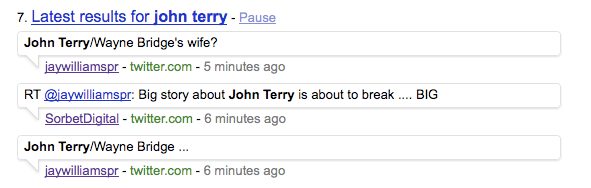
  • Ecen when the superinjunction was in force, you could find out about the story on Twitter and Google – both even promoted the fact of Terry’s affair – via the Twitter trends list and the real-time Google search box.
  • No one got the difference between an injunction and a superinjunction – the former banned reporting of Terry’s alleged affair, the latter banned revealing there was an injunction. They weren’t necessarily both overturned, but there was a widespread assumption you could say what you liked about Terry once the superinjunction was overturned. This wasn’t necessarily the case …
  • The Mail and Telegraph seemed to flout the superinjunction – as did the Press Gazette which decided if wasn’t bound as it hadn’t seen a copy. This seemed risky behaviour legally – which makes me wonder if the papers were looking for a weak case to try to discredit superinjunctions.
  • This superinjunction should never have been granted. What was the original judge thinking?

Google and Twitter ignored the superinjunction

Tweets from while the superinjunction was in force

Tweets from while the superinjunction was in force

The superinjunction was overturned at about 1pm or 2pm on Friday. Needless to say, the papers had a field day over the weekend. Continue reading