Data journalism during the election lacked case studies and quotes from those outside of the Westminster bubble, according to an analysis of over 50 pieces published during the election campaign.
But the rare exceptions offer examples of how we can do better election data journalism which sets the agenda and gives voters a louder voice.
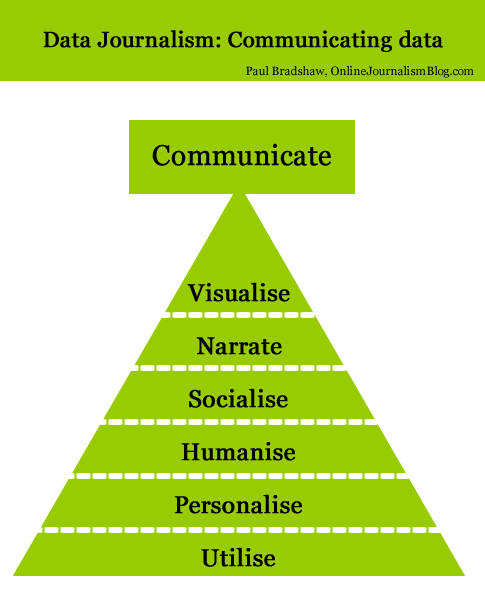
Last week I published an inverted pyramid of data journalism which attempted to map processes from initial compilation of data through cleaning, contextualising, and combining that. The final stage – communication – needed a post of its own, so here it is.
Below is a diagram illustrating 6 different types of communication in data journalism. (I may have overlooked others, so please let me know if that’s the case.)
Modern data journalism has grown up alongside an enormous growth in visualisation, and this can sometimes lead us to overlook different ways of telling stories involving big numbers. The intention of the following is to act as a primer for ensuring all options are considered. Continue reading →
Few things illustrate the challenges facing journalism in the age of ‘Big Data’ better than Cable Gate – and specifically, how you engage people with stories that involve large sets of data.
The Cable Gate leaks have been of a different order to the Afghanistan and Iraq war logs. Not in number (there were 90,000 documents in the Afghanistan war logs and over 390,000 in the Iraq logs; the Cable Gate documents number around 250,000) – but in subject matter.
I once heard a journalist trying to put the number ‘£13 billion’ into context by saying: “imagine 13 million people paying £1,000 more per year” – as if imagining 13 million people was somehow easier than imagining £13bn. Comparing numbers to the size of Wales or the prime minister’s salary is hardly any better.
Generally misattributed to Stalin, the quote “The death of one man is a tragedy, the death of millions is a statistic” illustrates the problem particularly well: when you move beyond scales we can deal with on a human level, you struggle to engage people in the issue you are covering.
Research suggests this is a problem that not only affects journalism, but justice as well. In October Ben Goldacre wrote about a study that suggested “People who harm larger numbers of people get significantly lower punitive damages than people who harm a smaller number. Courts punish people less harshly when they harm more people.”
“Out of a maximum sentence of 10 years, people who read the three-victim story recommended an average prison term one year longer than the 30-victim readers. Another study, in which a food processing company knowingly poisoned customers to avoid bankruptcy, gave similar results.”
“”As long as we have reporting that gives the impression to everyone that poor, black folks in these communities don’t value life, it just adds to their sense of isolation,” says Stephen Franklin, the community media project director at the McCormick Foundation-funded Community Media Workshop, where he led the “We Are Not Alone” campaign to promote stories about solution-based anti-violence efforts.
“Natalie Moore, the South Side Bureau reporter for the Chicago Public Radio, asks: “What do we want people to know? Are we just trying to tell them to avoid the neighborhoods with many homicides?” Moore asks. “I’m personally struggling with it. I don’t know what the purpose is.””
“Whistleblowing that lacks salience does nothing to serve the public interest – if we mean capturing the public’s attention to nurture its discourse in a way that has the potential to change something material. “
He is right. But Charlie Beckett, in the comments to that post, points out that Wikileaks is not operating in isolation:
“Wikileaks is now part of a networked journalism where they are in effect, a kind of news-wire for traditional newsrooms like the New York Times, Guardian and El Pais. I think that delivers a high degree of what you call salience.”
This is because last year Wikileaks realised that they would have much more impact working in partnership with news organisations than releasing leaked documents to the world en masse. It was a massive move for Wikileaks, because it meant re-assessing a core principle of openness to all, and taking on a more editorial role. But it was an intelligent move – and undoubtedly effective. The Guardian, Der Spiegel, New York Times and now El Pais and Le Monde have all added salience to the leaks. But could they have done more?
Visualisation through personalisation and humanisation
In my series of posts on data journalism I identified visualisation as one of four interrelated stages in its production. I think that this concept needs to be broadened to include visualisation through case studies: or humanisation, to put it more succinctly.
There are dangers here, of course. Firstly, that humanising a story makes it appear to be an exception (one person’s tragedy) rather than the rule (thousands suffering) – or simply emotive rather than also informative; and secondly, that your selection of case studies does not reflect the more complex reality.
“Avastin extends survival from 19.9 months to 21.3 months, which is about 6 weeks. Some people might benefit more, some less. For some, Avastin might even shorten their life, and they would have been better off without it (and without its additional side effects, on top of their other chemotherapy). But overall, on average, when added to all the other treatments, Avastin extends survival from 19.9 months to 21.3 months.
“The Daily Mail, the Express, Sky News, the Press Association and the Guardian all described these figures, and then illustrated their stories about Avastin with an anecdote: the case of Barbara Moss. She was diagnosed with bowel cancer in 2006, had all the normal treatment, but also paid out of her own pocket to have Avastin on top of that. She is alive today, four years later.
“Barbara Moss is very lucky indeed, but her anecdote is in no sense whatsoever representative of what happens when you take Avastin, nor is it informative. She is useful journalistically, in the sense that people help to tell stories, but her anecdotal experience is actively misleading, because it doesn’t tell the story of what happens to people on Avastin: instead, it tells a completely different story, and arguably a more memorable one – now embedded in the minds of millions of people – that Roche’s £21,000 product Avastin makes you survive for half a decade.”
Broadcast journalism – with its regulatory requirement for impartiality, often interpreted in practical terms as ‘balance’ – is particularly vulnerable to this. Here’s one example of how the homeopathy debate is given over to one person’s experience for the sake of balance:
Journalism on an industrial scale
The Wikileaks stories are journalism on an industrial scale. The closest equivalent I can think of was the MPs’ expenses story which dominated the news agenda for 6 weeks. Cable Gate is already on Day 9 and the wealth of stories has even justified a live blog.
With this scale comes a further problem: cynicism and passivity; Cable Gate fatigue. In this context online journalism has a unique role to play which was barely possible previously: empowerment.
3 years ago I wrote about 5 Ws and a H that should come after every news story. The ‘How’ and ‘Why’ of that are possibilities that many news organisations have still barely explored. ‘Why should I care?’ is about a further dimension of visualisation: personalisation – relating information directly to me. The Guardian moves closer to this with its searchable database, but I wonder at what point processing power, tools, and user data will allow us to do this sort of thing more effectively.
‘How can I make a difference?’ is about pointing users to tools – or creating them ourselves – where they can move the story on by communicating with others, campaigning, voting, and so on. This is a role many journalists may be uncomfortable with because it raises advocacy issues, but then choosing to report on these stories, and how to report them, raises the same issues; linking to a range of online tools need not be any different. These are issues we should be exploring, ethically.
All the above in one sentence
Somehow I’ve ended up writing over a thousand words on this issue, so it’s worth summing it all up in a sentence.
Industrial scale journalism using ‘big data’ in a networked age raises new problems and new opportunities: we need to humanise and personalise big datasets in a way that does not detract from the complexity or scale of the issues being addressed; and we need to think about what happens after someone reads a story online and whether online publishers have a role in that.
Jonathan McIntosh of Rebellious Pixels has just published a mashup of Donald Duck cartoons matched to a mashed-up Glenn Beck (of Fox News) voice track, called “Right Wing Radio Duck”.
Jonathan has taken dozens of segments from the cartoon archives, and dozens of voice clips from Glenn Back, to create a new jigsaw from existing pieces, satirising the North American Right.
This is work of studio quality. Alternatively, it can be produced by an individual in their bedroom, and can potentially in this case be a career-creating “splash”.
Either way, it demonstrates how high the bar can be raised. It also illustates the advantages of having a liberal set of copyright laws. How difficult would it be to make this in the UK?
Here’s the Youtube blurb:
“This is a re-imagined Donald Duck cartoon remix constructed using dozens of classic Walt Disney cartoons from the 1930s to 1960s. Donald’s life is turned upside-down by the current economic crisis and he finds himself unemployed and falling behind on his house payments. As his frustration turns into despair Donald discovers a seemingly sympathetic voice coming from his radio named Glenn Beck.
“This transformative remix work constitutes a fair-use of any copyrighted material as provided for in section 107 of the US copyright law. “Right Wing Radio Duck” by Jonathan McIntosh is licensed under a Creative Commons BY-NC-SA 3.0 License – permitting non-commercial sharing with attribution.”
As a contrast, this below is an agitprop video produced by Lib Dem campaigners within a few hours of Gordon Brown’s decision to back away from holding an Election in Autumn 2007. This one was made so quickly, that they used a US version of “The Grand Old Duke of York”.
This is a Guest Article from political blogger Anna Raccoon about questionable Election reporting by theSutton and Cheam Guardian, where all the candidates but one received objective biographies; it’s also a case study of one way that bloggers can hold journalists to account, and how the media is becoming more permeable.
For me, the more cross-scrutiny we get between journalists and bloggers, the better it will be for our media. It firstappeared on Anna’s blog
The interesting, and potentially damning, points of this story are that one candidate was included with a joke biography in a survey of all candidates, that the audit trail seems to show conclusively that the newspaper had a full biography available – having used the photo which was attached to the same email, and that the journalist concerned has been shown to be a supporter of the candidate who would probably benefit most from damage to the Libertarian Party candidate. I’ll be pleased to run a reply from the Sutton and Cheam Guardian; I think it needs one. Continue reading →
Ecen when the superinjunction was in force, you could find out about the story on Twitter and Google – both even promoted the fact of Terry’s affair – via the Twitter trends list and the real-time Google search box.
No one got the difference between an injunction and a superinjunction – the former banned reporting of Terry’s alleged affair, the latter banned revealing there was an injunction. They weren’t necessarily both overturned, but there was a widespread assumption you could say what you liked about Terry once the superinjunction was overturned. This wasn’t necessarily the case …
The Mail and Telegraph seemed to flout the superinjunction – as did the Press Gazette which decided if wasn’t bound as it hadn’t seen a copy. This seemed risky behaviour legally – which makes me wonder if the papers were looking for a weak case to try to discredit superinjunctions.
This superinjunction should never have been granted. What was the original judge thinking?
Google and Twitter ignored the superinjunction
Tweets from while the superinjunction was in force
The superinjunction was overturned at about 1pm or 2pm on Friday. Needless to say, the papers had a field day over the weekend. Continue reading →
The NUJ’s New Ways to Make Journalism Pay conference on Saturday brought together a group of journalists and entrepreneurs who are making money through online journalismin the UK. Many of the speakers had toiled to build brands online, and those that had were now running sustainable businesses. If the future of journalism is entrepreneurial, then these speakers are evidence of it.
1. Getting to a sustainable position is difficult.
David Parkin, founder of Thebusinessdesk.com, took two years to raise the £300,000 he thought he’d need to survive an estimated 18 months of operating at a loss. In the end it only took 9 months after an expansion into the Northwest, but it was still very “hairy.” He had to “make noise”: put up posters, give away coffee on the street, and branded mints to posh restaurants where businesspeople dined. Daniel Johnston, founder of Indusdelta.co.uk, had to live off his savings for the first 18 months. The site is now profitable, and supports the salary of another staff member.
2. The rules of the journalism game aren’t changed by the internet.
Paul Staines of the Guido Fawkes blog gets up at 6.30AM, and is still up when Newsnight is on in the late evening. He hasn’t got any ins with big politicians, and most of his news comes from disgruntled interns. No wonder! David Parkin found that for him, starting a successful venture was still “very much about contacts.” Daniel Johnston, although professing to not know whether he was a journalist, borrowed the principle of independence from good journalism: providing a counter point to the Government view (which he said was “gospel” before he came along) of the welfare-to-work industry also allowed him to build a sustainable business.
3. Traditional media doesn’t do investigative journalism.
Gavid MacFadyean, director of the Centre for Investigative Journalism, said 75% of investigative journalism is now done by foundations or NGOs. This is because of cost cutting at newspapers and in TV, but also because foundations offer a far more effective environment for investigative journalism. Gavid said: “Foundations say just do your worst, and we’re trying! It’s no strings attached money,” which seems to be bliss compared to less independent advertising-supported models.
4. Email is important.
Many of the speakers had collected the email addresses of their readers in the tens or hundreds of thousands, allowing them to quickly notify readers of news, while also opening up possibilities for making money. David Parkin recalled success with sending emails when the interest rates changed. By providing this information within 2-3 minutes (speed which the BBC and “big media” don’t bother with) after it had happened, businesspeople could be more informed. Angie Sammons of Liverpool Confidential said having an email list of interested individuals means you can directly provide them with sponsored offers, making you money and also helping your readers.
5. Local freelance journalism is dying.
Since this was an NUJ conference organised by the London freelance branch, it’s not surprising that the room was full of freelance writers, many of them used to pitching stories to editors of local newspapers. Note that many seemed to be “used to” doing this. A combination of a crash in rates, an unwillingness for local editors to commission work and the virtual impossibility for newcomers to get their first (paid) start gave me the impression that it’s never been harder to get work as a freelance local journalist. Fortunately, the overriding message from the day was it’s never been easier to make it online.
We’re all being told that mobile is the next big thing for news, but what does it mean to have a good mobile news application? Jonathan Stray reports.
Just as an online news site is a lot more than a newspaper online, a mobile news application is a lot more than news stories on a small screen. The better iPhone news apps integrate multimedia, social features, personalization, and push notifications.
Not all apps get even the basics right. But a few are pushing the boundaries of what mobile news can be, with innovative new features such as info-graphic displays of hot stories, or integrated playlists for multimedia.
Here is my roundup of 14 iPhone news offerings. I’ve included many of the major publishers, some lesser known applications, and a few duds for comparison.
NYTimes
The New York Times Company
Free
The New York Times iPhone application
The Times doesn’t do anything new with this application, but they do everything fairly well.
The app is designed around a vertical list stories, with a headline, lede, and photo thumbnail for each. Stories are organized into standard news sections, plus the alway interesting “Most Popular.” Banner ads sometimes appear at the bottom, plus occasional interstitial ads when appear when you select a story.
The focus of the news is of course American. There’s no personalization of news content based either on interest or location, which may well prove to be a standard feature for mobile news applications. Fortunately, the app includes a search function, though it only seems to go a few days back.
Downloaded articles are available when the device is offline, which is a useful feature. Favorites stories can be saved, or shared via email, text message, Twitter, and Facebook.
The UI has a few quirks. The “downloading news” progress bar is expected, but the sometimes equally long “processing news” phase makes me wonder what the app is doing. The photos in a story very sensibly download after the text, but the scroll position jumps when the photo appears,which is hugely annoying.
There’s little innovation or differentiation here, but the experience is smooth.
I recently heard a newspaper chief editor say something quite shocking. I attended a meeting arranged by the Norwegian consortium New Media Network where the chief editor of the second biggest national tabloid in Norway, Dagbladet, was to give a speech. And believe it or not, chief editor of Dagbladet, Anne Aasheim, said: “I have been a media executive for 20 years now and I must say; it’s more fun today than ever before!”
More fun today than ever before? Everybody at the meeting knew that Dagbladet has suffered massive losses in recent years – much more than their competitor VG, which is the flagship of Schibsted, one of Europe’s most successful and innovative newspaper publishers, according to The New York Times. Dagbladet is probably the newspaper that has suffered the most in the Norwegian newspaper market in recent years. What could possibly be fun about that? Was Anne Aasheim joking?
Anne Aasheim wasn’t joking. She soon explained what she meant: “When the crisis becomes big enough you no longer just mend things. Your tear everything apart and then you re-construct it. We are now searching for the power to do disruptive innovation. It’s going to be a cut-throat competition to have the greatest power of innovation.”
Then she smiled before exclaiming: “And we are gonna win that competition!”
I thought this was an interesting argument – especially since I have conducted much research in the Dagbladet newsroom during the last four years. Dagbladet is one of those newspapers that always wants to be the first mover. When new technology comes around Dagbladet jumps on it. Dagbladet was the first Norwegian newspaper to launch an online edition, it implemented bloging as the first online newspaper in Scandinavia, etc, etc. Dagbladet’s position in the shadow of the bigger and more successful newspaper VG has forced it to push for innovative initiatives.
The key question for Dagbladet and any other firm that push for successful innovations, is of course: How do you know if a innovative initiative will be a success? I shall not claim that I have the answer to that question (if I did, I would probably be very rich man). However, I have done some research in order to pinpoint the factors that influence processes of innovation in newsrooms. In an article in the current issue of the journal Journalism Studies I argue that there are five factors that affect whether an innovation is diffused successfully or not in an online newsroom:
Newsroom autonomy: are innovative projects initiated and implemented within an autonomous newsroom and with relative autonomy within the online newsroom? (If not, the project is less likely to succeed)
Newsroom work culture: does the online newsroom reproduce editorial gatekeeping or are alternative work cultures explored? (reproduction of “old media” work cultures is likely to prevent innovative initiatives from being successful)
The role of management: is newsroom management able to secure stable routines for innovation?
The relevance of new technology: is new technology perceived as relevant, i.e. efficient and useful? (New technology can be costly and time consuming to utilize)
Innovative individuals: is innovation implemented and understood as part of the practice of journalism?
One last point: Innovation and crisis tend to go hand in hand. Businesses, organisations and nation states alike have always pushed for innovations in times of crisis. There are two reasons for this assumed causal link between recession and innovation, according to an article by Geroski and Walters published in The Economic Journal. First, in times of recession the value of existing rents usually falls, thus making it more attractive for firms to implement new products and processes that hopefully will yield higher returns. Second, to invest in innovations requires a firm to divert resources from activity/production to product development. Such a diversion of resources is more likely to be feasible when the current production is less profitable, e.g. in times of recession.
No wonder why the chief editor of Dagbladet, Anne Aasheim, was so enthusiastic about the opportunities for disruptive innovation…



 The NUJ’s
 Online Journalism Blog