Category Archives: data journalism

Model for the 21st century newsroom pt.6: new journalists for new information flows

new journalists for new information

new journalists for new information

Information is changing. The news industry was born in a time of information scarcity – and any understanding of the laws of supply and demand will tell you that that made information valuable.

But the past 30 years have seen that the erosion of that scarcity. Not only have the barriers to publishing,  broadcast and distribution been lowered by desktop publishing, satellite and digital technologies, and the web – but a booming PR industry has grown up to provide these news organisations with ‘cheap’ news.

Information is changing. Increasingly, we are not seeking information out – instead, it finds us. The scarcity is not in information, but in our time to wade through it, make meaning of it, and act on it.

Information is changing, and so journalists must too. In the previous parts of this series I’ve looked at how the news process could change in a multiplatform environment; how to involve the former audience; what can now happen after a story is published; journalists and readers as distributors; and new media business models. In this part I want to look at personnel – and how we might move from a generic, hierarchy of ‘reporters’, ‘subs’ and ‘editors’ to a more horizontal structure of roles based on information types. Continue reading

US election coverage – who’s making the most of the web?

Elections bring out the best in online journalism. News organisations have plenty of time to plan, there’s a global audience up for grabs, and the material lends itself to interactive treatment (voter opinions; candidates’ stances on various issues; statistics and databases; constant updates; personalisation).

Not only that, but the electorate is using the internet for election news more than any other medium apart from television (and here are some reasons why).

PaidContent has a good roundup of various UK editors’ views, and decides blogs, Twitter and data are the themes (more specifically, liveblogging and mapping). Continue reading

Elections08: Storytelling with public databases

Written by Wilbert Baan

Today is the day of the US elections. I don’t think we ever had a live event on the web that will get so much live coverage. This means incredible amounts of information will be published over all kind of services and social networks. Websites like Facebook, Twitter, Flickr, WordPress, Blogger and many more.

Most popular web services have programmable interfaces. These interfaces allow developers to extract information out of the system. This creates a whole new genre of storytelling: storytelling with public databases. You can aggregate the information you need and sort it the way you want.

To prove the concept I made three small mock-ups. They all use search.twitter.com to see how people voted.

When I made the first the first animation Erik Borra replied by developing the idea into something that stores the data retrieved from Twitter in a database. I made a new interface that shows a graph based on what people say they voted on Twitter. And the result is a Twitter Poll.

These three examples are not representative data, it is extracted from Twitter. But it shows you how much personal and valuable information is in the public database. All you have to do is ask yourself what you want to tell to your readers and if this information is available.

I voted

This animation gets the latest twitter message where someone says they voted on McCain or Obama. It automatically refreshes. Continue reading

Why fantasy football may hold the key to the future of news

This season, after years of loyalty to the BBC/Channel 4 fantasy football competition, I’ve switched to The Guardian’s. Their game takes advantage of the reams of player data now available to newspapers – not just goals scored, clean sheets and assists, but also clearances, interceptions, tackles, shots on target, and so on, making for a very different challenge indeed.

The move mirrors that made by The Telegraph a year ago when they introduced a Flash element to their match reports that allowed you to look at an incredible range of match statistics. As I wrote at the time: it’s like having your own ProZone.

What’s all this got to do with the future of news? This: data. It’s one of the few advantages that news organisations have, and they should be doing more with it. What the Guardian fantasy football and the Telegraph demonstrate is the flexibility of that data.

And if we can do it in sport, why aren’t we doing it more elsewhere? Schools tables, pollution records, crime data, geotagged information, and election results are just a few that spring to mind – can you add some more?

For a good example of a particularly creative use of data (again with a sport twist), see Channel 4’s alternative Olympics medals table, which matches medals results against various other country stats, such as human rights record.

Oh, and by the way, if you want to join my fantasy football friends’ league, search for Game 39 – or just post a comment below…

More database-related posts

Could this be the tipping point for UK data mashups?

The best thing that I took from this week’s 2gether08 event was yesterday’s announcement by blogging MP Tom Watson and Ofcom’s blogging Tom Loosemore of Show Us a Better Way.

The site (also a blog – notice a pattern here?) is releasing a range of public data and inviting people to mash them up, or come up with ideas to do so. In their words:

The UK Government wants to hear your ideas for new products that could improve the way public information is communicated. The Power of Information Taskforce is running a competition on the Government’s behalf, and we have a £20,000 prize fund to develop the best ideas to the next level. You can see the type of thing we are are looking for hereContinue reading

Dutch site reinvents what news looks like online

Recently my attention has been drawn to the Dutch news website www.en.nl. Wilbert Baan, interaction designer for the Dutch newspaper de Volkskrant, told me he wants to see “what we can do with news, social networks, wikis and more.

“I think you might like the experiment we are doing,” he wrote.

And bloody hell was he right. Continue reading

Ten ways journalism has changed in the last ten years (Blogger’s Cut)

A few weeks ago I wrote an 800-word piece for UK Press Gazette on how journalism has changed in the past decade. My original draft was almost 1200 words – here then is the original ‘Blogger’s Cut’ for your delectation…

The past decade has seen more change in the craft of journalism than perhaps any other. Some of the changes have erupted into the mainstream; others have nibbled at the edges. Paul Bradshaw counts the ways…

From a lecture to a conversation

Perhaps the biggest and most widely publicised change in journalism has been the increasing involvement of – and expectation of involvement by – the readers/audience. Yes, readers had always written letters, and occasionally phoned in tips, but the last ten years have seen the relationship between publisher and reader turn into something else entirely.

You could say it started with the accessibility of email, coupled with the less passive nature of the internet in general, as readers, listeners and watchers became “users”. But the change really gained momentum with… Continue reading

BASIC principles of online journalism: A is for Adaptability

In the second part of this five-part series, I explore how adaptability has not only become a key quality for the journalist – but for the information they deal with on a daily basis too. This will form part of a forthcoming book on online journalism – comments very much invited.

The adaptable journalist

A key skill for any journalist in the new media age, whatever medium they’re working in, is adaptability. The age of the journalist who only writes text, or who only records video, or audio, is passing. Today, the newspaper and magazine, the television and the radio programme all have an accompanying website. And that website is, increasingly, filled with a whole range of media, which could include any of the following:

  • (Hyper)Text
  • Audio
  • Video
  • Still images
  • Audio slideshows
  • Animation
  • Flash interactivity
  • Database-driven elements
  • Blogs
  • Microblogging/Text/email alerts (Twitter)
  • Community elements – forums, wikis, social networking, polls, surveys
  • Live chats
  • Mapping
  • Mashups

This does not mean that the online journalist has to be an expert in all of these fields, but they should have media literacy in as many of these fields as possible: in other words, a good online journalist should be able to see a story and think:

  • ‘That story would have real impact on video’;
  • or: ‘A Flash interactive could explain this better than anything else’;
  • or ‘This story would benefit from me linking to the original reports and some blog commentary’;
  • or ‘Involving the community in this story would really engage, and hopefully bring out some great leads’. Continue reading

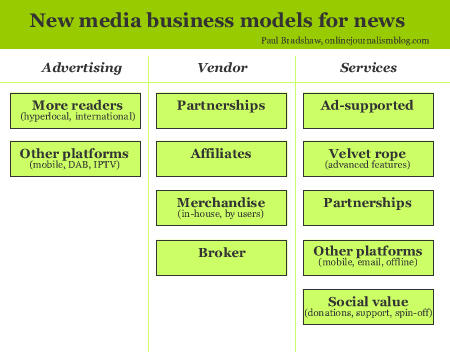
Making money from journalism: new media business models (A model for the 21st century newsroom pt5)

In the final part of the Model for the 21st Century Newsroom I look at how new media has compounded problems in news organisations’ core business models – and the new business models which it could begin to explore.

Let’s start by looking at the traditional newspaper business model. This has rested on selling, in a broad simplification, three things:

  • Advertising. Put more explicitly: selling readers to advertisers.
  • Selling content to readers, and, twinned with that:
  • Selling the delivery platform to readers – i.e. the paper

Developments in the past few decades have eaten into each of those areas as follows: Continue reading