The Guardian has brought its typical idiosyncratic approach to social bookmarking with the launch of ‘Clippings’. But for once I think they’ve missed the mark.
What happens when you bring together local journalists, bloggers, web publishers, online journalism experts and new media startups – and get them talking?
That was the question that JEEcamp sought to answer: an ‘unconference’ around journalism enterprise and entrepreneurship that looked to tackle some of the big questions facing news in 2008: how do you make money from news when information is free? Where is the funding for news startups? How do you generate community? What models work for news online? Continue reading →
In an attempt to reconnect with its readers, German newspaper Frankfurter Allgemeine Zeitung(FAZ) introduced a thematic and participatory website a few weeks ago.
The translation of The Kindly Ones, a blockbuster book wherever it’s been released, landed in German bookstores last Saturday, February 23. Its controversial content (sex, Nazis and sadism) makes it a favorite conversation topic among the quality-newspaper-reading population. FAZ decided to organize this conversation.Continue reading →
Yes, the previous contender for Worst Newspaper Video have done it again. But this time, instead of Sports Editor David Wright, it’s young gun News Reporter Stuart White, who looks quite smart in the official picture that sits above a slightly less well-dressed moving picture version of the same.
The 1980s-era production style remains, with the same stock music, garish graphics – and this time, some appalling spinning, zooming, transition wipes.
Stuart’s challenge: to read out the day’s headlines “in just 60 seconds“. Yes, that’s some challenge. Perhaps someone should suggest that idea to BBC3.
One problem: when you take out the credits it’s not actually 60 seconds, which may be why Stuart is drowned out by the closing music at the end, just as David Wright was before him. Do they ever watch their own videos?
I’ll be more barbed: Stuart has the flat delivery of a 12-year-old reading ‘What I did on my summer holidays’, while his eyes flit below the camera like he’s checking his emails as well as reading the headlines. Presumably he’s reading a script. Doesn’t he know what the news is?
And what was that about a “sweet Haribo ring”? Some lessons in writing for broadcast needed.
Of course I’m being harsh, and as before this is not Stuart’s fault. Step up owners Surrey and Berkshire Newspapers Limited, part of the Guardian Media Group.
The one good thing is they’ve discovered YouTube, so unlike last time, I can embed it below for your convenience and their viewing figures. Let’s see if I can generate more views from this blog than from their own site – at least it will prove the value of making your video embeddable.
In the final part of the Model for the 21st Century Newsroom I look at how new media has compounded problems in news organisations’ core business models – and the new business models which it could begin to explore.
Let’s start by looking at the traditional newspaper business model. This has rested on selling, in a broad simplification, three things:
Advertising. Put more explicitly: selling readers to advertisers.
Selling content to readers, and, twinned with that:
Selling the delivery platform to readers – i.e. the paper
Developments in the past few decades have eaten into each of those areas as follows: Continue reading →
Norway is one of the most newspaper-reading in countries in the world, a fact also reflected in the country’s online media environment. In contrast to many other countries, Norwegians seem to prefer news-driven sites with journalistic content to all others.
Early starters
Early adoption has put Norwegian online media at a great at advantage, some of the online players even earn good money. Continue reading →
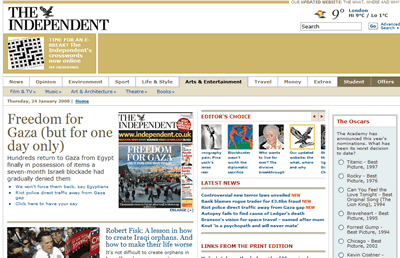
So the Independent has relaunched its website. At first glance there’s nothing spectacularly new or innovative, but a deeper look reveals some intelligent changes – particularly on the business side of things. Here are the headlines: Continue reading →
Last week I interviewed Mike Hill, Deputy Editor of the Lancashire Evening Post, for an article on changing tools and approaches in local newsrooms (due to appear on Journalism.co.uk). Mike has some interesting plans on using surveys beyond the simple reader poll (since reported here), and experiences of the weaknesses of geotagging, among other things. The interview can be heard here – it’s around 10 minutes.
Could 2008 be the year geotagging breaks through? Archant are the ones to watch in the UK with (delayed) plans to geotag all their stories. I asked Suffolk’s Web Editor James Goffinto write a piece for the OJB on his experience with the process – and the opportunities it’s opening up.
Journalists have always asked the question “Where?”. People are interested in news from where they live, and it’s a sad fact that tragedies abroad have more resonance when there’s a British passport holder involved.
As communities have become more mobile, those associations have become more complex – people reminisce about their home town, where they used to work; they are interested in where they live now, where their brothers and sisters have moved to. The world around them has become more complex too, as has the sheer amount of information being pumped out around them. Continue reading →

 ) next to a story users can now ‘clip’ an article to their own account. They could do this before anyway – but importantly, the revamped service means they can see others’ saved stories and subscribe to a feed, or publish their own feed elsewhere.
 Online Journalism Blog