Category Archives: online journalism

Daily express website relaunching

Express.co.uk is about to undergo a redesign (and there’s a good review of the new look, still currently in beta, at econsultancy).

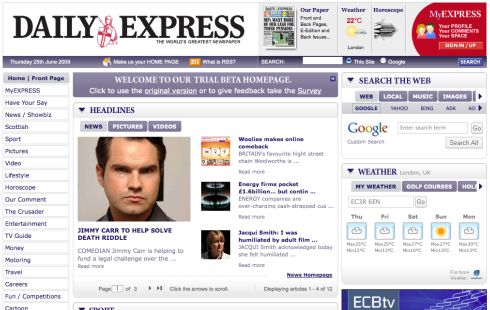
To me, the new site isn’t that impressive (screenshot below, or you can compare the old front page or new front page) – it looks like a poor mashup of the BBC and Yahoo in the existing colour scheme.

Even worse, it’s not very accessible as there is literally no content on the new home page with javascript turned off.

The agency behind it is Netro42 who say here about the old version that “Netro42 working in partnership with Northern and Shell quickly established that the key to success was in wholly utilising the digital space.”

Personally, I like to partially use the analogue space when working on websites, but I may be old fashioned.

New Express homepage

New Express homepage

I wonder if the new design means they’ll update their site on a sunday? Or get some better suggested search terms?

Even “heavy newspaper readers” spend a quarter of their media time online

Some research from The Media Audit makes a pretty strong point about how quickly media consumers’ behaviour is changing:

“The Internet now represents 32.5% of the typical “media day” for all U.S. adults when compared to daily exposure to newspaper, radio, TV and outdoor advertising.

“Even those who are considered heavy newspaper readers spend about as much time online today as the typical U.S. adult. According to the report, heavy newspaper readers, those who spend more than an hour per day reading, currently spend 3.7 hours per day online. In 2006 the Internet represented only 18.4% of a heavy newspaper reader’s “media day,” but today it represents 28.4%.”

But there’s good news for some US newspapers who have made the most of their online presence to achieve an impressive reach “of 80% or more when the past 30-day website visitor figure is combined with the past month print readership figure.”

It will be interesting to see how paywall experiments might result in quite different reach stats for other newspapers in the coming months.

More at MediaPost.

ABCe: please sort out your terrible website (again)

In March, I appealed to the Audit Bureau of Circulations to sort out its terrible ABCe website. It’s had a redesign. Here’s a list of its latest problems (originally published here).

If at any point the ABC wants to pay me a consultancy fee, for all this free advice, just leave me a comment to tell me how to receive my money …

All the URLs have changed but there are no redirects

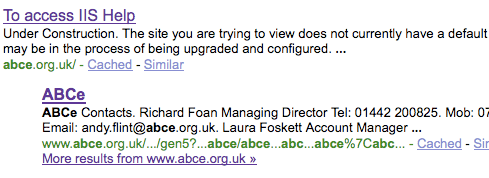
New ABCe homepage in Google

New ABCe homepage in Google

They’ve had a redesign, but they haven’t redirected the old URLs to new ones. So, for instance, if you click the second link shown in Google for a search on ABCe, you get page not found.

Lesson When relaunching a website, always 301 redirect your old pages to new ones (even if they’re all just to your new home page). That way, external links still work and you keep the SEO benefit of any links.

They haven’t sorted www vs non www

The more observant will have noticed that the title of the first result in that screenshot says ‘To access IIS Help’. The ABC hasn’t realised that abce.org.uk is not the same URL as http://www.abce.org.uk. And if you go to the ABC URLs without www, you get page not found or server errors.

Compare these pages:

and these ones:

Lesson When you set up your website, redirect yourdomain.co.uk/whatever to http://www.yourdomain.co.uk/whatever. And log in to your google webmaster account to set your preferred domain (www or non-www).

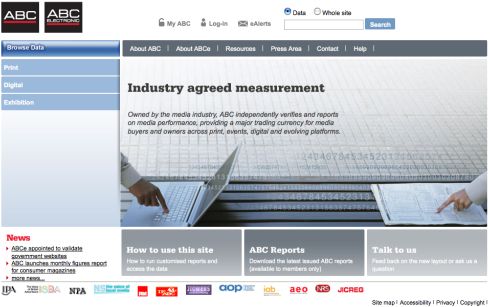
They’re running two absolutely identical websites

ABCs new homepage. No, it's ABCe's. No, it's aaaaggghhh

ABCs new homepage. No, it's ABCe's. No, it's aaaaggghhh

You can access the entire website at www.abc.org.uk – or you can see an identical website at www.abce.org.uk. Continue reading

J-Tweeters: Are they journalists or tweeters? Does it matter?

I follow the BBC World, the Guardian and the New York Times through my Twitter account, among other news services, but I get more news and information from the friends I follow on the microblogging service. My friends just happen to read stories from a wide variety of sources and pass along the kind of information they are interested in, and that by extension, I am interested in. In other words, they act as my personal filters for news. And I can safely say that I return the favor for several of my friends as well.

This concept is not exclusive to the new media world. Since the 1940s, media scholars such as Paul Lazarsfeld have spoken about the two-step flow of communication where “opinion leaders” play a huge part in transmitting information from the media to its audience. These mediators help the process by disseminating news in a more concise,  intelligible way, but also often infuse their personal agendas and perspectives. Opinion leaders have always existed; who they might be and how you obtain your information from them has changed over time. Continue reading

UK investigative journalism foundation established – asks for pledges of support

There have been rumblings for a while about the establishment of a UK investigation foundation, and now it’s here. They’re not accepting cash at the moment, just pledges of support and help. So go help them.

Here’s their open letter: Continue reading

Meanwhile, A.nnotate puts all MPs expense PDFs online for free annotation

On the day that Parliament released MPs’ expenses in their ‘official’ form, I was hawking around on Twitter trying to find a good way to crowdsource analysis of the documents (this was before The Guardian’s crowdsourcing tool went live).

Central to the problem was that the expenses were presented in search-unfriendly PDFs. So I was looking for a place people could upload those PDFs and post comments, tag and annotate them.

Scribd was the obvious option: you can comment and tag – but not annotate. After a number of responses on Twitter (in particular Jen Michaels’ suggestions and Marcelo Soares, who had converted Brazilian parliamentary salaries from PDF to Excel with Able2Extract), I had one from Fred Howell of A.nnotate.

A.nnotate was indeed an ideal candidate – however, the website charges for use, which made it redundant for crowdsourcing purposes. But I was feeling cheeky…

“Perhaps you could let users do #mpexpenses for free as a great bit of PR?” I asked.

Fred saw the potential. Within a couple of hours he had twittered back:

“Put a list of all #mpexpenses pdfs for free shared online annotation at : http://a.nnotate.com/beta/mpexpenses/

So credit to Fred – and the power of Twitter. Had The Guardian not created their tool, we had hacked together our own platform within hours – and there lies lesson #1: the power of the web to enable people to mobilise very quickly. It also brought to mind something I said to a group of people at an event the same day: don’t obsess with the tools – the networks are more important: because through the networks you should be able to find someone who knows the tools, or how to use them.

The Guardian meant Fred’s efforts were – this week – to no avail. But in the longer term, I know who to turn to if I need a bunch of PDFs annotated – as will anyone else who saw those tweets. And anyone reading this blog post will know about A.nnotate too. So there is lesson #2: it wasn’t the PR of ‘delivering a message’ but simply ‘doing a good turn’, which in social media is the best PR there is.

But I still wish there was a free online PDF upload service that did annotation.

The Guardian’s tool to crowdsource MPs’ expenses data: time to play

So here’s The Guardian’s crowdsourcing tool for MPs’ expenses. If you’ve not already, you should have a play: it’s a dream. There are over 77,000 documents to get through – and in less than 24 hours users have gone through over 50,000 of those. You wonder how long it took The Telegraph to get that far.

Meanwhile, that process is doing much more than just finding ‘stories’. It’s generating data: the date, the amount, the type of expense, the type of document. When this stage is finished, The Guardian will have a database that will allow people to filter, mix and combine the expenses data in different ways.

It’s also about telling a ‘story’ in a different way. There’s an element of game mechanics in the site – that progress bar (shown above) compels you to bring the site to completion (it strangely reminds me of the Twitter game Spymaster). This makes it more engaging than a made-for-print exclusive – as I wrote about Help Me Investigate, this isn’t ‘citizen journalism’: it’s micro-volunteering. And when you volunteer, you tend to engage.

And when you treat news as a platform rather than a destination, then people tend to spend more time on your site, so there’s an advertising win there.

Finally, we may see more stories, we may see interesting mashups, and this will give The Guardian an edge over the newspaper that bought the unredacted data – The Telegraph. When – or if – they release their data online, you can only hope the two sets of data will be easy to merge. 

More support for my ‘Fantasy Football as future of news’ hypothesis

Last September in ‘Why fantasy football may hold the key to the future of news‘ I wrote that data was one of the few advantages that news organisations have, and they should be doing more with it. A piece in today’s ReadWriteWeb adds a little commercial stardust to that hypothesis:

MLB.com’s already wildly successful iPhone app [has] a $10 price tag that sports fans are apparently happy to pay, this could provide a great model for other struggling media to find an important new revenue stream – and not just because it charges for content. “… Any media outlet that can leverage statistics and data visualization as a central part of its coverage would be well served to put those visualizations in an iPhone app and sell it. The iPhone and Android platforms are brilliant for scrolling and zooming through layers of data in ways that print, TV and radio could only dream of. Mobile, touchscreen and hand-held beats a web page on the desktop computer too for data visualization.”

Amen to that.

Whenever I do sessions with people in the industry about online business models I show them The Guardian’s Chalkboard. That for me is a prime candidate for a premium mobile app (assuming there are no licensing issues) – not just because of the data, but because it is social. News orgs take note.

7 ways to blog anonymously {updated}

Following today’s landmark judgement on one blogger’s right (or not) to anonymity, I thought it might be useful to post the following tips on maintaining anonymity online.

1. Use an anonymous email account to register your blog. Hushmail is one free service that provides encrypted accounts; RiseUp is aimed at activists; MintEmail gives you a 3 hour temporary email address and FilzMail gives you one that expires after 24 hours. You could also use these to post to your blog via email. Posterous is a great blogging service that allows you to do this.

2. Make sure your IP address isn’t logged when you register or post to the blog. You could use something like Anonymizer or Tor or Psiphon. Other services that mask your IP are listed on this forum.

3. Or you could use an anonymous blogging platform. Invisiblog was one but no longer exists. BlogACause claims to be “anonymous” but I’m trying to find out exactly how UPDATE: here’s how, apparently. In the meantime, this post recommends WordPress and something like Tor.

4. Use a pseudonym that you don’t use anywhere else. If you use a pseudonym, don’t use it on other services as well, as this will make it easier to trace you. If you’re struggling, this Random Name Generator will create one for you.

5. If you’re going to register a domain name do so anonymously with a service like The Online Policy Group.

6. Be careful what information you include. Although police blogger NightJack changed or did not include names in cases he was involved in, the details were specific enough for a journalist to track him down.

7. Don’t win awards. Or book deals. It’s safe to say that a major newspaper would not have been interested in the identities of NightJack or Girl With A One Track Mind if both had remained cult underground heroes. So just pretend you’re sub-literate, OK?

For more information, the following guides go into much more detail:

More links and tips welcome. My Delicious bookmarks on anonymity are at http://delicious.com/paulb/anonymity