What things should you never say in a newsroom?

No tecknolegy by Sammy0716

No tecknolegy by Sammy0716

There are certain things an aspiring journalist should never say. Here are three for starters – but what others are there?

1. “I don’t read the news”

Whether you mean newspapers, or listening to radio or TV, this is heard as “I don’t care about anything much. I have no interest in my profession. I have no understanding of the current news agenda.”

The listener doesn’t care if you’re the best writer in the world, or have a world exclusive on the back burner – they just scratched your name off a list somewhere.

2. “I can’t spell!”

“…” That… is the sound of tumbleweed. Whether you say this half-jokingly or even totally-jokingly, what an editor actually hears is:

“Everything I write will take up someone else’s time to sub-edit. At some point, some bad copy will get through and make this organisation look like a bunch of illiterate fools. PS: Don’t let me near Twitter.”

Editors don’t joke about spelling.

3. “I hate using the phone.”

Most other journalists do, too: it’s annoying, having to speak to human beings when we could be spending hours honing a killer intro. But no one says it because this is the one part of the role that distinguishes them from everyone else.

So rest assured you’re not alone. Then shut up and pick up the phone.

…And here are some others suggested in comments and on Twitter:

4. “I’m waiting for them to reply to my email”

…Because of course your email went straight to the top of their list. See 3. above.

sun email front cover

An exception to the rule: The Sun lead their front page on an ‘out of office’ auto reply – although the full story draws more on an interview with a friend.

5. “I forgot to ask”

5. “What’s a blog?”

6. “They never got back to me.”

From Cliff in the comments: You are responsible for following it up. Say “They are being evasive. I’ll keep trying.”

7. “I’ve done my shift.”

8. “Where is this running?”

Also from Cliff in the comments: “Whether it’s on the front page or on page five of the TV guide, treat is just as professionally. Where it’s running isn’t your job.”

9. “Do you have the contact number for..?”

From John Thompson in the comments.

10. “There’s no news”

Reply: “Look harder.”

11. “Well, it’s gotta be… “/“Everybody knows that it’s…”

From Jack Rosenberry in the comments: Saying things such as this equate to “I’m too lazy to do enough fact checking/verification”, which is a slippery slope to errors that will clobber you.

12. “I wrote a piece about [blank] instead.”

From paperguydavies in the comments: “Did you ask ahead of time if you could write a piece about (blank) instead? Because if you did, you don’t need to say that, and if you didn’t, you shouldn’t have written a piece about (blank) instead.”

13. “We ran that story last year”

That doesn’t mean nothing new has happened since. Even the annual ‘A levels getting easier’ debate deserves coverage (because a trend has continued, and people are talking about it again), and in some cases ‘no news’ is news – if something was revealed a year ago and nothing has been done about it, for example.From Bart Brouwers.

14. “We can wait – it’s an exclusive”

…Until someone else gets it. Also from Bart Brouwers.

15. “That’s how it was written in the press release”

16. “Well that’s what he told me. I didn’t understand it either.”

If you didn’t understand it, why do you think your readers will? From Deputy Editor of Devon Life Owen Jones.

17. “It’s not news – everyone [in our circle] knows about it”

After a while of working in news you can start to believe ‘new’ means ‘new to me and my friends’. It doesn’t – it means new to your audience. Stories can be new in the specialist or local press one day, new in the national press the next day, and new on TV the day after. But more than that, people in different circles know different things at different times. What matters is whether your audience knows about it.

Can you think of others?

UPDATE: Here’s a list of things to avoid in a job application too…
Study: do news industry metrics underplay print’s importance? (cross post)

In a cross-post for OJB originally published on The Conversation, Neil Thurman argues that his recent research that suggests current news industry metrics underplay the importance of print reading time. 

Figures published recently suggest that more than 90% of newspaper reading still happens in print. This might come as a surprise given the gloomy assessments often made of the state of print media in the UK but, it turns out, we’re just not measuring success properly. Continue reading

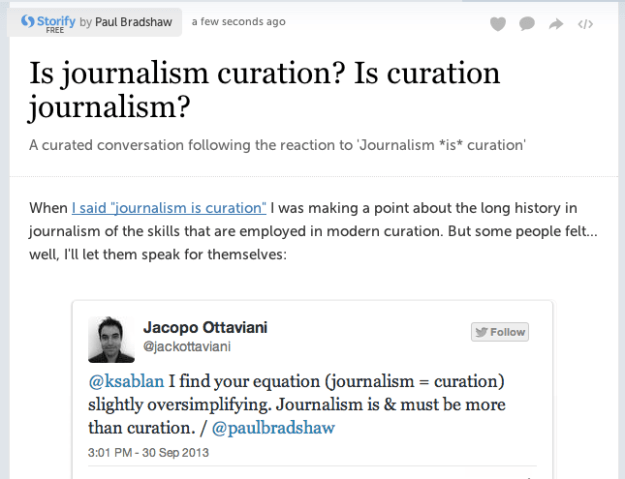
Journalism *is* curation: tips on curation tools and techniques

Curation is a relatively new term in journalism, but the practice is as old as journalism itself. Every act of journalism is an act of curation: think of how a news report or feature selects and combines elements from a range of sources (first hand sources, background facts, first or second hand colour). Not only that: every act of publishing is, too: selecting and combining different types of content to ensure a news or content ‘mix’. 

Amazon’s Jeff Bezos’ in his talk to employees at the Washington Post said: “People will buy a package … they will not pay for a story.” Previously that package was limited to what your staff produced, and wire copy. But as more content becomes digitised, it is possible to combine more content from a wider variety of sources in a range of media – and on any one of a number of platforms.

Curation is nothing new – but it is becoming harder.

Choosing the tools

I’ve identified at least three distinct types of curation (you may think of more):

  1. Curation as distribution or relay: this is curation at the platform level: think of Twitter accounts that relay the most useful links and tweets from elsewhere. Or Tumblr blogs that pass on the best images, video and quotes. Or UsVsTh3m.
  2. Curation as aggregation or combination: seen in linkblogging and news roundups, or galleries, or news aggregators (even creating an algorithm or filter is a journalistic act of selection).
  3. Curation as filter or distillation: this often comes in the form of the list: Buzzfeed is a master of these, distilling conversations from Reddit and complementing them with images.

Buzzfeed lists

There are also a number of ways in which the journalist adds value (again, you may think of more):

  • Through illustrating (as Buzzfeed, above, does with images to liven up highlights from a text discussion)
  • Through contextualising
  • Through verification
  • Through following up

As a journalist operating online, you are both reporter and publisher, able to curate content both at the article level and that of ‘publication’ – whether that’s a Twitter stream, a Tumblr blog, or a Flipboard magazine. Here are some suggestions for tools and techniques:
Continue reading

An online journalism reading list

It’s the start of a new academic year so I thought I’d compile a list of the latest reading I would recommend for any students looking at online journalism. (If you have suggestions for additions please let me know!):

Theoretical, historical and conceptual background

  • Digital Journalism by Jones & Lee (Sage, 2011) is very comprehensive and worth reading in full.
  • Gatewatching by Axel Bruns (Peter Lang, 2005) covers areas that tend to be overlooked by journalism books, such as new media methods and startups from outside traditional media. Read: Chapter 4: Making News Open Source
  • The Wealth of Networks by Yochai Benkler (Yale University Press, 2007) provides a wider context and is available free online. Read: Chapter 4: The Economics of Social Production.
  • We The Media by Dan Gillmor (O’Reilly, 2006) is a seminal book on citizen journalism which is also available free online.

Practical online journalism – general

  • Clearly I’m going to say my own book, the Online Journalism Handbook (2017, Routledge), [UPDATE: now in its second edition], which covers blogging and web writing, data journalism, online audio and video, interactivity, community management and law. Continue reading

Ethics in data journalism: automation, feeds, and a world without gatekeepers

This is the last in a series of extracts from a draft book chapter on ethics in data journalismOthers have looked at how ethics of accuracy play out in data journalism projects; culture clashes, privacy, user data and collaborationmass data gathering; and protection of sources. This is a work in progress, so if you have examples of ethical dilemmas, best practice, or guidance, I’d be happy to include it with an acknowledgement.

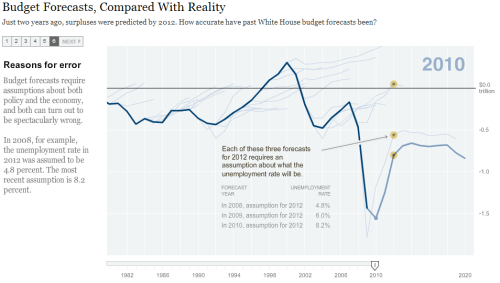
Budget Forecasts, Compared With Reality

Budget Forecasts, Compared With Reality

The ethics of automation and feeds

Since Adrian Holovaty built ChicagoCrime.org in 2005 to automatically update a map with police crime statistics, automation has been an important element of data journalism. Few news organisations have guidelines on automation, but the BBC’s guidelines (2013) on video feeds do provide a framework. Continue reading

Ethics in data journalism: mass data gathering – scraping, FOI and deception

chicago_crime

Automated mapping of data – ChicagoCrime.org – image from Source

This is the third in a series of extracts from a draft book chapter on ethics in data journalismThe first looked at how ethics of accuracy play out in data journalism projects, and the second at culture clashes, privacy, user data and collaborationThis is a work in progress, so if you have examples of ethical dilemmas, best practice, or guidance, I’d be happy to include it with an acknowledgement.

Mass data gathering – scraping, FOI, deception and harm

The data journalism practice of ‘scraping’ – getting a computer to capture information from online sources – raises some ethical issues around deception and minimisation of harm. Some scrapers, for example, ‘pretend’ to be a particular web browser, or pace their scraping activity more slowly to avoid detection. But the deception is practised on another computer, not a human – so is it deception at all? And if the ‘victim’ is a computer, is there harm? Continue reading

Ethics in data journalism: privacy, user data, collaboration and the clash of codes

This is the second in a series of extracts from a draft book chapter on ethics in data journalism. The first looked at how ethics of accuracy play out in data journalism projectsThis is a work in progress, so if you have examples of ethical dilemmas, best practice, or guidance, I’d be happy to include it with an acknowledgement.

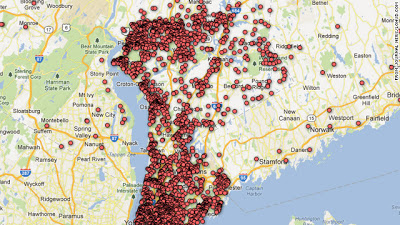
Gun permit holders map - image from Sherrie Questioning All

Gun permit holders map – image from Sherrie Questioning All

Hacks/Hackers: collaboration and the clash of codes

Journalism’s increasingly collaborative and global nature in a networked environment has raised a number of ethical issues as contributors from different countries and from professions outside of journalism – with different codes of ethics – come together.

This collaborative spirit is most visible in the ‘Hacks/Hackers’ movement, where journalists meet with web developers to exchange tips and ideas, and work on joint projects. Data journalists also often take part in – and organise – ‘hack days’ or ‘hackathons’ aimed at opening up and linking data and creating apps, or work with external agencies to analyse data gathered by either party. Continue reading

Ethics in data journalism: accuracy

The following is the first in a series of extracts from a draft book chapter on ethics in data journalism. This is a work in progress, so if you have examples of ethical dilemmas, best practice, or guidance, I’d be happy to include it with an acknowledgement.

Data journalism ethics: accuracy

Probably the most basic ethical consideration in data journalism is the need to be accurate, and provide proper context to the stories that we tell. That can influence how we analyse the data, report on data stories, or our publication of the data itself.

In late 2012, for example, data journalist Nils Mulvad finally got his hands on veterinary prescriptions data that he had been fighting for for seven years. But he decided not to publish the data when he realised that it was full of errors. Continue reading