Tag Archives: interactivity

French, Norwegian and US newspapers added to News Interactivity Index

Just to let you know that the News Interactivity Index now includes newspapers from Norway (thanks Kristine Lowe), France, the Netherlands and the US. You can use it to compare any two newspapers or country averages. The following countries are now covered:

  • France
  • Hungary
  • Macedonia
  • Netherlands
  • Norway
  • Poland
  • Portugal
  • Spain
  • Switzerland
  • UK
  • US

The European News Interactivity Index

Over the past couple of weeks I’ve been turning the Online Journalism Blog into a group blog. For our first project we have taken Jo Geary’s news interactivity index, and applied it Europe-wide, creating an ‘interactivity index’ of newspapers across European countries – at the moment: the UK, Spain, Portugal, Macedonia, Hungary, Poland and Switzerland…

European News Interactivity Index

Not just that, but we’ve made the index itself interactive. Specifically, Nicolas Kayser-Bril has created this PHP object which allows you to compare two selected newspapers or countries.

The team so far is as follows: UK and France: Nicolas Kayser-Bril; Switzerland: Nico Luchsinger; Portugal and Spain: Alex Gamela; Poland: Marek Miller; Macedonia: Darko Buldioski; Hungary: Molnar Emil; Netherlands: Wilbert Baan.

If you want to help add information on one or more of your country’s newspapers you can do so here – you’ll need to ask Nicolas for a password: nicolas (at) observatoiredesmedias.com.

More newspapers will continue to be added, and there are other graphical tricks to come.

You can also embed this widget on your own blog with the following code:

<iframe src=”http://tinyurl.com/5c9vmy&#8221; frameborder=”0″ height=”605″ scrolling=”no” width=”415″></iframe>

BASIC principles of online journalism: I is for Interactivity

Part four of this five-part series looks at how interactivity forms the basis of true online journalism, and explores ways to think about interactivity in practice. This will form part of a forthcoming book on online journalism – comments very much invited.

In his 2001 book Online Journalism, Jim Hall argues that, in the age of the web, interactivity could be added to impartiality, objectivity and truth as a core value of journalism. It is that important.

Interactivity is central to how journalism has been changed by the arrival of the internet. Whereas the news industries of print, radio and TV placed control firmly in the hands of the publishers and journalists, online you try to control people at your peril.

It is important to remember that people use the web on devices – whether a computer, mobile phone or PDA – with cultural histories of usefulness or utility, very different to the cultural histories of television, radio or even print.

People go online to do something. Companies that help with that process tend to prosper online. Those that attempt to curtail users’ ability to do things with their content often find themselves on the end of a backlash.

News is, of course, a service. But up until now news organisations have been under the mistaken impression that it is a product. The web is reminding them otherwise.

What is interactivity?

Interactivity is not video, or ‘multimedia’; it is not flashy bells and whistles. At its core, it is about giving the user control. Continue reading

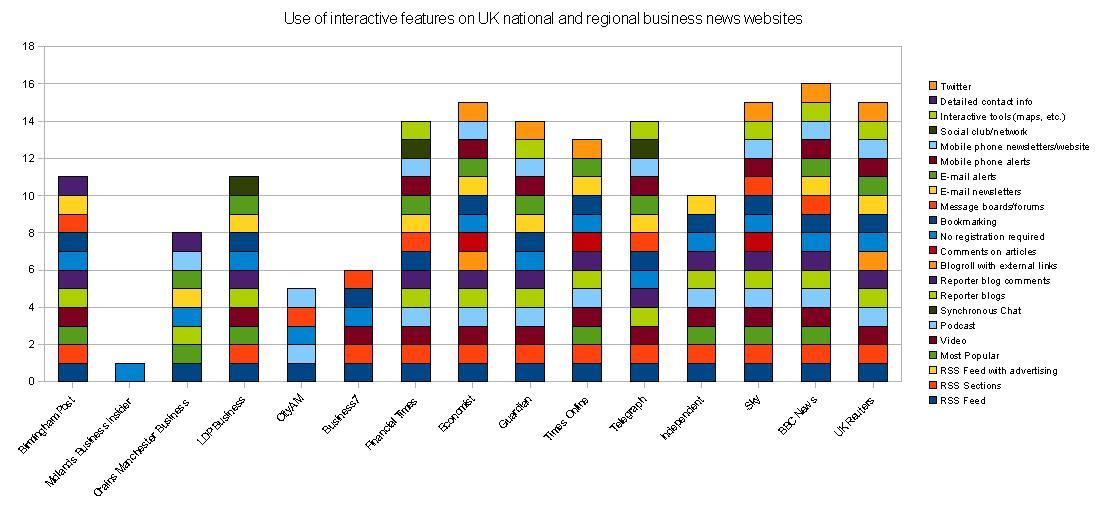
How interactive are UK business news websites?

That’s the question Birmingham Post reporter Joanna Geary has been asking herself, and has come up with the following rather lovely graphic:

Clickon the image for a larger, more readable version – you’ll see she’s looking for availability of email contacts, use of things like maps, blogs, bookmarking, video (is that interactive? Or multimedia?), email newsletters, mobile alerts, RSS, podcasts, chats, forums – and Twitter: “I know it’s not yet a mass communication device but I think it’s a good indicator of those who are thinking about the development of the market” Continue reading

Something for the Weekend #5: Who needs to know Flash? Vuvox

Vuvox is to Flash what WordPress is to Dreamweaver. Vuvox is, effectively, a content management system for multimedia content – an easy way to create Flash interactives without having to know Flash.

I first explored it a few months ago, but still haven’t had the time to really see what it can do. But here’s some things:

Vuvox also works with RSS feeds, Flickr, Buzznet and Picasa, so you can create dynamically updated content.

One problem: the resulting movie is hosted by Vuvox  (although you can embed it). If you want to get the movie to host yourself you’ll have to use an .swf ripper, which is probably breaking the terms and conditions of Vuvox.

Anyway, over to you – what uses can you think of?

War reporting: two online reports – spot the difference

Two approaches to reporting on war have crossed my virtual desk recently. First, a broadcast journalist at ITV News told me about their video blogs from Afghanistan – embedded below:

Second, Reuters send me a press release about ‘Bearing Witness, “a unique multimedia package and online documentary to mark 5 years of reporting war in Iraq”
Watch the video. Then, go to http://iraq.reuters.com/

Spot the difference? Continue reading

Ten ways journalism has changed in the last ten years (Blogger’s Cut)

A few weeks ago I wrote an 800-word piece for UK Press Gazette on how journalism has changed in the past decade. My original draft was almost 1200 words – here then is the original ‘Blogger’s Cut’ for your delectation…

The past decade has seen more change in the craft of journalism than perhaps any other. Some of the changes have erupted into the mainstream; others have nibbled at the edges. Paul Bradshaw counts the ways…

From a lecture to a conversation

Perhaps the biggest and most widely publicised change in journalism has been the increasing involvement of – and expectation of involvement by – the readers/audience. Yes, readers had always written letters, and occasionally phoned in tips, but the last ten years have seen the relationship between publisher and reader turn into something else entirely.

You could say it started with the accessibility of email, coupled with the less passive nature of the internet in general, as readers, listeners and watchers became “users”. But the change really gained momentum with… Continue reading

BASIC principles of online journalism: A is for Adaptability

In the second part of this five-part series, I explore how adaptability has not only become a key quality for the journalist – but for the information they deal with on a daily basis too. This will form part of a forthcoming book on online journalism – comments very much invited.

The adaptable journalist

A key skill for any journalist in the new media age, whatever medium they’re working in, is adaptability. The age of the journalist who only writes text, or who only records video, or audio, is passing. Today, the newspaper and magazine, the television and the radio programme all have an accompanying website. And that website is, increasingly, filled with a whole range of media, which could include any of the following:

  • (Hyper)Text
  • Audio
  • Video
  • Still images
  • Audio slideshows
  • Animation
  • Flash interactivity
  • Database-driven elements
  • Blogs
  • Microblogging/Text/email alerts (Twitter)
  • Community elements – forums, wikis, social networking, polls, surveys
  • Live chats
  • Mapping
  • Mashups

This does not mean that the online journalist has to be an expert in all of these fields, but they should have media literacy in as many of these fields as possible: in other words, a good online journalist should be able to see a story and think:

  • ‘That story would have real impact on video’;
  • or: ‘A Flash interactive could explain this better than anything else’;
  • or ‘This story would benefit from me linking to the original reports and some blog commentary’;
  • or ‘Involving the community in this story would really engage, and hopefully bring out some great leads’. Continue reading