What if we just asked students to keep a record of all their interactions with AI? That was the thinking behind the AI diary, a form of assessment that I introduced this year for two key reasons: to increase transparency about the use of AI, and to increase critical thinking.
As universities adapt to a post-ChatGPT era, many journalism assessments have tried to address the widespread use of AI by asking students to declare and reflect on their use of the technology in some form of critical reflection, evaluation or report accompanying their work. But having been there and done that, I didn’t think it worked.
So this year — my third time round teaching generative AI to journalism students — I made a big change: instead of asking students to reflect on their use of AI in a critical evaluation alongside a portfolio of journalism work, I ditched the evaluation entirely.
Journalism students now need training for 'vile' online abuse they will face, study finds + tips for dealing with ugly social media https://t.co/lXn3bQKJOE
Online abuse of journalists has become so routine that a study this week recommends that journalism students need training to prepare them for it.
But how do you incorporate online abuse into journalism curricula? Over the past year I’ve been trying to do just that — here are some ideas.
1. Ask about online abuse on news days
Most journalism courses already have news days, so considering online abuse in news meetings is a simple way to incorporate the topic into teaching without having to create new classes or materials.
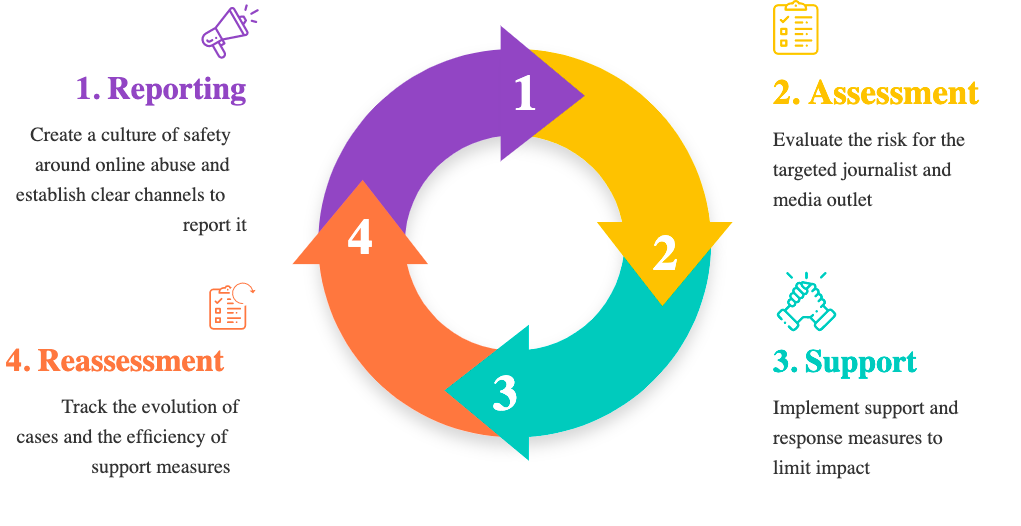
“The objective is to normalize discussions about online harassment in the newsroom,” they say. “An important step toward a creating a culture of safety. Journalists should feel comfortable coming forward with their experiences and concerns.”
This is especially important in election weeks: the IPI suggest that discussions about online abuse should be more frequent during politically tense periods or ahead of elections.
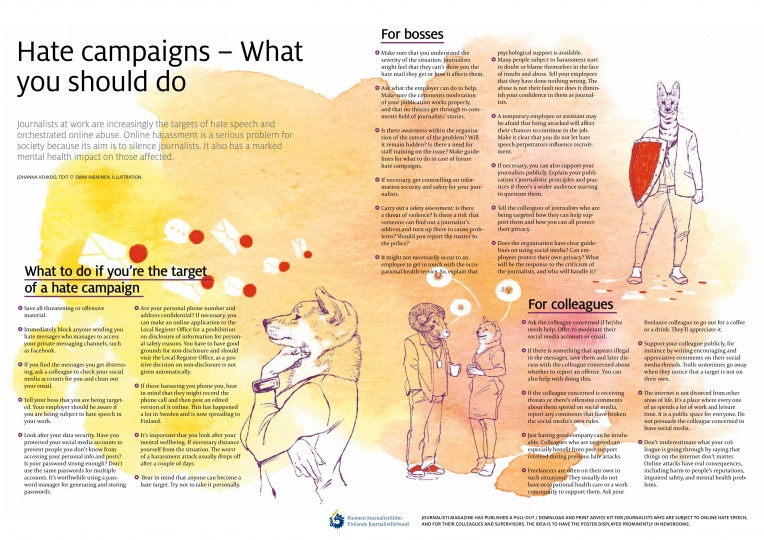
If the outlet you use for student journalism has its own style guide or guidelines, you can also add a section about online abuse that outlines what they should do when it happens, and resources they can draw on, such as this Trollbusters infographic on actions to take regarding a range of threats, and those listed below.
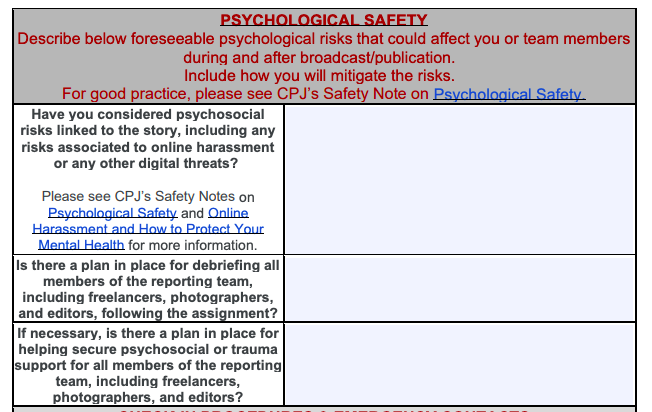
2. Include online abuse in risk assessments
The section on psychological safety from the CPJ risk assessment template
Journalists and journalism students are often required to complete risk assessments ahead of certain newsgathering activity, such as filming on location.
Teaching on risk assessment can include these dimensions and point to those resources. It might be explained that risk factors include the nature of the story being covered: those relating to gender, ethnicity, immigration, extremism, disinformation, and other topics where there are strong feelings are likely to be higher risk than others.
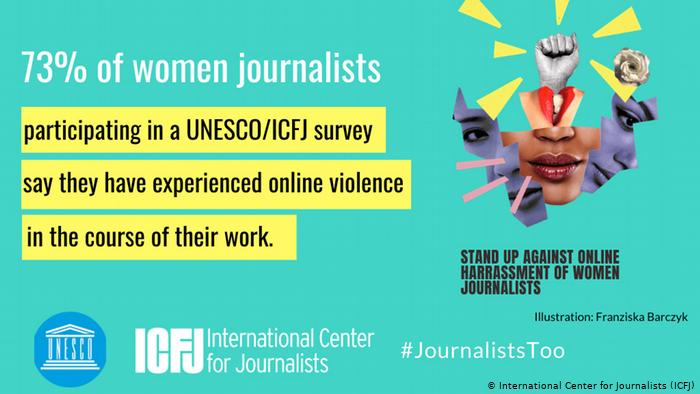
This is also a good opportunity to talk about the risk factors related to the journalist’s own gender, ethnicity and sexuality, and how those aren’t limited to the online world: 73% of UNESCO research (PDF) respondents identifying as women said they had experienced online violence, and one in five said that abuse had moved offline.
3. Cover both sides of harassment in media law…
Harassment laws (or dimensions of industry codes) have become increasingly used against journalists — but journalists are also increasingly having to report harassment under the same laws. Media law classes on privacy, harassment, and malicious communications can address the law both as something to consider when reporting, and something that the reporter and their employer can draw on themselves.
In addition to the law, social media companies themselves are increasingly policing content, a form of regulation which both journalists and their audiences are now subject to. Understanding how that works — and how and when online abuse can be reported on different platforms — is an important new dimension to media law and regulation.
4. …and information security, too
Many strategies of online abuse mean the target needs to consider information security
In the media law module on my MA journalism courses I teach information security. Why? Journalists, as I concluded in research in 2015, can no longer protect sources through legal channels alone, and therefore need to understand both technological and legal defences.
This year I extended that teaching to talk about personal information security in the context of online abuse as well.
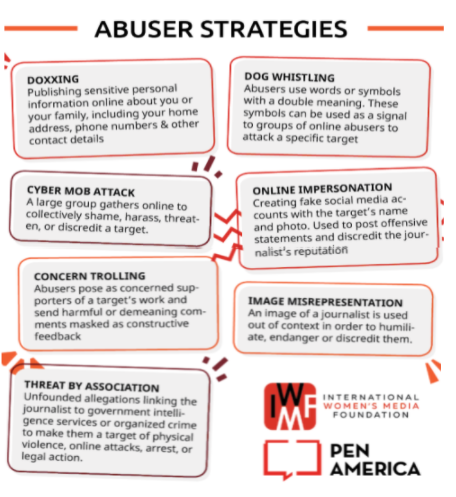
PEN America‘s Online Harassment Field Manual compiles “strategies to protect and arm yourself before you become the target of abuse, with an emphasis on tightening your cybersecurity and establishing supportive online communities who will have your back”, addressing a number of tactics used by online abusers, from doxxing and impersonation to hacking. Feminist Frequency also provides a guide to online safety.
The Data Detox Kit also outlines “steps you can take to control your digital privacy, security, and wellbeing in ways that feel right to you.”
5. Include guidelines in classes on writing for social media
Social media is the main space where online abuse takes place, so classes on writing for those platforms, and related skills such as community management (the IPI has a whole section on audience moderation), are an obvious place to address some of the techniques for dealing with online abuse.
One of those techniques, for example, is to “flood social media with positive posts about the work of colleagues to drown out any abuse they may be facing”.
“Keep work and personal social media accounts separate
“Use strict settings to filter out trolls — block, ignore and mute personal attacks
“Switch off outside office hours
“If the accuracy of a story is being called into question and you choose to respond, remain factual — but don’t expect to have the last word, as you can never win a ‘Twitter spat’
“Differentiate between attacks (personal) and criticism (on journalistic grounds)
“Document and threats or abuse
“Report abuse to management and use internal processes that are in place
“Speak about it with family, friends or colleagues to “take a bit of the heat out”
“Do things you enjoy outside work
“Remember abuse is never about your ability
“Take time away from social media if necessary and ask for an editor’s support to do so
“Know it is okay to be upset and that abuse is not acceptable and should not be part of the job.”
The International Women’s Media Federation (IWMF) has a Know your trolls course which can also be incorporated into social media training.
6. Organise a screening of A Dark Place
Earlier this month I organised a screening and Q&A around the one-hour documentary A Dark Place, which highlights “the experiences of female journalists who have been targeted by online harassment”.
It’s a must-see documentary, not least in understanding the gendered dimension of online violence, as outlined in a recent UNESCO report:
“Women journalists are both the primary targets of online violence and the first responders to it.
“Misogyny is one of the key features of online violence targeting women journalists, and it has been routinised … In detail and delivery, the threats are personal [and] they are often highly sexualised.”
7. Ask guest speakers about how they handle online abuse
There is a good chance that a planned guest speaker will have had to deal with some form of online abuse themselves. If you feel that this might be relevant or valuable to students it may be worth asking the speaker in advance if this is the case and if they are willing to talk about that as part of the session.
Hearing respected industry figures talk about online abuse makes the topic more concrete and manageable, while helping students to put it into the context of industry practice, support systems, and ongoing developments.
8. Include online abuse as a critical issue in academic classes
Most journalism courses require students to study the critical issues surrounding the profession. Online abuse — either on its own or alongside related issues such as misinformation, privacy, social media, diversity and/or propaganda — is a strong candidate to be included as one of those. Resources you can draw on and point students to include:
Describing journalism as a creative profession can cause discomfort for some reporters: we portray journalism as a neutral activity — “Just the facts” — different to fiction or arts that appear to ‘create something from nothing’.
But journalism is absolutely a creative endeavour: we must choose how to tell our stories: where to point the camera (literally or metaphorically), how to frame the shot, where to cut and what to retain and discard, and how to combine the results to tell a story succinctly, accurately and fairly (not always the story we set out to tell).
We must use creativity to solveproblems that might prevent us getting the ‘camera’ in that position in the first place, to find the people with newsworthy stories to tell, to adapt when we can’t find the information we want, or it doesn’t say what we expected (in fact, factual storytelling requires an extra level of creativity given that we can only work with the truth).
All of those are creative decisions.
And before all of that, we must come up with ideas for stories too. The journalist who relies entirely on press releases is rightly sneered at: it is a sign of a lack of imagination when a reporter cannot generate their own ideas about where to look for news leads, or how to pursue those. Continue reading →
In a previous post I outlined seven habits often associated with good journalism that are often talked about (wrongly) as ‘innate’ or ‘unteachable’. In this second post I look at scepticism: why it’s so important in journalism, and how it can be taught.
On its own the first habit of a successful journalist — curiosity — can only take us so far as a journalist: as we ask questions of our sources, we cannot merely report what people tell us — especially if two different sources say contrasting things.
Scepticism is important in journalism because it moves us from merely repeating what people have said, to establishing the factual basis that puts that information into context — whether those facts support or contradict those statements, or do not exist at all.
This has become particularly important in a modern information age when most public bodies can communicate with the public directly, without that accountability.
Scepticism as the voice of the audience
If curiosity represents the journalist acting as the eyes and ears of the audience, scepticism is where we act as the mouth of the audience.
More specifically, it is the way in which we give a voice to an audience which isn’t able to ask questions itself. Continue reading →
Death by Zoom: are we mistakenly trying to recreate the classroom instead of making something web-native?
A few weeks ago I was invited to talk at an online mini-fest about a ‘big idea’ for the future of online learning. I decided to talk about what I called ergodic education — how concepts from interactivity can be used to inform teaching as learners move online. In this post I talk about some of those concepts and how they can be adopted to a lockdown-era classroom. Continue reading →
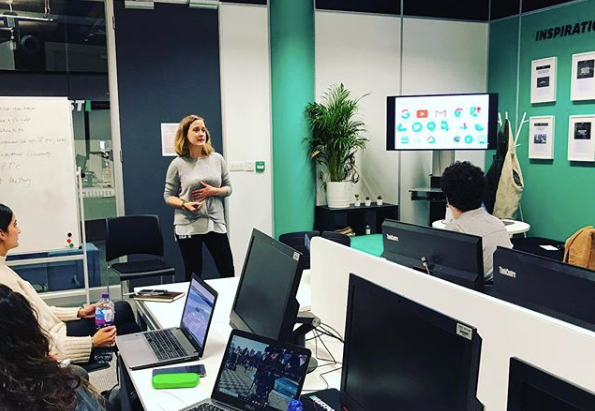
Abigail Edge teaches a guest workshop on advanced Google tools in BCU’s newsroom
The latest frequently asked questions post is an answer to Ian Silvera who asks a number of questions about teaching journalism within the context a fast-changing industry. You can read his post here.
How do you think journalism lecturers should keep up with the fast-changing industry?
Following the industry press is pretty essential for anyone teaching in the field. Sites like Journalism.co.uk and Niemanlab are especially good at covering developments, but there’s also InPublishing and HoldtheFrontPage who cover it more broadly including new technologies and issues. And tons of email newsletters.
It’s easier than ever to follow individuals inside the industry, too – on Twitter as well as professional blogs, Medium.com and anywhere else. I maintain Twitter lists of people reporting in particular fields or in particular roles, for example, and generate Nuzzel newsletters for those lists so I’m up to date with what they’re sharing. Continue reading →
In contrast to the one-off classes involving data journalism, courses and modules that focus on data journalism skills present a different type of challenge.
These courses typically attract a different type of student, and provide more time and space to work with.
I’ve now been teaching data journalism for over a decade — from one-off guest classes at universities with no internal data journalism expertise, to entire courses dedicated to the field. In the first of two extracts from a commentary I was asked to write for Asia Pacific Media Educator I reflect on the lessons I’ve learned, and the differences between what I describe (after Daniel Kahneman) as “teaching data journalism fast” and “teaching data journalism slow”. First up, ‘teaching data journalism fast‘ — techniques for one-off data journalism classes aimed at general journalism students.
In this commentary, I outline the different pedagogical approaches I have adopted in teaching data journalism within different contexts over the last decade. In each case, there was more than enough data journalism to fill the space — the question was how to decide which bits to leave out, and how to engage students in the process. Continue reading →








 Online Journalism Blog
