
They’re at it again. Following the very domestic issue of MPs’ expenses, The Guardian’s latest experiment with crowdsourcing goes international: Iran. Continue reading
More crowdsourcing from the Guardian and NYT – this time on Iran
3 Replies

They’re at it again. Following the very domestic issue of MPs’ expenses, The Guardian’s latest experiment with crowdsourcing goes international: Iran. Continue reading
The internet blows my mind. Ryan Carson opened my eyes to the power of it a few months ago. We can sit down and create a blog or web application and have it instantly accessible to the world. That’s unique, and it’s exciting.
We’re asking the BBC to join us in this creativity. Today, we’re launching BBC Free – it’s a campaign to convince the BBC to offer full article RSS feeds.

Currently, their feeds are just a single line or two and this hurts your RSS experience, and it also hinders creativity in online news. RSS feeds are machine readable and a ton of great startups base their news products off that content. By making the feed “full article”, we can be far more creative with how we improve your online news experience.
We’re not asking the BBC to create an amazing news API like The Guardian. The BBC doesn’t run adverts, any users of RSS will appreciate this change, and people who don’t use RSS won’t know anything has changed.
We’re imploring you, internets, to help us with our campaign. Full details are at our site http://bbcfree.net – the twitter hash tag is #bbcfree and you can follow the campaign at @bbcfree.
— Peter Clark, CEO of Broadersheet.
Update, 2 days later: Paul lets me guest post here (ie I wrote this, not him). It was going fairly well until I wrote this post … You can read my climbdown here…
The latest subscriber figures (see table below, and first published in my blog’s newspapers category) show that, apart from a couple of exceptions, it’s time for newspapers to turn off their RSS feeds – and hand over the server space, technical support and webpage real estate to an alternative, such as their Twitter accounts.
(You can read some of the defences of RSS here and here)
The table below shows that only 3 of the 9 national newspapers have an RSS feed with more than 10,000 subscribers in Google Reader.
And most newspaper RSS feeds have readerships in the 00s, if that.
 Daily Mail columnist Melanie Phillips has just 11 subscribers to her RSS feed (maybe there’s hope for the UK population yet …).
Despite having virtually no users, the Mail churns out 160 RSS feeds and the Mirror 280. All so a couple of thousand people can look at them in total.
The other papers are just as bad. And while the Guardian has a couple of RSS readers with decent numbers (partly because Google recommends it in its news bundle), it has more feeds than there are people in the UK … Continue reading
Scientology has long been a tricky subject for journalists to cover; the corporate-structured religious movement has a reputation for litigation, against government agencies, news organisations and individuals.
Given this it is all the more interesting to consider the recent series of articles about Scientology in Florida’s St Petersburg Times, which focus on the behaviour of its leader David Miscavige and offer a counterpoint to the Church’s own line that “since the founding of the first Church of Scientology in 1954, Scientology has become the fastest-growing religion in the world.”
The Times presented the series as three large articles (totalling nearly 15,000 words, with the first article alone stacking up 6,618) published across print and web over three consecutive days, starting on Sunday 21st June. In addition the paper ran ancillary features which fleshed out elements of the main story, provided historical context, and also laid out some of the raw material which helped to underpin the series. Continue reading
Express.co.uk is about to undergo a redesign (and there’s a good review of the new look, still currently in beta, at econsultancy).
To me, the new site isn’t that impressive (screenshot below, or you can compare the old front page or new front page) – it looks like a poor mashup of the BBC and Yahoo in the existing colour scheme.
Even worse, it’s not very accessible as there is literally no content on the new home page with javascript turned off.
The agency behind it is Netro42 who say here about the old version that “Netro42 working in partnership with Northern and Shell quickly established that the key to success was in wholly utilising the digital space.”
Personally, I like to partially use the analogue space when working on websites, but I may be old fashioned.
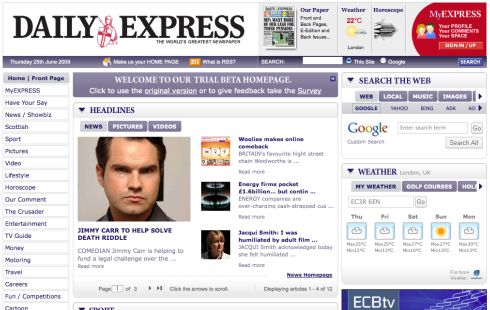
New Express homepage
I wonder if the new design means they’ll update their site on a sunday? Or get some better suggested search terms?
Some research from The Media Audit makes a pretty strong point about how quickly media consumers’ behaviour is changing:
“The Internet now represents 32.5% of the typical “media day” for all U.S. adults when compared to daily exposure to newspaper, radio, TV and outdoor advertising.
“Even those who are considered heavy newspaper readers spend about as much time online today as the typical U.S. adult. According to the report, heavy newspaper readers, those who spend more than an hour per day reading, currently spend 3.7 hours per day online. In 2006 the Internet represented only 18.4% of a heavy newspaper reader’s “media day,” but today it represents 28.4%.”
But there’s good news for some US newspapers who have made the most of their online presence to achieve an impressive reach “of 80% or more when the past 30-day website visitor figure is combined with the past month print readership figure.”
It will be interesting to see how paywall experiments might result in quite different reach stats for other newspapers in the coming months.
More at MediaPost.
In March, I appealed to the Audit Bureau of Circulations to sort out its terrible ABCe website. It’s had a redesign. Here’s a list of its latest problems (originally published here).
If at any point the ABC wants to pay me a consultancy fee, for all this free advice, just leave me a comment to tell me how to receive my money …
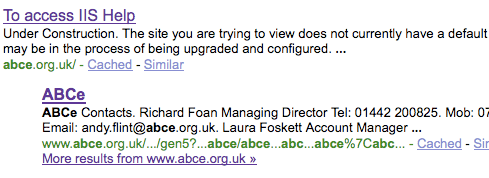
New ABCe homepage in Google
They’ve had a redesign, but they haven’t redirected the old URLs to new ones. So, for instance, if you click the second link shown in Google for a search on ABCe, you get page not found.
Lesson When relaunching a website, always 301 redirect your old pages to new ones (even if they’re all just to your new home page). That way, external links still work and you keep the SEO benefit of any links.
The more observant will have noticed that the title of the first result in that screenshot says ‘To access IIS Help’. The ABC hasn’t realised that abce.org.uk is not the same URL as http://www.abce.org.uk. And if you go to the ABC URLs without www, you get page not found or server errors.
Compare these pages:
and these ones:
Lesson When you set up your website, redirect yourdomain.co.uk/whatever to http://www.yourdomain.co.uk/whatever. And log in to your google webmaster account to set your preferred domain (www or non-www).
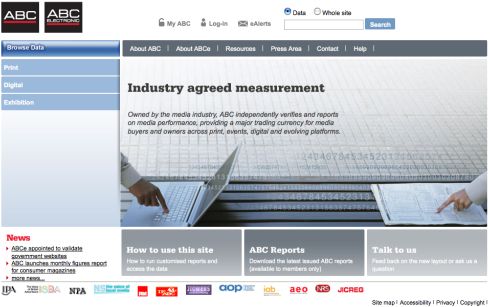
ABCs new homepage. No, it's ABCe's. No, it's aaaaggghhh
You can access the entire website at www.abc.org.uk – or you can see an identical website at www.abce.org.uk. Continue reading
I follow the BBC World, the Guardian and the New York Times through my Twitter account, among other news services, but I get more news and information from the friends I follow on the microblogging service. My friends just happen to read stories from a wide variety of sources and pass along the kind of information they are interested in, and that by extension, I am interested in. In other words, they act as my personal filters for news. And I can safely say that I return the favor for several of my friends as well.
This concept is not exclusive to the new media world. Since the 1940s, media scholars such as Paul Lazarsfeld have spoken about the two-step flow of communication where “opinion leaders” play a huge part in transmitting information from the media to its audience. These mediators help the process by disseminating news in a more concise, intelligible way, but also often infuse their personal agendas and perspectives. Opinion leaders have always existed; who they might be and how you obtain your information from them has changed over time. Continue reading
I asked Tim Rowell, Digital Publisher at Telegraph.co.uk 3 questions about how they dealt with the MPs expenses story online. The main headline is that the new domain hosting the expenses database – parliament.telegraph.co.uk -will expand in the run-up to the next election along with the MP expenses database itself.
There are also curious “legal reasons” given for disabling the embed/email option on the PDFs. I’m pushing on that because I don’t see how publication on your site is different from allowing someone to embed it on their own, or email it. If you have any insight on that, let me know. [See response below]
Here are the responses in full:
From day one, it was agreed that we would work towards the publication of an online database that contained not only the files themselves but also an aggregation of publicly available data (Parliament Parser, They Work for You, Register of Members Interests etc.) with our own unique data analysis.
The publication by Parliament last week of the redacted files has provided a glimpse into the scale of operation required to analyse such a volume of documentation but one has to realise that the full files contain many, many more pages.
The launch yesterday of the database is the first phase. We will, in due course, publish the full uncensored files for all 646 MPs. Crucially, the expenses investigative team of reporters spent a week aggregating and processing the data (the unique 2007/8 analysis of the Additional Costs Allowance) themselves. Integration in action again! The end result of that work is the first accurate breakdown of those ACA figures. We soon realised that this data provided a great basis upon which to build the Complete Expenses Files supplement in last Saturday’s newspaper.
“Secret documents’ is not our term, it is Issuu’s. We think Issuu is a great product and that it provides a fantastic user experience and have plans to use it more extensively. But for legal reasons we need to be sure that the document cannot be downloaded. By disabling the download function, Issuu automatically restricts email/embed.
It is a precautionary measure. In the unlikely event that one of the source documents puts at risk the identity of a supplier or the full postcode of an MP we need to be confident that a) we can amend that file immediately and b) that the file has not been distributed more widely. For that reason, we do not want the files to be downloadable. We’d be very happy for other to embed the files in their pages but if you restrict the download option in Issuu you restrict the ability to embed.
Yes. You may also notice that it is on a new domain parliament.telegraph.co.uk. We will be enhancing our political resources over the coming months as we build up to the General Election. This application is not just for the Expenses files, we have plans to develop this area into a full service that enables our users to engage more closely with the democratic process.
The Telegraph have finally published their MPs’ expenses data online – and it’s worth the wait. Here are some initial thoughts and reactions:
I’ll most likely update this post later as I get some details from behind the curtain.
And there are more general thoughts around the online treatment of expenses generally which I’ll try to blog at another point.

