Author Archives: Paul Bradshaw

USA Today’s awesome jobs forecast interactive


USA Today interactive - click for larger image

USA Today interactive - click for larger image

Here’s a hugely rich interactive from USA Today which does a number of things very well.

Firstly, it’s an intelligent use of resources: the recession is likely to last for some time, and be the biggest ongoing story of our time. With everyone talking about it, you need something with that ‘wow’ factor, that will not only attract a great deal of attention now, but also a long tail of repeat visits.

Secondly, it’s personalised – not only can you get information on jobs growth in your state, but your particular industry in your state.

Thirdly, it’s dynamic – the graphic promises to be updated each month “with revised data from Moody’s Economy.com.”

There’s one major element missing – interaction. Find a way to capture users’ experiences (value) and you have an extra dimension that really capitalises on all the attention your interactive is getting.

Still, I’m not complaining…
How to build an iPhone app

You may have seen this on Mashable, but equally, you may not, so I thought I’d pass it on. Demonstrating the value of being open about your processes (because this document will now be viewed by thousands of people), PhotoKast created this 37-page guide to how they developed their iPhone app. Very useful reading if you’re thinking of doing something for iPhones.

Building PhotoKast: Creating an iPhone app in one month

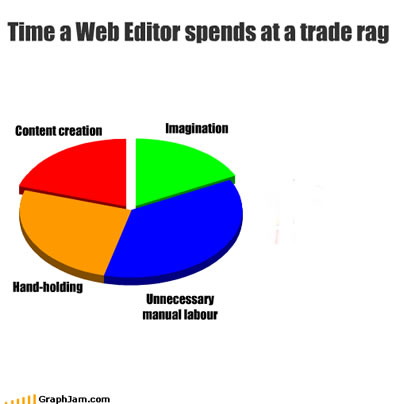
The day-to-day activities of a web editor. In summary


After years writing for both print and web, I decided to express myself in a different way. I’ve done photojournalism for some time now, but I need another form of expression to convey humour in my narration. Photography is cool, but much too refined for lampoons (feel free to disagree with me). Paul pointed me to a few websites on infographics, and I thought: wow, this is cool.

I use Graphjam to teach myself, and the business writers, how to create charts to illustrate business stories. Prof Randy Pausch, that great 3D imaging engineer, said that if you want to teach someone a very difficult computer concept, use a ‘head fake’. Tell him to build a game, not a programming language, and the whole learning process will be a lot easier.

Writing/producing for the web: BASIC principles of online journalism (Online journalism lesson #3)

Here’s the 3rd in my series of classes in online journalism. Having already set up an RSS readers and Delicious account, a Twitter account and a blog, this week they start the news website, and learn about writing and producing for the web:

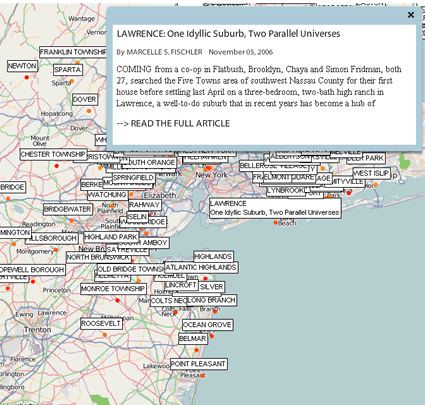
Adding value to the archives: Suburbified.com mashes up NYT real estate articles

Want to know the value of opening up your article databases and APIs? Suburbified is one of the first mashups created using the New York Times’ recently opened API.

suburbified

suburbified

Here’s what it does, according to KillerStartUps: Continue reading

Kitemarks to save the news industry? Q&A with Andrew Currah

Reuters recently published a report entitled: ‘What’s Happening to Our News: An investigation into the likely impact of the digital revolution on the economics of news publishing in the UK‘. In it author Andrew Currah provides an overview of the situation facing UK publishers, and 3 broad suggestions as to ways forward – namely, kitemarks, public support, and digital literacy education.

The kitemark idea seems to have stirred up the most fuss. In the first of a series of email exchanges I asked Currah how he saw this making any difference to consumption of newspapers, and how it could work in practice. This is his response:

Yes, the kitemark idea has triggered quite a response… Unfortunately, as the discussion online suggests, the term has implied to many a top-down, centralised system of certification which would lead to some form of
‘apartheid’ between bloggers and journalists. Continue reading

Telegraph.co.uk top of Digg league

The Daily Telegraph has more stories submitted to Digg, the social news website, than any other daily newspaper site.

Times Online may be winning at StumbleUpon, but the Telegraph has:

  • had more stories submitted to Digg,
  • more stories on the front pages of Digg,
  • and its most-Digged story has more Diggs than any other newspaper site’s top story.

The graph shows how many pages have been submitted for each site that made the Digg ‘front pages’ (ie proved sufficiently popular).

It’s based on an analysis of newspaper site pages submitted to Digg (which also suggests that the reason for the success of the Telegraph and Mail is that their users are more likely to Digg than those of other newspaper sites).

Newspaper site Diggs

Newspaper site Diggs

Twickie: easily blog responses to a Twitter question (Something for the Weekend #14)

Twickie

Twickie

This week’s Something for the Weekend tool review continues the Twitter theme with a simple tool which helps bridge the Twitter-blog divide.

If you’ve ever posted a question on Twitter and followed it up with a blog post discussing the responses, you’ll have probably been frustrated by the inability to present those responses in the blog post – you either have to link to each one, or copy and paste them from Twitter Search (which means ugly table-based HTML and irrelevant messages, newest-first).

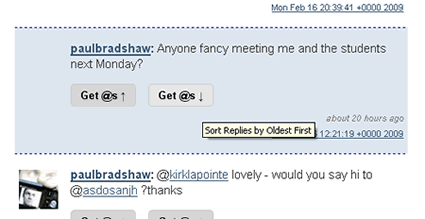
Twickie is a cute solution to that problem. You log on with your Twitter username and password, browse through your recent tweets to find the question you posted, and click on ‘Get @s‘ to see the replies ordered oldest- or newest-first. Continue reading

Times Online tops newspaper Stumble list

All self-respecting newspaper sites have share and social-bookmarking functionality, such as links to Digg, Reddit, Fark etc.

But if the results of StumbleUpon are typical then:

  1. Times Online is miles ahead of its rivals when it comes to users sharing / bookmarking its pages.
  2. The FT has a lot of work to do.
  3. Adding icons for an individual service makes no difference to how often users submit a given page.

Continue reading