Tag Archives: BBC

Q: Who owns a journalist’s Twitter account? A: The users

Screengrab of Laura Kuenssberg's Twitter settings renamed to ITV

image from Tom Callow's Wall blog

When Laura Kuenssberg announced she was leaving the BBC for ITV, much was made of what might happen to her Twitter account. Was @BBCLauraK owned by her employer? (After all, it was branded as such, promoted on TV, and tweets were ‘processed’ by BBC producers). Or should Laura be able to take it with her? (After all, it was Laura that people were following, rather than a generic BBC political news feed).

The implications for the ‘journalist as brand‘ meme were well explored too, while newly empowered journalists may have been concerned to read that companies are inserting social media clauses into contracts:

“To keep hold of the good will created by a brand personality. Recruiters, for example, are often required to hand over their LinkedIn accounts upon leaving, so their contacts remain with the employer.”

Amidst all the speculation, Tom Callow stood out in offering some hard facts:

“When she had earlier tweeted the details of a new separate ITV account to her then 59,000 followers, only around 1,000 of them started following the new account.”

This sounds compelling until you remember that tweets are only seen for a relatively brief period of time by those followers who happen to be watching at that moment, and that a significant proportion of followers of celebrity/high profile accounts are likely to be idle or spam.

Still, it also highlights the fundamental weakness in all the debates about who ‘owns’ a Twitter account. One very important party is not being represented: the users.

Much of the commentary on Laura Kuenssberg’s move treated her 60,000 followers as an “audience”. But of course, they are not: they are users.

Some will be personal acquaintances; some will be fans of the BBC’s political coverage; and yes, some will be spam accounts or accounts set up by curious BBC viewers who forgot their password the next day. Some will follow her to ITV, some will follow her replacement at the BBC, and some never worked out how to click ‘unfollow’. (Kuenssberg’s successor – @BBCNormanS – had 5,824 followers after she tweeted a link, according to Paul Gregory, which means that only around 10% of her followers read either of those tweets and acted on them.)

Whether an employer claims ownership of a social media account or not, they cannot ‘own’ the relationship between users and that account. And there will be as many relationships as users. Some passive; some collaborative; some neglected; some exploitative.

It is those relationships that we should be concerned with developing, not the small print of an employee’s contract.

FAQ: How can broadcasters benefit from online communities?

Here’s another set of questions I’m answering in public in case anyone wants to ask the same:

How can broadcasters benefit from online communities?

Online communities contain many individuals who will be able to contribute different kinds of value to news production. Most obviously, expertise, opinion, and eyewitness testimony. In addition, they will be able to more effectively distribute parts of a story to ensure that it reaches the right experts, opinion-formers and eyewitnesses. The difference from an audience is that a community tends to be specialised, and connected to each other.

If you rephrase the question as ‘How can broadcasters benefit from people?’ it may be clearer.

How does a broadcaster begin to develop an engaged online community, any tips?

Over time. Rather than asking about how you develop an online community ask yourself instead: how do you begin to develop relationships? Waiting until a major news event happens is a bad strategy: it’s like waiting until someone has won the lottery to decide that you’re suddenly their friend.

Journalists who do this well do a little bit every so often – following people in their field, replying to questions on social networks, contributing to forums and commenting on blogs, and publishing blog posts which are helpful to members of that community rather than simply being about ‘the story’ (for instance, ‘Why’ and ‘How’ questions behind the news).

In case you are aware of networks in the middle east, do you think they are tapping into online communities and social media adequately?

I don’t know the networks well enough to comment – but I do think it’s hard for corporations to tap into communities; it works much better at an individual reporter level.

Can you mention any models whether it is news channels or entertainment television which have developed successful online communities, why do they work?

The most successful examples tend to be newspapers: I think Paul Lewis at The Guardian has done this extremely successfully, and I think Simon Rogers’ Data Blog has also developed a healthy community around data and visualisation. Both of these are probably due in part to the work of Meg Pickard there around community in general.

The BBC’s UGC unit is a good example from broadcasting – although that is less about developing a community as about providing platforms for others to contribute, and a way for journalists to quickly find expertise in those communities. More specifically, Robert Peston and Rory Cellan-Jones use their blogs and Twitter accounts well to connect with people in their fields.

Then of course there’s Andy Carvin at NPR, who is an exemplar of how to do it in radio. There’s so much written about what he does that I won’t repeat it here.

What are the reasons that certain broadcasters cannot connect successfully with online communities?

I expect a significant factor is regulation which requires objectivity from broadcasters but not from newspapers. If you can’t express an opinion then it is difficult to build relationships, and if you are more firmly regulated (which broadcasting is) then you take fewer risks.

Also, there are more intermediaries in broadcasting and fewer reporters who are public-facing, which for some journalists in broadcasting makes the prospect of speaking directly to the former audience that much more intimidating.

Should you ‘brand’ a hashtag?

Faisal Islam: Sure that all the brilliant BBC reporters realise that #BBCBudget goes against the entire point of SOCIAL media. It will be abandoned.

Two experiments by news organisations with Twitter hashtags during today’s UK budget have raised an issue around ‘branding’ and how appropriate it is to social media.

The BBC, it seems, is encouraging users to adopt the #BBCBudget hashtag to flag their tweets as part of the ‘national conversation’. Channel 4’s Faisal Islam, above, feels it’s a waste of 3 characters.

But Channel 4 itself is trying something not too dissimilar: #C4cuts aims to crowdsource details of UK spending cuts. Ed Fraser, online editor for Channel 4 News, is quoted by Journalism.co.uk as saying the channel wants to “harness the power of social media and the wisdom of the crowd”. Continue reading

Guest post: Do we need moderation guidelines for dealing with mental health issues?

Last month the Press Complaints Commission made a judgement in a case involving discriminatory comments on a newspaper article. The case highlighted the issue of journalism on mental health and how it is treated by publishers alongside similar considerations such as sexuality, gender, religion and ethnicity. The complaint also led to a change in The Guardian’s moderation rules.

In a guest post for the Online Journalism Blog the person who brought that case, Beatrice Bray, writes about her experiences of comment abuse, and the role she feels publishers should take in dealing both with comments relating to mental health, as well as writers with mental health issues.

Last April I wrote a rallying cry for the Guardian for all who have endured taunts about mental ill health. In my reply article Cartoonists should be careful how they portray mental health (23/4/10) I reclaimed the word “psychotic”. Guardian cartoonist Martin Rowson had used the word to abuse Mrs Thatcher. I put him right.

I am a long-standing reader of the Guardian newspaper but I did not know the website audience. Being a proud campaigner I told Guardian readers that I had bipolar disorder and had experienced psychosis.

I expected a civil hearing. Newspaper readers did oblige but many online readers were foul.

The Guardian’s managing editor Chris Elliott did not warn me about the impending abuse. That was a mistake. I think Mr Elliott knew I would face hostility but I do not think he realised how badly I would be hurt.

Those insults made me physically sick. My head was sore for many weeks. This was all so pointless. If Mr Elliott had given me a chance to discuss the risks involved we both could have taken precautions. Instead there was a row.

Guardian staff gave me an apology but told me to grow a “thick skin”. That jibe spurned me into going to the Press Complaints Commission. It is free. It is also less adversarial and less costly than a disability tribunal.

I was not asking for anything unprecedented. The BBC has guidelines on working with vulnerable people. We need to extend this to new media.

Working with vulnerable people

For example when dealing with discussion sites moderators need to deal swiftly with abuse. They also must facilitate discussions so that they do not turn nasty.

Staff should appreciate the reasons for this action. This is not prima donna treatment. This action is necessary because the writer and many of the readers share a common disability. They all have mental health problems.

Section 2 of the PCC Editors’ code promised fairness to complainants. I thought it only fair to ask for warning of abuse but in my PCC ruling the Guardian and the PCC disagreed with me. The PCC did not say why.

However, I did score other points.

Before the PCC ruling the Guardian at my request did add the word “disability” to its moderation rules.

The PCC and the Guardian and did apologise with regard to the abuse.

Guardian online readers called me, amongst other things, a “nutter” and a “retard”. Unfortunately both the Guardian and PCC refused to accept that this was discrimination as defined by the terms of section 12 of the Editor’s code of the PCC.

This is not just semantics. To me the word “discrimination” is a word with power. It holds the abuser responsible but the PCC fights shy of doing that online.

I now know that you can only complain to the PCC if a staff member makes a discriminatory remark about you. Comments made by non-staff members do not fall within the PCC’s remit. My abusers were not Guardian staff.

It is a shame. By being discrimination deniers both the Guardian and the PCC cut themselves off from a store of knowledge on handling disability and mental health in particular.

Bella Hurrell on data journalism and the BBC News Specials Team

BBC_Special_ReportsBella Hurrell is the Specials Editor with BBC News Online. I asked her how data journalism was affecting their work for a forthcoming article. Here is her response in full:

The BBC news specials team produces multimedia interactives, daily graphics as well as more complex data visualisations. The team consists of journalists, designers and developers all working closely together, sitting alongside each other.

We have found that proximity really important to the success of projects. Although we have done this for a while, increasingly other organisations are reorganising along these lines after coming to realise the benefits of breaking down silos and co-locating people with different skillsets can produce more innovative solutions at a faster pace.

As data visualisation has come into the zeitgeist, and we have started using it more regularly in our story-telling, journalists and designers on the specials team have become much more proficient at using basic spreadsheet applications like Excel or Google Docs. We’ve boosted these and other skills through in house training or external summer schools and conferences.

Data as a service, data as a story

There are two interrelated elements to data journalism: firstly data as a service, often involving publicly available data.  The school league tables which the BBC news website has produced every year for over a decade are an example here. We know they are hugely popular and they provide a valuable public service for users. More recently the government has started to get better at putting data / information  online, so we have adjusted our coverage. Instead of replicating what is done by government sites (such as providing individual school pages) we try to provide value by doing something extra, such as mini charts and the ability to select and compare schools – as well as news stories and analysis.

The second element is data as a story. The simple fact that loads of data has been published is not really very interesting to most people. Data is only useful if it is personal – I want to find out about schools in my area, restaurants near me and so on – or when it reveals something remarkable. The duck pond debacle from MPs expenses data or the Iraq civilian death records kept by the US revealed by Wikileaks’ release of the Iraq war documents are both examples of individual stories from big tranches of data that really resonated.

Dealing with large numbers of documents

With data stories that involve thousands of documents we face two challenges. Firstly deciding whether we can provide a platform or tool for people to look at the documents or data. This can be valuable but might involve significant technical resources and may not be worth doing if others are already providing this service.

Secondly we need to find the stories and then report them but clearly that can be tricky when there are thousands of documents to examine. Crowdsourcing is an obvious approach but we need to use what the crowd tells us. When readers told us about potential stories they spotted in the MPs expenses data we pulled in our whole politics team off normal duties to sift users’ questions and put them directly to the relevant MPs. Then we published their answers on our site. This is a very resource heavy approach and not sustainable over a long time.

Another model for reporting stories that involve large sets of data was Panorama’s public sector pay story, where the website partnered with the investigative unit to tell the story online. The Panorama team spent months collecting data and we provided simple visualisations and  a way for users to examine the data.

3 things that BBC Online has given to online journalism

It’s now 3 weeks since the BBC announced 360 online staff were to lose their jobs as part of a 25% cut to the online budget. It’s a sad but unsurprising part of a number of cuts which John Naughton summarises as: “It’s not television”, a sign that “The past has won” in the internal battle between those who saw consumers as passive vessels for TV content, and those who credited them with some creativity.

Dee Harvey likewise poses the question: “In the same way that openness is written into the design of the Internet, could it be that closedness is written into the very concept of the BBC?”

If it is, I don’t think it can remain that way for ever. Those who have been part of the BBC’s work online will feel rightly proud of what has been achieved since the corporation went online in 1997. Here are just 3 ways that the corporation has helped to define online journalism as we know it – please add others that spring to mind:

1. Web writing style

The BBC’s way of writing for the web has always been a template for good web writing, not least because of the BBC’s experience with having to meet similar challenges with Ceefax – the two shared a content management system and journalists writing for the website would see the first few pars of their content cross-published on Ceefax too.

Even now it is difficult to find an online publisher who writes better for the web.

2. Editors blogs

Thanks to the likes of Robin Hamman, Martin Belam, Jem Stone and Tom Coates – to name just a few – when the BBC did begin to adopt blogs (it was not an early adopter) it did so with a spirit that other news organisations lacked.

In particular, the Editors’ Blogs demonstrated a desire for transparency that many other news organisations have yet to repeat, while the likes of Robert Peston, Kevin Anderson and Rory Cellan-Jones have played a key role in showing skeptical journalists how engaging with the former audience on blogs can form a key part of the newsgathering process.

Unfortunately, many of those innovators later left the BBC, and the earlier experimentation was replaced with due process.

3. Backstage

While so many sing and dance about the APIs of The Guardian and The New York Times, Ian Forrester’s BBC Backstage project was well ahead of the game when it opened up the corporation’s API and started hosting hack days and meetups way back in 2005.

Backstage closed at the end of last year, just as the rest of the UK’s media were starting to catch up. You can read an e-book on its history here.

What else?

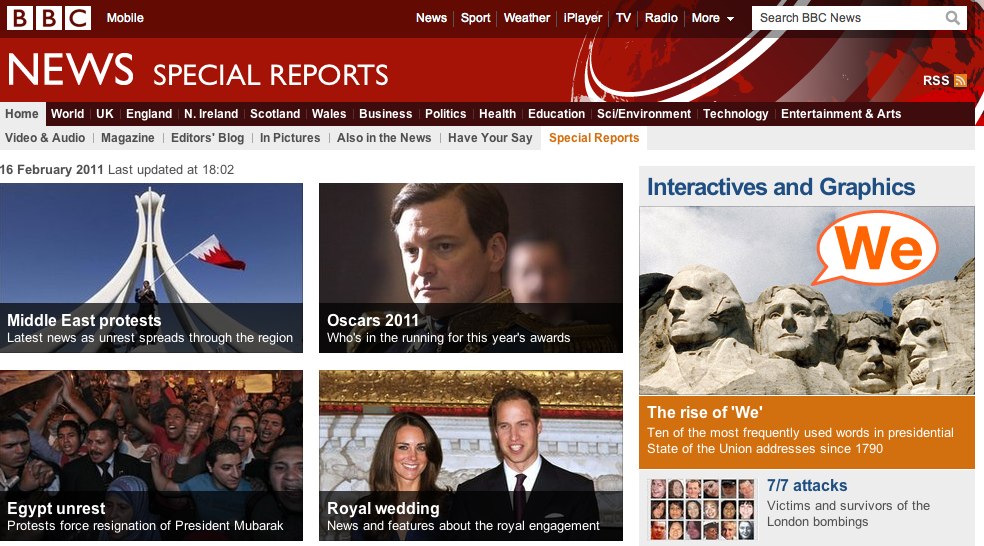
I’m sure you can add others – the iPlayer and their on-demand team; Special Reports; the UGC hub (the biggest in the world as far as I know); and even their continually evolving approach to linking (still not ideal, but at least they think about it) are just some that spring to mind. What parts of BBC Online have influenced or inspired you?

When we can’t believe our own eyes: Balance, objectivity, or transparency?

Time magazine's Wikileaks correction

It’s been a good week for followers of that endangered beast objectivity. On Friday Glenn Greenwald reported on factual inaccuracies in Time’s Wikileaks article, and the ‘correction’ that was then posted (reproduced above). Greenwald writes:

“The most they’re willing to do now is convert it into a “they-said/he-said” dispute.  But what they won’t do — under any circumstances — is state clearly that the Government’s accusations are false, even where, as here, they unquestionably are.”

Meanwhile, the BBC is facing a viral backlash (described as “lobbying” by a spokesperson) over Ben Brown’s interview with Jody McIntyre (transcript here):

Kevin Bakhurst has responded to the complaints and the copious comments on his post are worth reading in full – not only because many of them flesh out the debate extremely well (and others would sit well in a textbook on interviewing technique), but because they provide a compelling story of how people’s relationship with the media is changing.

In particular, on the subject of balance one journalist comments:

“This story demonstrates the fallacy of ‘balanced reporting’. On the evidence of the video Mr McIntyre is almost certainly a victim of an assault and battery, he should sue, and if he does – he will almost certainly win. Even if were he found to be in some way contributorily negligent ‘for rolling towards the police’ as it were – the Tort will still have been committed by the police. The Law makes it clear there is no such balance, yet through this kind of aggressive cross examination, perpetrator and victim are reduced to the same standing in the eyes of the viewer: both are placed under suspicion. And – vitally – to begin with such suspicion is not sceptical, but cynical. There’s a considerable difference.”

Meanwhile Kevin Marsh makes a strong argument against the swing from objectivity towards “transparency” as “replacing one impossibility with another”.

I lay all these out as fertile ground for any discussion on objectivity, transparency and ethics.

BBC new linking guidelines issued – science journals mentioned

The BBC have just emailed new linking guidelines to their staff. They stipulate that linking is “essential” to online journalism and in one slide (it’s a PowerPoint document) titled ‘If you remember nothing else’ highlight how linking will change:

What we used to do…

  • Lists of archive news stories
  • Homepages only on external websites
  • No inline linking in news stories

What we do now – think adding value…

  • Avoid news stories and link to useful stuff – analysis, explainers, Q&As, pic galleries etc
  • On external websites look beyond homepage to pages of specific relevance
  • Inline linking in news stories is OK when it’s to a primary source

Other points of note in the document include the repeated emphasis on useful deep linking, and the importance of the newstracker module (which links to coverage on other news sites). Curiously, when referring to inline links it does say that “different rules can apply” to BBC blogs – “speak to blogs team if in doubt”.

Something I did look for – and find – was a reference to linking to scientific journals. And here it is: “In news stories inline links must go to primary sources only– eg scientific journal article or policy report (1 or 2 per story; avoid intro)”

This is significant given the previous campaigning on this issue.

On the whole it’s a good set of guidance – I’ll refrain from publishing it in hope that the BBC will…

UPDATE: It seems The Guardian followed up the story and embedded the document, so here it is:

BBC guidelines for linking – Sept 2010

The BBC and missed data journalism opportunities

Bar chart: UN progress on eradication of world hunger

I’ve tweeted a couple of times recently about frustrations with BBC stories that are based on data but treat it poorly. As any journalist knows, two occasions of anything in close proximity warrants an overreaction about a “worrying trend”. So here it is.

“One in four council homes fails ‘Decent Homes Standard'”

This is a good piece of newsgathering, but a frustrating piece of online journalism. “Almost 100,000 local authority dwellings have not reached the government’s Decent Homes Standard,” it explained. But according to what? Who? “Government figures seen by BBC London”. Ah, right. Any chance of us seeing those too? No.

The article is scattered with statistics from these figures “In Havering, east London, 56% of properties do not reach Decent Homes Standard – the highest figure for any local authority in the UK … In Tower Hamlets the figure is 55%.”

It’s a great story – if you live in those two local authorities. But it’s a classic example of narrowing a story to fit the space available. This story-centric approach serves readers in those locations, and readers who may be titillated by the fact that someone must always finish bottom in a chart – but the majority of readers will not live in those areas, and will want to know what the figures are for their own area. The article does nothing to help them do this. There are only 3 links, and none of them are deep links: they go to the homepages for Havering Council, Tower Hamlets Council, and the Department of Communities and Local Government.

In the world of print and broadcast, narrowing a story to fit space was a regrettable limitation of the medium; in the online world, linking to your sources is a fundamental quality of the medium. Not doing so looks either ignorant or arrogant.

“Uneven progress of UN Millennium Development Goals”

An impressive piece of data journalism that deserves credit, this looks at the UN’s goals and how close they are to being achieved, based on a raft of stats, which are presented in bar chart after bar chart (see image above). Each chart gives the source of the data, which is good to see. However, that source is simply given as “UN”: there is no link either on the charts or in the article (there are 2 links at the end of the piece – one to the UN Development Programme and the other to the official UN Millennium Development Goals website).

This lack of a link to the specific source of the data raises a number of questions: did the journalist or journalists (in both of these stories there is no byline) find the data themselves, or was it simply presented to them? What is it based on? What was the methodology?

The real missed opportunity here, however, is around visualisation. The relentless onslaught on bar charts makes this feel like a UN report itself, and leaves a dry subject still looking dry. This needed more thought.

Off the top of my head, one option might have been an overarching visualisation of how funding shortfalls overall differ between different parts of the world (allowing you to see that, for example, South America is coming off worst). This ‘big picture’ would then draw in people to look at the detail behind it (with an opportunity for interactivity).

Had they published a link to the data someone else might have done this – and other visualisations – for them. I would have liked to try it myself, in fact.

UPDATE: After reading this post, a link has now been posted to the report (PDF).

Compare this article, for example, with the Guardian Datablog’s treatment of the coalition agreement: a harder set of goals to measure, and they’ve had to compile the data themselves. But they’re transparent about the methodology (it’s subjective) and the data is there in full for others to play with.

It’s another dry subject matter, but The Guardian have made it a social object.

No excuses

The BBC is not a print outlet, so it does not have the excuse of these stories being written for print (although I will assume they were researched with broadcast as the primary outlet in mind).

It should also, in theory, be well resourced for data journalism. Martin Rosenbaum, for example, is a pioneer in the field, and the team behind the BBC website’s Special Reports section does some world class work. The corporation was one of the first in the world to experiment with open innovation with Backstage, and runs a DataArt blog too. But the core newsgathering operation is missing some basic opportunities for good data journalism practice.

In fact, it’s missing just one basic opportunity: link to your data. It’s as simple as that.

On a related note, the BBC Trust wants your opinions on science reporting. On this subject, David Colquhoun raises many of the same issues: absence of links to sources, and anonymity of reporters. This is clearly more a cultural issue than a technical one.

Of all the UK’s news organisations, the BBC should be at the forefront of transparency and openness in journalism online. Thinking politically, allowing users to access the data they have spent public money to acquire also strengthens their ideological hand in the Big Society bunfight.

UPDATE: Credit where it’s due: the website for tonight’s Panorama on public pay includes a link to the full data.

Mapping global events in a local way: BBC Dimensions

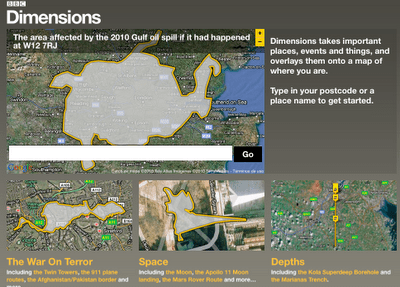
BBC Dimensions

This is one of the best BBC projects I’ve seen in a while: Dimensions maps key events, places and things such as the Pakistan floods, the Gulf oil spill and the Afghanistan-Pakistan border – over your postcode.

It’s a simple idea, but hugely effective.

The prototype comes not from the corporation’s News arm – it was commissioned by History. Commissioning Executive for the Multi-Platform Team Max Gadney writes:

“Our challenge was to make it relevant to audiences.

“This is a common desire. Commissioning editors often want stuff ‘made relevant’ – TV producers might translate this as putting a celebrity in it – one we can relate to (Who Do You Think You Are does this very well). How does digital media make something relevant?”

Currently this is a prototype, so feedback is welcomed. I hope that News will be rubbing their hands at the potential applications and making their own suggestions for improvements on those lines.

For once we may be able to stop comparing things to the size of Wales. Unless, of course, you have a Welsh postcode.