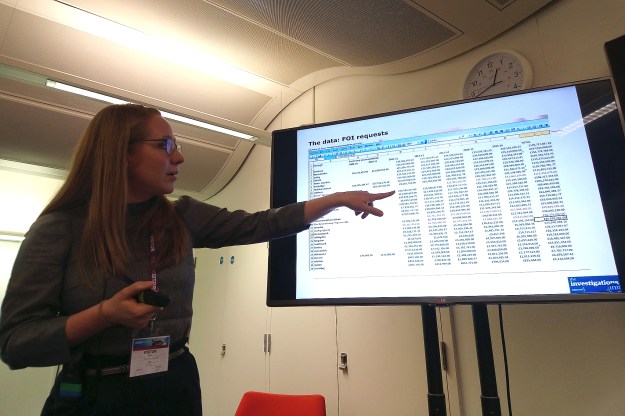
Last month the BBC’s Shared Data Unit held its annual Data and Investigative Journalism UK conference at the home of my MA in Data Journalism, Birmingham City University. Here are some of the highlights…
Continue reading

Last month the BBC’s Shared Data Unit held its annual Data and Investigative Journalism UK conference at the home of my MA in Data Journalism, Birmingham City University. Here are some of the highlights…
Continue reading
Earlier this month I was interviewed for a feature about data journalism in the Argentina newspaper La Nacion. Here are the full questions and answers, in English, published as part of the FAQ series.
Continue reading
In many countries public data is limited, and access to data is either restricted, or information provided by the authorities is not credible. So how do you obtain data for a story? Here are some techniques used by reporters around the world.
Continue reading
It’s over a decade since I published the Inverted Pyramid of Data Journalism. The model has been translated into multiple languages, taught all over the world, and included in a number of books and research papers. But in that time the model has also developed and changed through discussion and teaching, so here’s a round up of everything I’ve written or recommended on the different stages — along with a revised model in English (shown above; versions have been published before in German, Spanish, Finnish, Russian and Ukrainian).
The most basic change to the Inverted Pyramid of Data Journalism is the recognition of a stage that precedes all others — idea generation — labelled ‘Conceive’ in the diagram above.
This is often a major stumbling block to people starting out with data journalism, and I’ve written a lot about it in recent years (see below for a full list).
The second major change is to make questioning more explicit as a process that (should) take place through all stages — not just in data analysis but in the way we question our sources, our ideas, and the reliability of the data itself.
A third change is to remove the ‘socialise‘ option from the communication pyramid: in conversation with Alexandra Stark I realised that this is covered sufficiently by the ‘utilise’ stage (i.e. making something useful socially).
Replacing that is a new communication option — in fact, two: audiolise and physicalise. This recognises the emergence of sonification as a method of communicating data, and physical methods of representing data from crochet to art installations.
Alongside the updated pyramid I’ve been using for the past few years I also wanted to round up links to a number of resources that relate to each stage. Here they are…
Continue reading
On Tuesday I will be hosting the award-winning investigative journalist and FOI campaigner Jenna Corderoy at the Lyra McKee Memorial Lecture. Ahead of the event, I asked Jenna about her tips on investigations, FOI, confidence, and the challenges facing the industry.
The story that I learned the most from was definitely our Clearing House investigation. Back in November 2020, we revealed the existence of a unit within the heart of government, which screened Freedom of Information (FOI) requests and instructed government departments on how to respond to requests. The unit circulated the names of requesters across Whitehall, notably the names of journalists.
Continue reading
Beatriz Farrugia used Brazil’s freedom of information laws to investigate the country’s hosting of the World Cup. In a special guest post for OJB, the Brazilian journalist and former MA Data Journalism student passes on some of her tips for using FOIA.
I am from Brazil, a country well-known for football and FIFA World Cup titles — and the host of the World Cup in 2014. Being a sceptical journalist, in 2019 I tried to discover the real impacts of that 2014 World Cup on the 213 million residents of Brazil: tracking the 121 infrastructure projects that the Brazilian government carried out for the competition and which were considered the “major social legacy” of the tournament.
In 2018 the Brazilian government had taken the website and official database on the 2014 FIFA World Cup infrastructure projects offline — so I had to make Freedom of Information (FOIA) requests to get data.
The investigation took 3 months and more than 230 FOIA requests to 33 different public bodies in Brazil. On August 23, my story was published.
Here is everything that I have learned from making those hundreds of FOIA requests:
Continue reading
Empty Shops image by Dan Thompson
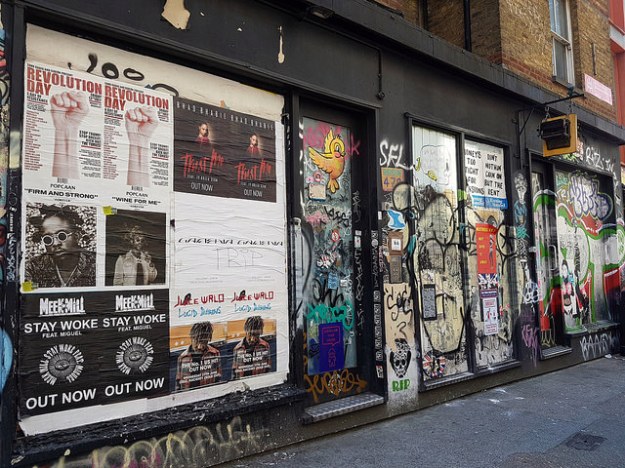
For the last three years Gavin Chait has been fighting — and winning — multiple Freedom of Information cases to unlock data on vacant properties. In a special guest post ahead of his latest hearing, he explains how he uses a range of evidence to fight a widely misused exemption.
I don’t know how to break this to you, but you’re probably a terrorist.
According to Richard Woolford, Strategic Director of Security and Counter Terrorism with the City of London Corporation, unoccupied properties — and especially unoccupied commercial properties — are attractive for those intent on committing terrorism.
Any knowledge about vacant properties is so dangerous, he believes, that no information about them should be placed in the public domain.
This will come as tough news to terrorism enablers, especially real-estate agents, property developers, banks, insurers, and Google Street View.
If you were hoping to find somewhere new to live, or somewhere to open your dream business, then – for the safety of everyone – you’ll need to stay put. Continue reading

Emma Youle speaking at the Data Journalism UK conference in 2017 – photo by Wan Ulfa Nur Zuhra
As Archant’s award-winning Emma Youle announces she is to leave local newspapers to join Huffington Post UK as a special correspondent. Victoria Oliveres spoke to the investigative journalist about setting up local investigations, using data, and campaigning.
If you’ve looked at any UK journalism awards ceremony in the last few years, chances are you will have seen Emma Youle’s name: winner of the Private Eye Paul Foot Award in 2017, and the Weekly Reporter of the Year at Regional Press Awards 2016, she has also been shortlisted in many others, largely for her approach to showing the impact of national decisions at local level.
This success has come after a career of over a decade in journalism, including the last three years as part of Archant‘s investigations unit, where she uncovered in-depth stories from London boroughs.
The unit was set up in 2015, which Youle considers to be quite pioneering at the time.
“I think local newspapers are one of the best places to do in depth investigations because they are very well connected to the community,” Emma says. Continue reading

Lecture theatre image by judy dean
I’ve now been teaching data journalism for over a decade — from one-off guest classes at universities with no internal data journalism expertise, to entire courses dedicated to the field. In the first of two extracts from a commentary I was asked to write for Asia Pacific Media Educator I reflect on the lessons I’ve learned, and the differences between what I describe (after Daniel Kahneman) as “teaching data journalism fast” and “teaching data journalism slow”. First up, ‘teaching data journalism fast‘ — techniques for one-off data journalism classes aimed at general journalism students.
Like a gas, data journalism teaching will expand to fill whatever space is allocated to it. Educators can choose to focus on data journalism as a set of practices, a form of journalistic output, a collection of infrastructure or inputs, or a culture (see also Karlsen and Stavelin 2014; Lewis and Usher 2014; Boyles and Meyer 2016). Or, they might choose to spend all their time arguing over what we mean by ‘data journalism’ in the first place.
We can choose to look to the past of Computer Assisted Reporting and Precision Journalism, emerging developments around computational and augmented journalism, and everything that has happened in between.
In this commentary, I outline the different pedagogical approaches I have adopted in teaching data journalism within different contexts over the last decade. In each case, there was more than enough data journalism to fill the space — the question was how to decide which bits to leave out, and how to engage students in the process. Continue reading

Bombings in Barcelona in 1938 (Image by Italian Airforce under CC)
In a guest post for OJB, Carla Pedret looks at a new data journalism project to catalogue what happened during the Spanish Civil War.
125,000 people died, disappeared or were repressed in the Spanish Civil War (1936-1939) and during the Franco dictatorship, according to historians. Many of their families still do not know, 40 years later, what exactly happened to them.
Now the Innovation and Human Rights (IHR) association has created the first central database of casualties, missing persons and reprisals during the Spanish Civil War and under Francoism.