Tag Archives: google

3 weeks in: launching a Midlands environmental news site

3 weeks ago my class of online journalism students were introduced to the website they were going to be working on: BirminghamRecycled.co.uk – environmental news for Birmingham and the West Midlands.

The site has been built by final year journalism degree student Kasper Sorensen, who studied the online journalism module last year.

In building and running the service Kasper has done a number of clever, networked things I thought I should highlight. They include:

  • Creating a Delicious network for the site – every journalist in the team has a Delicious account; this gathers together all of the useful webpages that journalists are bookmarking
  • Tweetgrid of all journalists’ tweets – again, every journalist has a Twitter account. This pulls them all together.
  • Twitter account @bhamrecycled
  • Kasper sent the whole team an OPML file of subscriptions to RSS feeds of searches for every Midlands area and environmentally related keywords. In other words, journalists could import this into their Google Reader and at a stroke be monitoring any mention of certain key words (e.g. ‘pollution’, ‘recycling’) in Birmingham areas.
  • He also shared a Google calendar of relevant events

The site itself is clever too.

  • The About page has a list of all contributing journalists with individual RSS feeds.
  • In addition, each author has a link to their own profile page which not only displays their articles but pulls Twitter tweets, Delicious bookmarks and blog posts.

Kasper wanted to explicitly follow a Mashable-style model rather than a traditional news service: he felt an overly formal appearance would undermine his attempts to build a community around the site.

And community is key. When unveiling the site to the journalists Kasper made the following presentation – a wonderful distillation of how journalists need to approach news in a networked world:

What won’t happen in 2009 – and what might

This month’s Carnival of Journalism looks forward to new media developments in the coming year. Here are my no doubt misguided and naive predictions:

2009 will not be the year of the mobile web

Every year we make end of year predictions that the coming year will finally see the mobile web hit the mainstream. In many ways, it already has. But any expectations of there being some significant spread in 2009 will be scuppered by the credit crunch: users will be increasingly reluctant to spend money on a smart phone as the purse strings tighten. We’re not all going to be carrying around iPhones.

On the plus side, as a result of that slowdown we can expect mobile service providers to become more competitive in their data rates and packages, so that those who do have smart phones will have more reason to take out a mobile web package. Continue reading

Will alternative voices get pushed off Google’s first page of results?

That’s the question bumping around my mind after reading this post at SEObook.com:

“if you are not an AdWords advertiser, are not in universal search verticals (like news and video), and are not wikipedia, then you don’t have many organic search results that you can rank for on the first page.”

The image makes it clearer:

google results

In some ways, blogs are better placed than ordinary websites, as Google may be indexing your blog as part of its news search. But that isn’t particularly comforting. The wider move towards mainstream results that keep you within Google doesn’t look particularly healthy. 

Here’s what SEObook suggests:

  • If your site is fairly close to what it takes to be considered in some of Google’s verticals – like Google news, then consider upping your game a bit and submitting an inclusion request.
  • Try to make some video content. Not good for everyone, but most sites could use some, and the competitive bar with video is much lower than it is with text – though I wouldn’t expect it to stay that way for more than a couple years.
  • If you have some top rankings that are bouncing around consider focusing on promoting that content again – when stratification occurs you are going to be better off focusing on owning a few ideas rather than being average to slightly above average at many. Top ranked sites also benefit from self-reinforcing rankings. Read up on cumulative advantage if you have not yet done so.
  • Usage data (and/or brand searches) may become a big part of future algorithms. Get ready for that by reading about BrowseRank then invest in advertising, branding, and user experience.

The only upside? Google may be making itself less relevant, and more open to competition.

US election coverage – who’s making the most of the web?

Elections bring out the best in online journalism. News organisations have plenty of time to plan, there’s a global audience up for grabs, and the material lends itself to interactive treatment (voter opinions; candidates’ stances on various issues; statistics and databases; constant updates; personalisation).

Not only that, but the electorate is using the internet for election news more than any other medium apart from television (and here are some reasons why).

PaidContent has a good roundup of various UK editors’ views, and decides blogs, Twitter and data are the themes (more specifically, liveblogging and mapping). Continue reading

1000 things I’ve learned about blogging

To mark 1000 posts on this blog, I thought I’d reflect on what I’ve learned since post #1.

UPDATE: Now available in German, Spanish, Hebrew, and Portuguese.

UPDATE 2: I’ll be posting further ‘1000 things’ via Twitter – you can find them with this search or this RSS feed. Continue reading

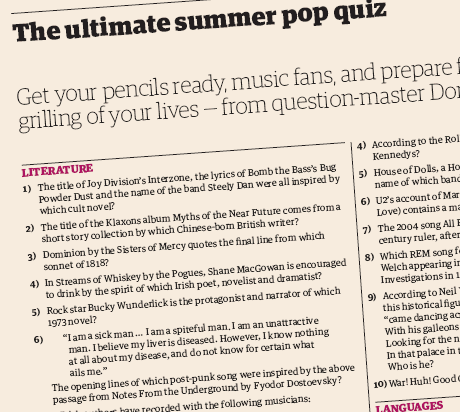
Did The Guardian miss a viral opportunity with their Ultimate Summer Pop Quiz?

summer pop quiz

Last Friday the Guardian published it’s ‘Ultimate Summer Pop Quiz’ – a typically original take on the pop quiz format with a gloriously, insanely difficult set of over 100 questions such as “The opening lines of which post-punk song were inspired by the above passage from Notes From the Underground by Fyodor Dostoevsky?”

Having only managed 31 answers (and 24 guesses) over the weekend, I took to the web on Monday to see who else was doing it – and if it was on the web so I could send it to friends. Continue reading

New York Times + LinkedIn = another step towards personalised news

The New York Times and LinkedIn have entered into a partnership that will see LinkedIn users “shown personalized news targeting their industry verticals … and will then be prompted to share those stories will professional associates.” Meanwhile, NYT readers will see a widget directing them to LinkedIn (see image below). Continue reading